

Why Modern Businesses Need More Than Just a Website
A modern business website is no longer just a digital brochure. Learn why companies need scalable web architecture, AI integration, automation, analytics, SEO, AEO, and cloud ready systems to grow in today’s digital market.
What does a modern business website mean?
A modern business website is not just a page where people read about your company. It is a complete digital system that helps your business attract visitors, explain your services, collect leads, improve trust, track user behavior, and support business growth.
Earlier, websites were mostly used to show basic information like company name, services, contact details, and images. But today, customers expect more. They want fast loading pages, clear information, simple navigation, mobile friendly design, useful content, instant support, and a trustworthy experience.
For a growing business, the website should work like a digital engine. It should support marketing, sales, operations, analytics, automation, and future expansion.
Why is a normal website not enough today?
A normal website is not enough because competition has changed. Customers compare companies online before they talk to anyone. They check your website, search results, social media, reviews, service pages, and overall brand quality.
If your website only looks good but does not bring leads, answer customer questions, rank on search engines, or support business operations, then it is not helping your business properly.
A good website should not only display services. It should help the business get discovered, build trust, collect inquiries, understand customers, and convert visitors into leads.
This is why modern companies need websites that combine design, technology, SEO, AEO, analytics, AI, and automation.
What problems do businesses face with basic websites?
Many businesses build websites only for appearance. They focus on colors, banners, and pages, but ignore the system behind the website. Because of this, the website may look decent but fail to produce real results.
Common problems include slow loading speed, poor mobile experience, weak content, no SEO structure, no analytics, no lead tracking, unclear service explanation, poor call to action, and no automation.
Another major problem is that many websites are not built for scaling. When the business grows, the website becomes difficult to manage. Adding new services, blogs, landing pages, forms, dashboards, or integrations becomes complicated.
This creates a gap between business growth and digital capability.
What should a modern website include?
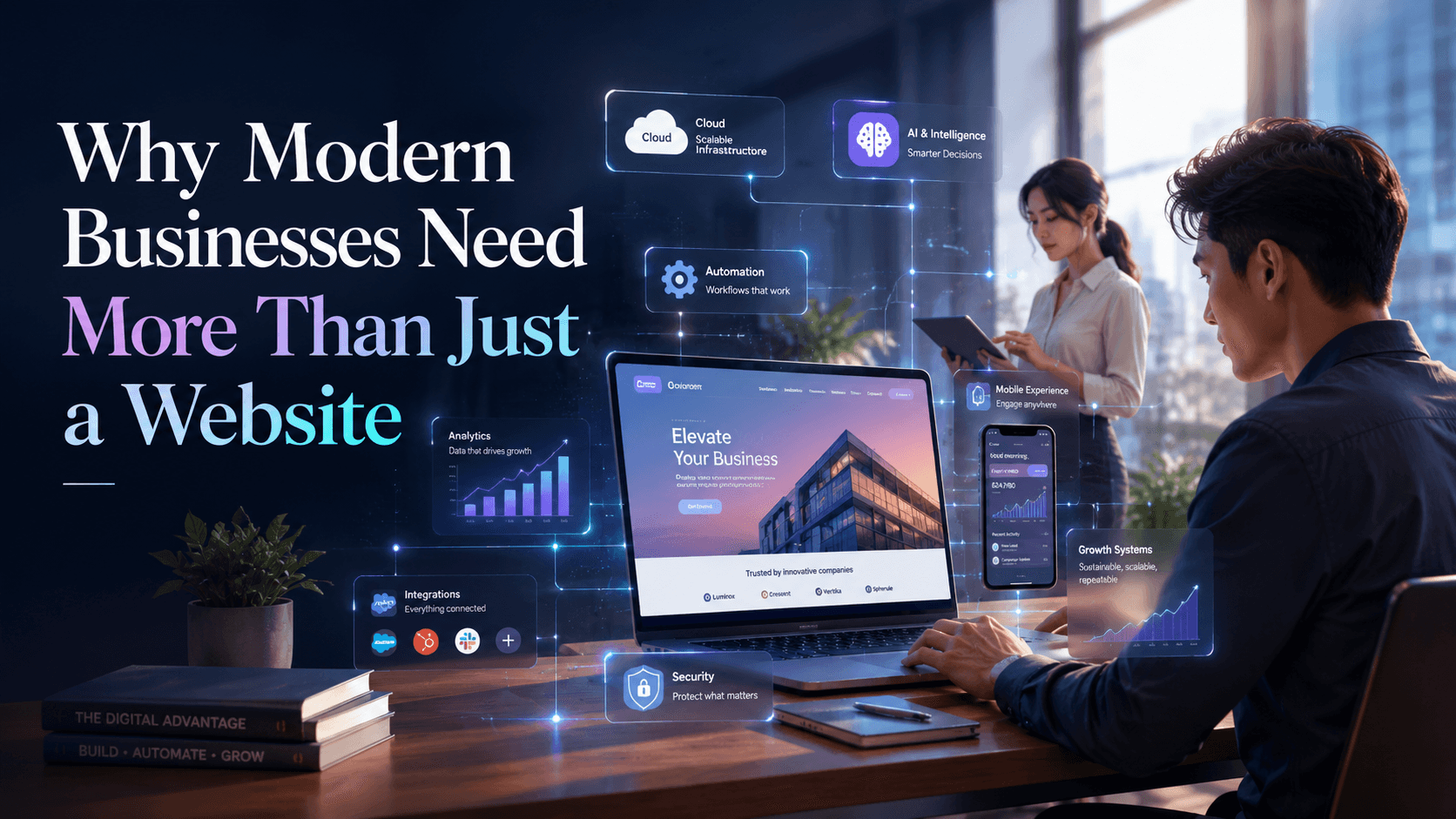
A modern website should include clear service pages, fast performance, mobile friendly design, SEO structure, AEO focused content, lead generation forms, analytics tracking, secure hosting, scalable backend, and integration with business tools.
It should also have content that answers real customer questions. Instead of only saying what the company does, the website should explain what problem it solves, who it helps, how the process works, and why customers should trust the company.
For example, a service based company should not only write “We build websites.” It should explain how the website helps businesses generate leads, improve brand trust, automate workflows, and support long term growth.
That is the difference between a basic website and a business growth platform.
How does AI improve a business website?
AI can improve a business website by making it more intelligent, interactive, and useful. Instead of being a static website, the platform can support smart chat systems, automated lead qualification, personalized recommendations, data analysis, and content automation.
For example, an AI powered website can answer customer questions, collect basic requirements, suggest relevant services, and send details to the sales team. This reduces manual work and improves response time.
AI can also help businesses understand user behavior. It can show which pages users visit, where they spend more time, what services they are interested in, and where they drop off.
This helps the company improve its website and marketing strategy based on real data.
Why are SEO and AEO important for growth?
SEO helps your website rank on search engines like Google. AEO helps your content appear in answer based search experiences, AI search results, featured snippets, and conversational search platforms.
Today, people do not only search keywords. They ask questions. For example, instead of searching “website development company,” they may ask “Which company can build a scalable website for my business?”
This means your website content should be written in a question and answer format. It should directly answer customer queries in a clear and useful way.
That is why blogs, service pages, FAQs, and educational content are important. They help search engines and AI systems understand your expertise.
For Pixenox, this is a strong opportunity because the company works across web development, AI systems, cloud, automation, analytics, and growth solutions.
How does cloud infrastructure help websites scale?
Cloud infrastructure helps websites handle growth without breaking performance. As traffic increases, the website needs better speed, storage, security, and reliability.
A cloud ready website can support more users, more data, more integrations, and more business activity. It can also improve uptime, backup, deployment, and security.
For startups and growing businesses, cloud infrastructure is important because it gives flexibility. The business can start small and scale as demand increases.
This is useful for websites, SaaS products, dashboards, customer portals, donation platforms, booking systems, ecommerce platforms, and AI powered applications.
Why should businesses connect website, data, and automation?
A website becomes more powerful when it is connected with data and automation. Without data, businesses do not know what is working. Without automation, teams spend too much time on repeated tasks.
For example, when a visitor fills a form, the data can automatically go to a CRM, trigger an email, notify the sales team, and store the lead details for follow up.
This makes the website part of the business workflow.
A connected digital system helps businesses save time, reduce manual errors, improve customer response, and make better decisions.
This is where web development, AI, cloud, analytics, and automation should work together.
How can Pixenox help businesses build better digital systems?
Pixenox can help businesses move beyond basic websites and build complete digital systems. This includes web platforms, SaaS products, mobile apps, AI workflows, cloud infrastructure, SEO, AEO, analytics, and automation.
For startups, Pixenox can help build products from idea to launch. For small and medium businesses, Pixenox can help create digital platforms that improve visibility, lead generation, and operations. For growing companies, Pixenox can build scalable systems that support long term expansion.
The goal is not only to build websites. The goal is to build intelligent digital infrastructure that helps businesses build, launch, and scale.
Final thoughts
A website is no longer just an online presence. It is one of the most important growth assets for a modern business.
If your website only shows information, it may not be enough. But if it is built with the right strategy, technology, AI, SEO, AEO, analytics, and cloud infrastructure, it can become a powerful business growth system.
Modern businesses need digital platforms that are fast, intelligent, scalable, and connected.
That is the future of websites. That is where companies like Pixenox can create real value.
Any questions about this blog?