

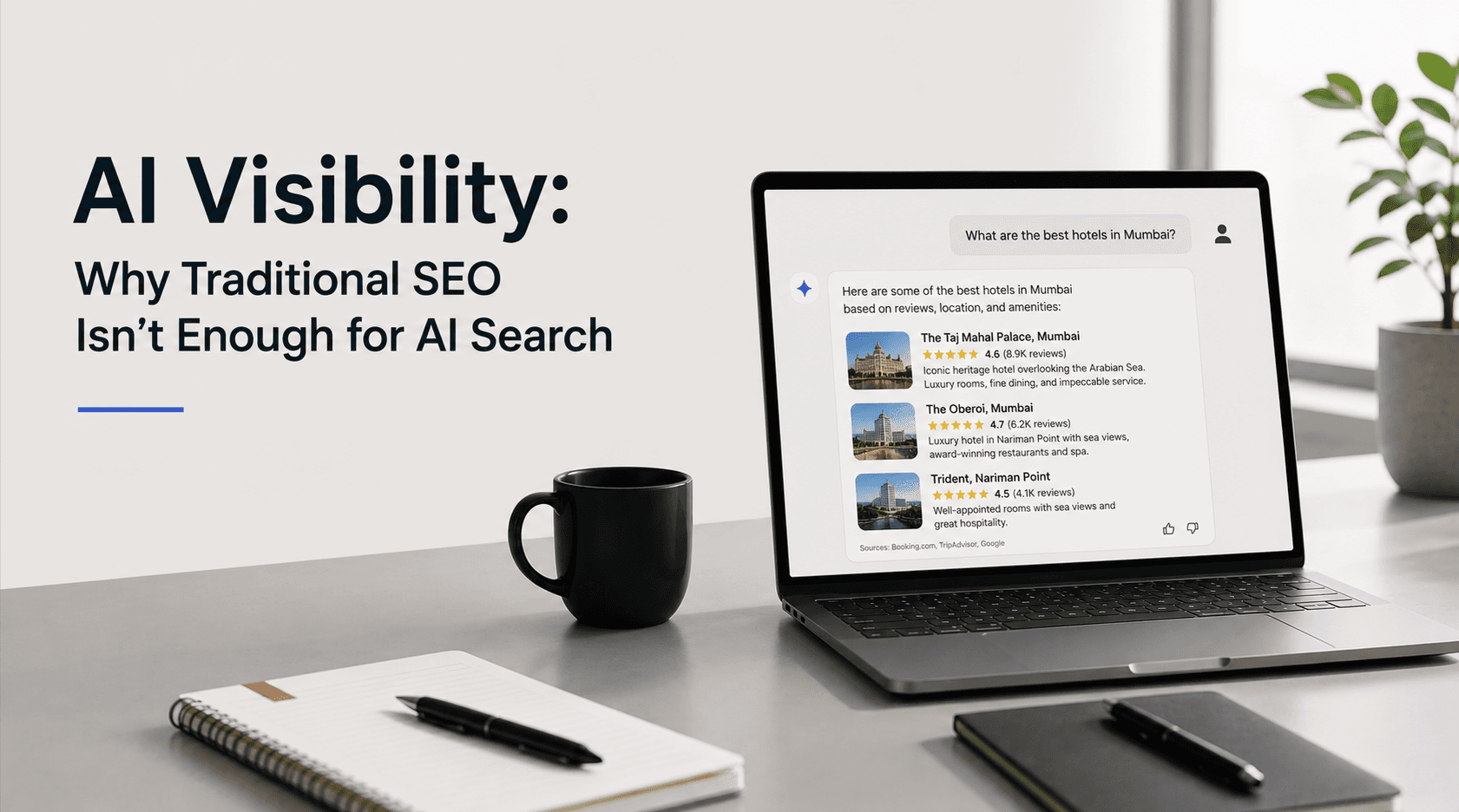
AI Visibility: Why Traditional SEO Isn't Enough for AI Search
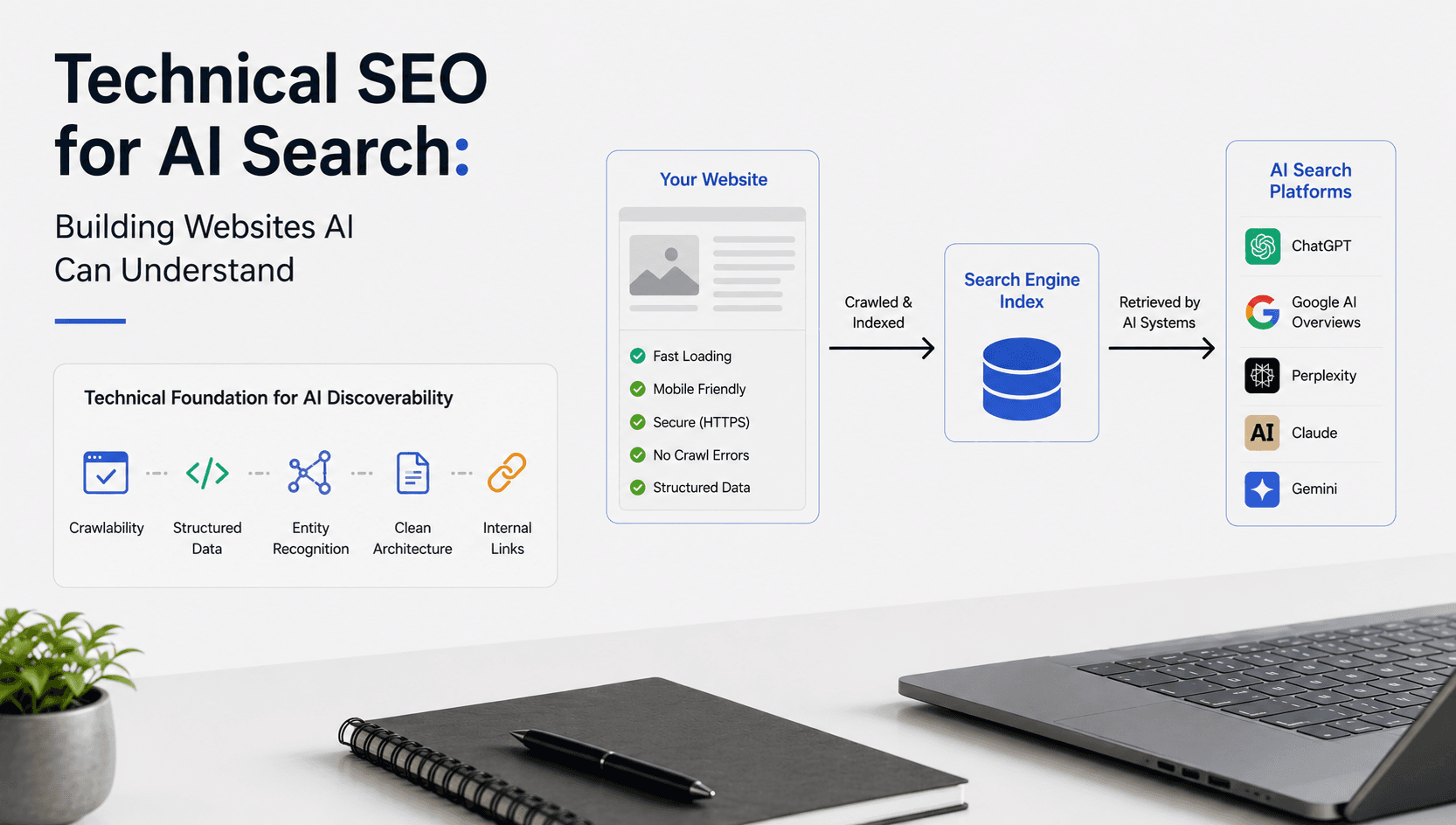
Learn how AI Visibility improves discoverability across ChatGPT, Google AI Overviews, Perplexity, Claude, and Gemini using entity optimization, semantic SEO, and retrieval-first strategies.
Introduction
For years, digital visibility meant appearing on the first page of Google. Businesses invested in technical SEO, content marketing, and link building because higher rankings translated into more traffic. That relationship still matters, but search behavior is changing rapidly as users increasingly interact with AI-powered search experiences instead of traditional search results.
Platforms such as ChatGPT, Google AI Overviews, Perplexity, Claude, and Gemini no longer present only a list of links. They generate direct answers by retrieving, evaluating, and synthesizing information from multiple sources. In many cases, users receive the information they need without visiting a single website.
This shift introduces a new challenge. Ranking well in search results does not guarantee that your brand will appear in AI-generated responses. An organization may dominate organic rankings while remaining virtually invisible to AI assistants because its content lacks the semantic clarity, entity relationships, and trust signals required for reliable retrieval.
AI Visibility addresses this challenge. It combines traditional SEO with entity optimization, structured data, semantic architecture, digital authority, and retrieval optimization to ensure that AI systems can confidently understand, retrieve, and recommend your content.
This guide explains what AI Visibility means, how AI platforms decide which sources to trust, and what businesses should prioritize to remain discoverable as search continues evolving.
What Is AI Visibility?
AI Visibility refers to a brand's ability to be discovered, understood, and referenced by AI-powered search systems. Unlike conventional SEO, which primarily focuses on improving rankings within search engine results pages, AI Visibility focuses on becoming a trusted source that AI models can confidently retrieve and cite.
The concept extends beyond website optimization. AI systems evaluate information from websites, documentation, business profiles, research publications, news articles, industry directories, social platforms, and knowledge bases. Every accurate and consistent mention strengthens the digital identity associated with your organization.
Visibility also exists on multiple levels. The first level is discoverability, where AI systems identify your content as relevant. The second is comprehension, where they correctly understand your products, services, and expertise. The third is recommendation, where they include your information in generated answers because it demonstrates sufficient authority and factual reliability.
Businesses that invest in AI Visibility position themselves for an environment where being cited may become as valuable as being clicked.
Why AI Search Changes the Rules of Discoverability
Traditional search engines rank web pages. AI systems retrieve information.
Although those concepts appear similar, they involve different evaluation methods. Search engines compare pages using ranking algorithms, while AI retrieval systems evaluate which pieces of information best answer a user's question.
This distinction shifts optimization away from isolated keywords and toward semantic understanding. AI models analyze context, entity relationships, topical depth, factual consistency, and source credibility before incorporating information into a response.
For example, a search for "best practices for structured data" may produce an AI-generated answer compiled from several different websites. One source may contribute the definition, another implementation guidance, and another practical examples. The AI is selecting information rather than entire pages.
Businesses therefore compete for inclusion within answers rather than only for positions in search results. That requires content that is both technically accurate and easy for retrieval systems to interpret.
How AI Systems Decide Which Sources to Trust
Trust is not determined by a single ranking factor. AI platforms evaluate multiple signals before deciding whether information is reliable enough to present as part of an answer.
Source reputation is one of the strongest indicators. Information consistently published by recognized organizations, respected industry experts, academic institutions, and authoritative publications is more likely to be retrieved because independent sources reinforce the same facts.
Consistency also matters. When your website, documentation, author profiles, business listings, and external mentions all describe the same organization using consistent terminology, AI systems can resolve your entity with greater confidence.
Content quality further influences trust. Clear explanations, original research, transparent authorship, citations to primary sources, and regular updates help establish factual reliability. AI systems increasingly reward information that can be verified rather than unsupported claims.
These signals work together. No single factor guarantees AI visibility, but together they create a trustworthy digital footprint that retrieval systems can confidently use.
Entity SEO and Digital Identity
One of the biggest differences between traditional SEO and AI Visibility is the importance of entities. Search engines and large language models no longer rely exclusively on keywords to understand content. Instead, they build representations of real-world objects such as businesses, people, products, technologies, locations, and organizations. These representations are known as entities.
Consider a company specializing in AI search optimization. If its website consistently references concepts such as Generative Engine Optimization, semantic SEO, Retrieval-Augmented Generation, structured data, and knowledge graphs, AI systems begin associating the company with those topics. Over time, those relationships become part of the brand's digital identity.
A weak entity profile creates confusion. If one page describes the business as an SEO agency, another calls it a software company, and a third labels it a marketing consultancy without explaining the connection, retrieval systems receive mixed signals. Humans can often interpret these inconsistencies, but AI models perform better when entity definitions remain clear and consistent.
Entity SEO therefore extends beyond optimizing individual pages. It includes maintaining consistent brand names, product terminology, author information, organization details, and service descriptions across websites, documentation, business directories, social platforms, and media mentions. Every consistent reference strengthens entity resolution and improves the probability that AI systems correctly identify your expertise.
Another benefit of entity optimization is resilience. Keywords change as language evolves, but entities represent stable concepts. A company recognized as an authority on AI Search Optimization is more likely to remain discoverable across new search experiences than one optimized only for a handful of keyword phrases.
Structured Data Helps AI Understand Your Website
Most discussions about structured data focus on rich search results, but its value extends much further. Schema markup provides explicit information about the entities, relationships, and attributes present on a page, reducing the amount of interpretation required by machines.
For AI systems, reducing ambiguity is valuable. A page that identifies its author, organization, publication date, service, product, and frequently asked questions through structured data provides a clearer representation than one relying solely on unstructured text. While language models can infer meaning from content, structured data confirms those interpretations using standardized vocabulary.
Organization schema establishes the identity of the business behind the website. Article schema provides metadata about editorial content. FAQPage schema identifies questions and their corresponding answers, making them easier to extract for answer engines. BreadcrumbList schema communicates site hierarchy, helping search systems understand relationships between pages.
The effectiveness of structured data depends on accuracy rather than quantity. Adding schema that does not match the visible content creates inconsistencies that reduce trust. The objective is not to implement every available schema type but to accurately describe the information users actually see.
Structured data also supports interoperability across different platforms. Search engines, knowledge graphs, AI assistants, and other retrieval systems often rely on shared standards to exchange information. By implementing structured markup correctly, businesses create machine-readable content that remains useful across a growing ecosystem of AI-powered applications.
Building Topical Authority Instead of Publishing More Content
Many businesses assume AI Visibility requires publishing a large volume of articles. In reality, retrieval systems reward topical depth more consistently than content volume.
Topical authority develops when a website thoroughly explains a subject from multiple perspectives while maintaining clear semantic relationships between pages. Rather than creating dozens of disconnected blog posts, authoritative websites build content ecosystems where each page answers a distinct question and naturally supports related resources.
For example, an agency specializing in AI search could develop comprehensive resources on Generative Engine Optimization, Answer Engine Optimization, Entity SEO, Knowledge Graph Optimization, Technical SEO, Structured Data, AI Retrieval Optimization, Semantic SEO, and Search Experience Optimization. Together, these pages demonstrate expertise across the broader topic rather than competing against each other.
Internal linking strengthens these relationships. Contextual links help users navigate related concepts while allowing search engines and AI systems to understand how different topics connect. A page discussing structured data might naturally reference entity optimization, which in turn links to knowledge graphs and semantic search. This interconnected architecture reinforces topical relevance.
Information gain is another critical factor. AI systems increasingly prioritize content that contributes original value rather than repeating commonly available information. Practical implementation guidance, proprietary research, technical case studies, industry observations, and detailed explanations all increase the uniqueness of a resource.
Businesses should therefore focus on publishing fewer but substantially better resources. Comprehensive, technically accurate content supported by strong internal architecture creates lasting authority that retrieval systems can confidently reference.
Semantic SEO and Contextual Relevance
Semantic SEO expands optimization beyond exact keyword matching. Instead of asking whether a page contains a target phrase, semantic optimization considers whether the page fully explains the underlying concept and its relationships to other ideas.
Large language models naturally operate on semantic understanding. They recognize that "AI discoverability," "LLM Optimization," and "Generative Engine Optimization" belong to a related conceptual space even when different terminology is used. Content that covers these relationships provides richer contextual signals than content narrowly focused on repeating a single keyword.
Context also influences retrieval quality. A page explaining schema markup becomes more valuable when it discusses why structured data supports entity recognition, how knowledge graphs consume structured information, and where schema fits within a broader AI Visibility strategy. These connections create a more complete representation of the topic.
Semantic completeness reduces ambiguity for both users and AI systems. Readers gain a deeper understanding because concepts are explained within their broader context rather than in isolation. Retrieval systems benefit because they can identify multiple relevant relationships from a single authoritative resource.
This approach also improves resilience against changing search behavior. As conversational queries become more common, users increasingly ask broad questions requiring contextual explanations instead of exact keyword matches. Semantic SEO prepares content for these evolving patterns by optimizing for meaning rather than wording alone.
Knowledge Graphs and Their Role in AI Visibility
Knowledge graphs organize information into networks of entities and relationships rather than isolated documents. Instead of storing a webpage as a collection of keywords, a knowledge graph identifies that a company provides a service, employs specific people, operates in a particular industry, and is associated with defined technologies and locations. This structured representation allows AI systems to understand context instead of relying only on text matching.
Google's Knowledge Graph is one of the most recognizable examples, but the concept extends far beyond Google. Enterprise knowledge graphs, public datasets, and AI retrieval systems all use graph-based representations to improve reasoning and reduce ambiguity. When an AI assistant encounters the name of a company, it can connect that entity to related concepts, services, and authoritative sources through these relationships.
Knowledge graphs also improve disambiguation. Consider a company named "Atlas." Without contextual relationships, AI systems may struggle to determine whether the query refers to a logistics provider, a software platform, or a mapping service. Entity relationships resolve that ambiguity by connecting the company to its industry, products, founders, and relevant technologies.
Businesses can strengthen their presence in knowledge graphs by maintaining consistent entity information, implementing structured data, publishing authoritative content, and earning references from trusted sources. These actions reinforce connections that retrieval systems use when deciding whether an organization is a credible authority on a given topic.
The long-term value of knowledge graph optimization lies in persistence. Rankings fluctuate as algorithms evolve, but a well-established entity with strong semantic relationships remains easier for AI systems to understand regardless of how search interfaces change.
How to Measure AI Visibility
Unlike traditional SEO, AI Visibility cannot be evaluated using rankings alone. Success depends on whether AI systems consistently retrieve, understand, and reference your content when responding to user queries. That requires a broader measurement framework.
One of the most practical indicators is AI citation frequency. Regularly test relevant questions across ChatGPT, Google AI Overviews, Perplexity, Gemini, and Claude to determine whether your organization appears as a cited source or is mentioned within generated responses. Tracking this over time provides insight into how your authority is evolving across different AI ecosystems.
Brand recognition is another valuable metric. Ask AI platforms to describe your company, products, services, or industry expertise. Compare their responses with your intended positioning. If important services are omitted or descriptions are inaccurate, your entity signals may need strengthening through improved content, structured data, and external references.
Monitor topical coverage rather than isolated keyword rankings. Evaluate whether your website comprehensively addresses an entire subject area. A business with authoritative resources covering AI Visibility, Entity SEO, Knowledge Graphs, Structured Data, Semantic SEO, AI Retrieval Optimization, and GEO is more likely to establish long-term authority than one focused on individual keywords.
Technical performance remains foundational. Crawlability, indexability, canonical implementation, XML sitemaps, structured data validation, internal linking, and page speed all influence whether search engines and retrieval systems can efficiently process your content.
Finally, connect AI visibility metrics to business outcomes. Growth in branded searches, qualified leads, direct traffic, newsletter subscriptions, and sales influenced by AI recommendations often provides more meaningful evidence than rankings alone. Visibility is valuable only when it contributes to measurable business objectives.
Common AI Visibility Mistakes
Many organizations believe that publishing AI-generated content at scale will automatically improve discoverability. In practice, retrieval systems increasingly distinguish between content that adds genuine value and content that merely repeats existing information. High publication volume cannot compensate for limited expertise or weak information quality.
Another common mistake is optimizing only for Google. Modern users interact with multiple AI platforms throughout their research process. A prospect might begin with ChatGPT, validate information through Google AI Overviews, compare vendors on Perplexity, and ask Gemini for implementation advice before making a decision. Businesses should therefore optimize for retrieval principles that apply across ecosystems rather than focusing on a single platform.
Fragmented digital identity is another recurring issue. Inconsistent company descriptions, outdated author pages, conflicting service names, and inaccurate business listings weaken entity resolution. Every inconsistency forces AI systems to reconcile conflicting information, reducing retrieval confidence.
Some organizations also overlook content maintenance. AI systems generally prefer current and reliable information. Articles that reference outdated technologies, deprecated standards, or obsolete statistics gradually lose credibility even if they once ranked well. Periodic content reviews ensure that important resources remain accurate and trustworthy.
Perhaps the most significant mistake is viewing AI Visibility as a replacement for SEO. Technical SEO, information architecture, site performance, accessibility, and high-quality editorial standards remain essential. AI Visibility builds upon these foundations rather than replacing them. Organizations that ignore technical excellence often struggle to achieve consistent retrieval regardless of content quality.
The Future of AI Visibility
AI-assisted search is moving toward deeper reasoning rather than simple retrieval. Future systems will evaluate not only whether information is relevant but also whether it is internally consistent, supported by multiple trusted sources, and sufficiently detailed to answer increasingly complex questions. This evolution favors organizations that invest in expertise over content volume.
Multimodal search is another emerging trend. AI systems are becoming better at understanding images, videos, diagrams, audio, and structured datasets alongside text. Businesses that publish comprehensive resources across multiple formats may improve discoverability as retrieval expands beyond traditional web pages.
Agentic AI will also reshape search behavior. Instead of answering individual questions, AI agents will complete tasks such as researching software, comparing vendors, summarizing technical documentation, or recommending implementation strategies. These workflows require reliable information that can be retrieved repeatedly across different stages of a decision-making process.
Trust will become an increasingly differentiating factor. As AI-generated content continues to grow, retrieval systems will place greater emphasis on original research, transparent methodologies, expert authorship, and verifiable evidence. Organizations able to demonstrate real expertise will become more visible than those relying on generic content production.
The future of digital visibility is therefore less about manipulating algorithms and more about becoming a trusted participant within the web's knowledge ecosystem. Businesses that consistently publish accurate information, maintain strong entity relationships, and reinforce their authority across multiple trusted sources will be well positioned as AI search continues to mature.
Any questions about this blog?
Frequently Asked Questions
What is AI Visibility?
AI Visibility is the ability of a business, brand, or website to be discovered, understood, and referenced by AI-powered search platforms such as ChatGPT, Google AI Overviews, Perplexity, Claude, and Gemini. It combines technical SEO, semantic optimization, entity management, structured data, and digital authority to improve retrieval across AI systems rather than focusing solely on traditional search rankings.
How is AI Visibility different from SEO?
SEO primarily aims to improve rankings within search engine results pages. AI Visibility extends that objective by optimizing content for AI retrieval and answer generation. While SEO remains a critical foundation, AI Visibility emphasizes semantic understanding, entity relationships, structured information, citation quality, and retrieval confidence.
Why do some websites rank well but rarely appear in AI answers?
High rankings do not automatically translate into AI citations. AI systems evaluate semantic relevance, factual consistency, source authority, and entity clarity before selecting information. A lower-ranking page with better contextual explanations and stronger trust signals may be chosen over a page occupying the first organic position.
Does structured data improve AI Visibility?
Structured data helps AI systems understand entities, relationships, authorship, and content types with greater accuracy. Although it is not a direct ranking factor for AI platforms, it reduces ambiguity and supports more reliable interpretation, especially when combined with high-quality content and consistent entity information.
What role do knowledge graphs play?
Knowledge graphs connect entities through structured relationships, allowing AI systems to understand context rather than isolated keywords. Businesses with well-defined entities, consistent digital identities, and authoritative references are more likely to be accurately represented within these knowledge networks.
How long does AI Visibility optimization take?
The timeline varies depending on existing authority, technical health, content quality, and brand recognition. Organizations with established expertise and strong digital signals may observe improvements within a few months, while newer businesses often require sustained investment in content, entity optimization, and authority building before achieving consistent AI visibility.
Can small businesses compete in AI search?
Yes. AI retrieval systems prioritize relevance and trust rather than company size alone. Smaller organizations that publish technically accurate, well-structured, and highly specialized content can establish authority within focused subject areas and compete effectively against larger brands.
What should businesses prioritize first?
The strongest starting point is ensuring technical SEO fundamentals are in place, followed by building a consistent entity identity, implementing accurate structured data, creating comprehensive topical resources, strengthening internal linking, and earning trustworthy mentions from authoritative industry sources. These foundations support both traditional search performance and long-term AI visibility.