


Technical SEO for AI Search: Building Websites AI Can Understand
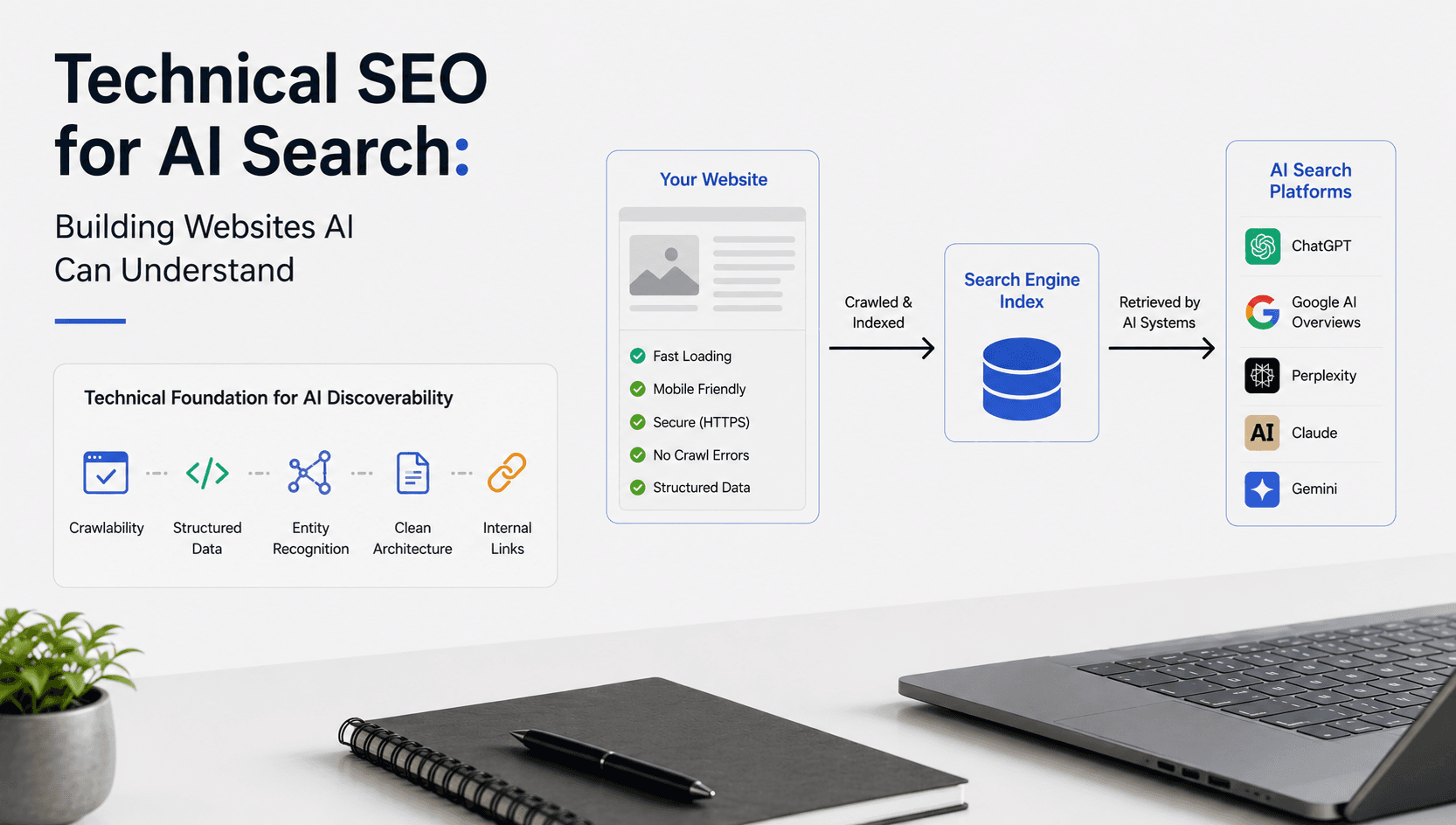
Learn how technical SEO supports AI search by improving crawlability, structured data, entity recognition, and retrieval across ChatGPT, Google AI Overviews, and Perplexity.
Introduction
Technical SEO has always been the foundation of organic search. Search engines cannot rank content they cannot efficiently crawl, interpret, or index. While AI-powered search introduces new retrieval models and answer generation, these systems still depend on technically accessible websites to discover trustworthy information.
Many organizations assume AI search has reduced the importance of technical SEO. The opposite is true. AI platforms increasingly rely on search engine indexes, structured knowledge, and retrieval pipelines that all begin with technically sound websites. Poor crawlability, duplicate content, broken internal links, and inconsistent structured data reduce not only search visibility but also AI discoverability.
Technical SEO for AI search therefore extends beyond traditional optimization. It ensures that both search engines and large language models can efficiently access, understand, and retrieve your information without ambiguity. As AI systems become more sophisticated, technical clarity becomes an increasingly valuable competitive advantage.
In this guide, you'll learn how technical SEO supports AI retrieval, which technical factors influence discoverability, and how to prepare your website for the next generation of search.
Why Technical SEO Still Matters in the AI Era
Artificial intelligence has transformed how search results are presented, but it has not eliminated the infrastructure that powers search. Crawlers still discover content. Indexes still organize information. Canonicalization still prevents duplicate pages from competing. Structured metadata still helps machines interpret meaning.
AI search systems frequently retrieve information from indexed web pages. If important content is blocked by robots.txt, hidden behind JavaScript that crawlers cannot render efficiently, or buried within poor site architecture, retrieval opportunities decrease regardless of content quality.
Technical SEO also influences trust. Websites with consistent canonical URLs, secure HTTPS connections, clean redirects, valid structured data, and logical internal linking create fewer ambiguities for automated systems. AI models benefit from this clarity because retrieval becomes more reliable.
Businesses should therefore view technical SEO as the infrastructure layer that enables every other optimization strategy. Without a technically healthy website, even exceptional content may remain underutilized by AI retrieval systems.
Crawlability Is the First Step Toward AI Discoverability
Search engines and AI retrieval systems cannot use information they cannot access. Crawlability determines whether automated systems can efficiently navigate your website, discover important pages, and understand their relationships.
A well-designed website exposes valuable content through clear internal links rather than relying entirely on search functionality or complex navigation. XML sitemaps further assist crawlers by providing a structured inventory of important URLs, while robots.txt should guide—not unintentionally block—legitimate crawling activity.
JavaScript-heavy websites deserve particular attention. Modern search engines have improved rendering capabilities, but excessive client-side rendering can still delay indexing or prevent critical content from being processed efficiently. Server-side rendering, static generation, or hybrid rendering approaches often improve accessibility for both search engines and AI retrieval pipelines.
Site depth also influences discoverability. Pages buried several clicks away from the homepage generally receive less crawl attention than those integrated into a logical information hierarchy. Important resources should therefore be easily accessible through contextual navigation and internal links.
Good crawlability does not guarantee visibility, but poor crawlability almost always limits it. Before optimizing content for AI retrieval, businesses should ensure that retrieval systems can consistently reach their most valuable information.
Indexing and Canonicalization: Making Every Page Count
Crawling and indexing are often discussed together, but they solve different problems. Crawling is the process of discovering pages, while indexing determines whether those pages become part of a searchable database. A page that is crawled but not indexed has little chance of appearing in search results or becoming a reliable retrieval source for AI systems.
Indexing decisions depend on content quality, uniqueness, accessibility, and technical implementation. Thin pages, duplicate content, parameter-based URLs, and inconsistent canonical tags create uncertainty about which version of a page should represent the topic. When multiple pages compete to answer the same query, search engines may index only one while ignoring the rest.
Canonicalization helps resolve this ambiguity. A canonical tag tells search engines which URL represents the preferred version of a page when similar content exists across multiple addresses. Correct implementation consolidates ranking signals, reduces duplicate content issues, and provides AI retrieval systems with a single authoritative source.
Pagination, faceted navigation, printer-friendly pages, and tracking parameters commonly generate duplicate URLs. Without proper canonical management, these variations dilute authority and increase crawl overhead. Instead of repeatedly processing nearly identical pages, search engines should be directed toward the version that best represents the content.
Index management is equally important. Pages with little long-term value, such as internal search results, staging environments, or temporary campaign pages, should not compete for crawl resources. Allowing crawlers to focus on valuable content improves overall site efficiency and strengthens the quality of indexed information.
Technical SEO is therefore not about maximizing the number of indexed pages. It is about ensuring that the right pages become authoritative resources for both search engines and AI retrieval systems.
Structured Data Creates Machine-Readable Context
Content written for humans often requires interpretation before machines can fully understand it. Structured data reduces that uncertainty by explicitly describing entities and their relationships using standardized vocabulary.
Schema markup tells search engines that a specific string represents an organization, a product, an author, a frequently asked question, or a published article. Rather than inferring meaning from surrounding text alone, retrieval systems receive direct signals about what the information represents.
For AI search, structured data contributes to retrieval confidence. A page containing valid Article, Organization, and Person schema provides more contextual information than plain HTML alone. The system can identify who created the content, which company published it, when it was updated, and how different entities relate to one another.
Some schema types are particularly valuable for educational and service-based websites.
| Schema Type | Primary Purpose | AI Search Benefit |
|---|---|---|
| Organization | Defines business identity, contact details, and official website. | Helps AI systems associate content with the correct organization. |
| Article | Identifies editorial content, authorship, and publication details. | Supports provenance and content credibility. |
| Person | Describes authors and contributors. | Strengthens expertise and entity recognition. |
| FAQPage | Structures questions and answers. | Makes concise responses easier to retrieve for answer engines. |
| BreadcrumbList | Defines page hierarchy. | Improves understanding of topical relationships. |
| Service | Describes professional services offered. | Clarifies business capabilities and expertise. |
Structured data should complement visible content rather than replace it. Marking up information that users cannot see or using inaccurate schema types introduces inconsistencies that reduce trust. The goal is clarity, not complexity.
As AI search evolves, structured information will continue supporting entity recognition, knowledge graph integration, and retrieval accuracy across multiple platforms.
Internal Linking and Information Architecture
Internal linking is often viewed as a method for distributing PageRank, but its role extends much further in AI search. Links communicate relationships between concepts, helping retrieval systems understand how topics connect within a website.
An effective information architecture begins with clear topical organization. Core pages should introduce broad subjects, while supporting pages explore related concepts in greater depth. This creates a logical hierarchy that mirrors how humans learn and how AI systems interpret semantic relationships.
For example, a pillar page on Technical SEO could naturally connect to resources covering crawlability, structured data, Core Web Vitals, XML sitemaps, canonicalization, and log file analysis. Each supporting article expands the broader topic while reinforcing the authority of the central resource.
Contextual anchor text also influences understanding. Generic phrases such as "click here" provide little semantic value. Descriptive anchors explain the destination page and strengthen topical relationships between linked resources.
Internal links also improve crawl efficiency. Well-connected pages are discovered more quickly and revisited more frequently because crawlers encounter multiple pathways leading to the same content. Orphan pages, by contrast, often receive minimal attention regardless of their quality.
Businesses should think of internal linking as knowledge architecture rather than navigation alone. A carefully designed network of related content improves user experience while simultaneously helping AI systems understand topical expertise.
Core Web Vitals and User Experience
Page speed and usability influence more than rankings. They affect whether users remain engaged long enough to consume the information that establishes authority and trust.
Core Web Vitals measure loading performance, visual stability, and interaction responsiveness. Although these metrics are not direct AI retrieval signals, they contribute to the overall quality of a website. Slow pages increase abandonment rates, reduce engagement, and may limit the effectiveness of otherwise valuable content.
Fast-loading pages also improve crawl efficiency. When servers respond quickly and resources load reliably, crawlers can process more pages within the allocated crawl budget. Large websites especially benefit from optimizing server response times, caching strategies, image compression, and efficient resource delivery.
Accessibility is another aspect of technical quality that is frequently overlooked. Clear heading structures, descriptive alternative text, logical HTML semantics, and keyboard-friendly navigation improve usability for people while also providing stronger structural signals for automated systems.
The relationship between user experience and AI search is indirect but meaningful. AI systems increasingly prioritize content from websites that consistently demonstrate quality, reliability, and accessibility. A technically optimized experience reinforces those broader quality signals.
Entity-Based Site Architecture
Traditional site structures were often organized around keyword categories. Modern websites benefit from organizing content around entities and their relationships instead.
Consider an agency specializing in AI search. Rather than maintaining disconnected categories for SEO, content marketing, and artificial intelligence, the site could establish interconnected entity hubs centered on AI Visibility, Technical SEO, Generative Engine Optimization, Answer Engine Optimization, Structured Data, Knowledge Graphs, Semantic SEO, and AI Retrieval Optimization.
Each hub introduces the core concept while linking to detailed resources addressing implementation, measurement, tools, case studies, and common challenges. This structure creates a semantic network that reflects how AI systems organize knowledge.
Entity-based architecture also reduces keyword cannibalization. Instead of publishing multiple articles competing for nearly identical phrases, each page serves a distinct purpose within the broader knowledge ecosystem. Retrieval systems gain a clearer understanding of which resource best answers a specific question.
Consistency remains critical. Entity names, service terminology, and conceptual definitions should remain stable throughout the website. Frequent changes in naming conventions create ambiguity that weakens semantic relationships and reduces retrieval confidence.
A website organized around entities becomes easier for both humans and machines to navigate. Users understand how concepts relate, while AI systems gain stronger contextual signals about the organization's expertise.
AI Crawl Optimization: Preparing Your Website for Modern Retrieval Systems
Search engine crawlers have evolved from simple HTML parsers into sophisticated systems capable of rendering JavaScript, interpreting structured data, and understanding semantic relationships. AI retrieval systems build on this foundation by identifying high-quality information that can support generated answers. Websites should therefore optimize not only for crawlability but also for efficient information extraction.
The first priority is making primary content immediately accessible. Important definitions, explanations, and service descriptions should appear in the initial HTML whenever possible instead of being loaded only after complex client-side interactions. Although modern crawlers can execute JavaScript, rendering introduces additional processing time and increases the possibility that critical information is delayed or overlooked.
Content organization also affects retrieval efficiency. AI systems frequently extract small sections rather than entire documents. Clear headings, concise introductory paragraphs, descriptive subheadings, and logically separated concepts make it easier for retrieval pipelines to identify the most relevant passage for a specific question.
URL design contributes to discoverability as well. Human-readable URLs that reflect content hierarchy provide stronger contextual signals than parameter-heavy or automatically generated addresses. A URL such as /technical-seo/structured-data-guide immediately communicates topical relevance, whereas /page?id=4827 provides little semantic information.
Media optimization is equally important. Images should include descriptive file names and meaningful alternative text rather than generic labels. Videos benefit from transcripts because AI systems can process textual information more reliably than multimedia alone. Documents such as PDFs should also contain searchable text instead of scanned images whenever possible.
Server reliability should not be overlooked. Frequent downtime, inconsistent response codes, redirect chains, and server errors interrupt crawling and reduce confidence in the accessibility of a website. Stable infrastructure supports continuous discovery and timely indexing, particularly for frequently updated content.
Ultimately, AI crawl optimization is about reducing friction. Every technical improvement that makes content easier to access, interpret, and organize increases the likelihood that retrieval systems can use it effectively.
Measuring Technical SEO Success
Technical SEO often succeeds quietly. Users rarely notice clean canonicalization, optimized crawl paths, or valid structured data, but these improvements significantly influence how search engines and AI systems interact with a website. Measuring the right indicators helps determine whether the technical foundation supports long-term discoverability.
Index coverage is one of the most valuable metrics. Compare the number of important pages that should be indexed with those actually appearing in search engine indexes. Unexpected exclusions often reveal crawl issues, duplicate content, or quality concerns requiring investigation.
Crawl efficiency provides another useful perspective. Server log files reveal how search engine bots navigate the website, which pages receive frequent attention, and whether valuable crawl budget is being consumed by low-value URLs. Log analysis often uncovers technical issues that traditional SEO tools cannot detect.
Structured data validation should become part of routine technical monitoring. Errors, warnings, and outdated implementations reduce the usefulness of machine-readable information. Regular testing ensures that schema remains accurate as the website evolves.
Internal linking metrics help identify orphan pages, excessive click depth, and weak topical connections. Every strategically important page should be easily reachable through contextual navigation rather than relying exclusively on XML sitemaps.
Performance metrics remain essential. Core Web Vitals, Time to First Byte, server response consistency, image optimization, and mobile usability all contribute to a technically healthy website that supports efficient crawling and a positive user experience.
The most mature organizations combine technical metrics with business outcomes. Improvements in crawl efficiency, indexing quality, and structured data should ultimately support stronger organic visibility, improved AI discoverability, higher-quality traffic, and increased conversions.
Common Technical SEO Mistakes That Limit AI Visibility
Many technical SEO issues persist because they do not immediately break a website. Pages remain accessible to users, yet subtle implementation problems gradually reduce search performance and AI discoverability over time.
One of the most common mistakes is allowing duplicate content to proliferate. Product filters, URL parameters, session identifiers, and multiple category paths often generate numerous versions of essentially identical pages. Without canonical guidance, search engines spend unnecessary resources processing duplicates instead of focusing on authoritative content.
Another frequent issue is treating XML sitemaps as static assets. Websites change continuously, but outdated sitemaps continue listing redirected, deleted, or non-canonical URLs. Search engines interpret these inconsistencies as signals of poor technical maintenance.
Poor internal linking is equally damaging. Valuable resources frequently become isolated because they are published without integration into the broader information architecture. Even exceptional content loses visibility when crawlers have difficulty discovering it through natural navigation.
Overreliance on JavaScript frameworks presents another challenge. Modern web applications offer excellent user experiences but sometimes prioritize client-side rendering over crawl accessibility. When primary content depends entirely on browser execution, indexing delays become more likely, especially for newly published pages.
Many organizations also neglect structured data maintenance. Schema implementations created years earlier often remain unchanged despite major website redesigns. Missing required properties, invalid entity references, and outdated markup reduce the clarity that structured data is intended to provide.
Finally, technical SEO is often approached as a one-time project rather than an ongoing process. Websites continually evolve through redesigns, migrations, new content, and changing technologies. Continuous monitoring ensures that technical quality keeps pace with those changes instead of gradually deteriorating.
The Future of Technical SEO in an AI-Driven Search Landscape
Technical SEO is becoming less about optimizing for individual algorithms and more about creating information systems that machines can reliably understand. As AI models become increasingly capable of reasoning across multiple sources, technical precision will play an even greater role in establishing trust and retrieval confidence.
Structured information is likely to become more influential as knowledge graphs expand and entity-based retrieval matures. Websites that clearly identify organizations, services, products, authors, and relationships using standardized formats will provide stronger signals than pages relying solely on unstructured content.
Machine-readable documentation may also grow in importance. Product specifications, API documentation, technical guides, research datasets, and other structured resources provide highly reliable information that AI systems can retrieve with minimal ambiguity. Organizations that publish comprehensive documentation create assets extending far beyond traditional marketing content.
Another trend is continuous content verification. Rather than periodically crawling static websites, future retrieval systems may monitor updates, revisions, and factual corrections more actively. Transparent publication dates, revision histories, and documented sources will contribute to long-term credibility.
AI agents capable of completing complex tasks will further increase the value of technically accessible information. Instead of answering isolated questions, these systems may compare products, evaluate vendors, summarize documentation, or automate purchasing decisions. Reliable technical infrastructure ensures that websites remain accessible participants in these emerging workflows.
Technical SEO will therefore remain a foundational discipline. While optimization tactics will continue evolving, the underlying objective will stay remarkably consistent: making information easy for machines to discover, understand, verify, and retrieve accurately.
Any questions about this blog?
Frequently Asked Questions
Is technical SEO still relevant with AI search?
Yes. AI search relies on content that search engines and retrieval systems can efficiently crawl, index, and interpret. Technical SEO provides the infrastructure that enables this process through proper site architecture, structured data, canonicalization, internal linking, and crawl optimization. Without a technically sound website, even exceptional content may struggle to achieve consistent visibility.
Does AI use structured data?
AI systems primarily understand natural language, but structured data provides explicit context that reduces ambiguity. Schema markup helps identify entities, relationships, authors, products, organizations, and services, making content easier to interpret and connect within broader knowledge ecosystems. While structured data alone does not guarantee AI citations, it strengthens overall discoverability.
What is the difference between crawlability and indexability?
Crawlability determines whether automated systems can access a page, while indexability determines whether that page is included within searchable databases. A page may be fully crawlable but excluded from indexing because of duplicate content, low quality, canonical conflicts, or explicit indexing directives.
How does internal linking help AI search?
Internal links establish semantic relationships between topics and improve crawl efficiency. They help search engines and AI systems understand which pages represent core resources and how supporting content contributes to broader subject expertise. Strong internal architecture also reduces orphan pages and strengthens topical authority.
Can JavaScript affect AI discoverability?
Yes. Although modern search engines can render JavaScript, excessive reliance on client-side rendering may delay indexing or complicate content extraction. Server-side rendering, static generation, or hybrid rendering approaches often improve crawl efficiency and retrieval reliability, particularly for content-heavy websites.
Should every page include schema markup?
Not necessarily. Schema should accurately represent the visible content of each page rather than being implemented indiscriminately. Relevant markup improves machine understanding, while inaccurate or misleading schema introduces inconsistencies that reduce trust.
How often should technical SEO audits be performed?
Comprehensive technical audits are commonly performed quarterly, with continuous monitoring of critical metrics such as crawl errors, index coverage, structured data validation, Core Web Vitals, and server health. Websites undergoing rapid development or frequent content updates may require more regular reviews.
What is the most overlooked aspect of technical SEO?
Information architecture is often underestimated. A logically organized website with clear topical relationships, descriptive internal links, consistent entity naming, and intuitive navigation benefits users, search engines, and AI retrieval systems simultaneously. Strong architecture amplifies the effectiveness of every other optimization effort.