

Why Bigger Context Windows Are Making Enterprise AI Less Reliable (And How to Fix It)

Million-token context windows didn't remove the need for retrieval discipline - they hid it. Here's how context contamination causes hallucinations, and the pruning, compression, and routing patterns that fix it.
Setting the Scene
The logic behind "just pass everything in" was reasonable on paper. Bigger windows meant you could skip the fiddly work of indexing and retrieval and just feed the model raw material - full manuals, complete ticket histories, entire policy libraries - and trust the attention mechanism to sort out what was relevant.
It doesn't work that way in production. A transformer doesn't spread its attention evenly across a few hundred thousand tokens. As prompts get longer, retrieval accuracy drops, time-to-first-token climbs (sometimes past four or five seconds), and inference costs rise with every extra token you push through. Worse, the tokens you didn't need - duplicate facts, superseded procedures, leftover chatter from earlier turns - actively interfere with the ones you did. We call this context window contamination: irrelevant or conflicting content sitting in the active window, disrupting the self-attention layers enough to produce hallucinations the model states with total confidence.
For systems where accuracy and response time are contractual, not aspirational, this isn't something you patch with a better prompt template. It's a systems design problem, and it needs to be treated like one - with deliberate pruning, compression, and routing built into the pipeline itself.
What's Actually Going Wrong Inside the Window
Contamination happens when tokens that are irrelevant, redundant, or contradictory make it into the model's active context and start competing for attention with the tokens that actually answer the question.
There are three specific mechanisms behind this, and they show up in almost every long-context production system we've looked at.
Position decides what gets noticed. Autoregressive models pay noticeably more attention to whatever sits near the start or the end of a prompt than to anything in the middle 60% or so. This is the well-documented "lost in the middle" effect. If your most important compliance clause happens to land in the interior of a 50,000-token prompt, don't be surprised when the model skips right past it.
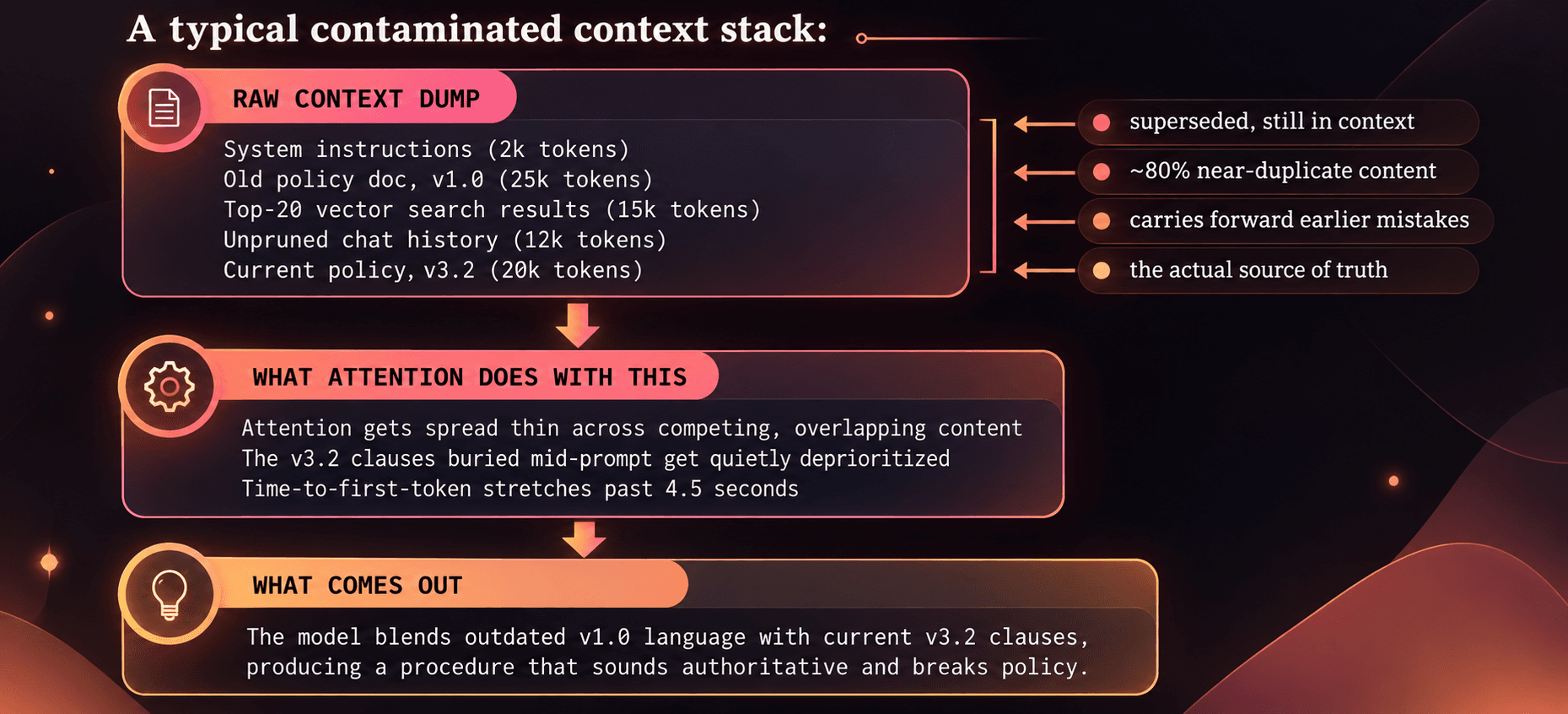
Old mistakes don't go away on their own. In agentic workflows and long-running copilots, the full conversation transcript sticks around - including the agent's own wrong turns, failed tool calls, and assumptions it should have dropped three steps ago. If the agent hallucinates something on turn three, that hallucination is still sitting in the context on turn ten, and the model treats its own earlier error as established fact. Errors compound instead of correcting.
Retrieval without filtering just adds noise. A lot of RAG pipelines still rely on plain cosine similarity to pick chunks, which means the top ten results can easily be ten near-identical restatements of the same paragraph. That's most of your token budget spent reinforcing one idea while everything else - including content that might actually answer the question - gets crowded out.
Weighing Your Options
Most teams end up choosing between four broad approaches to managing context at scale, and each one trades off differently on accuracy, latency, and cost.
| Approach | What it actually does | How much signal survives | Latency | Cost | Where it fits |
|---|---|---|---|---|---|
| Dump everything in | Pushes full documents and transcripts straight into a million-token window | Low key facts get buried by attention dilution and position bias | Severe - TTFT regularly exceeds 4 seconds | Scales badly; you pay for every redundant token, every query | Fine for a quick demo, not for anything with real traffic |
| Truncate the tail | Keeps system prompt and the last N turns, drops everything older | Poor - long-term context, prior decisions, and stated constraints vanish | Fast and predictable | Low, bounded by design | Simple, stateless customer interactions only |
| Rerank and reject | Pulls a wider candidate set, scores each with a cross-encoder, drops anything below a relevance threshold (commonly ~0.75) | High - keeps what's actually relevant, discards near-duplicates | Moderate - reranking adds roughly 50ms | Low downstream, since generation sees far fewer tokens | Compliance search, legal discovery, enterprise knowledge retrieval |
| Route and compress | Extracts durable state into a structured ledger, compresses the narrative history, routes only what's needed | Highest - structured facts persist without dragging along conversational bulk | Low - handled by lightweight routing models | Most efficient overall | Long-running agents, complex multi-step enterprise workflows |
The Architecture That Actually Holds Up
Fixing contamination means putting a real pipeline between your knowledge stores and the model - not just a bigger prompt template.
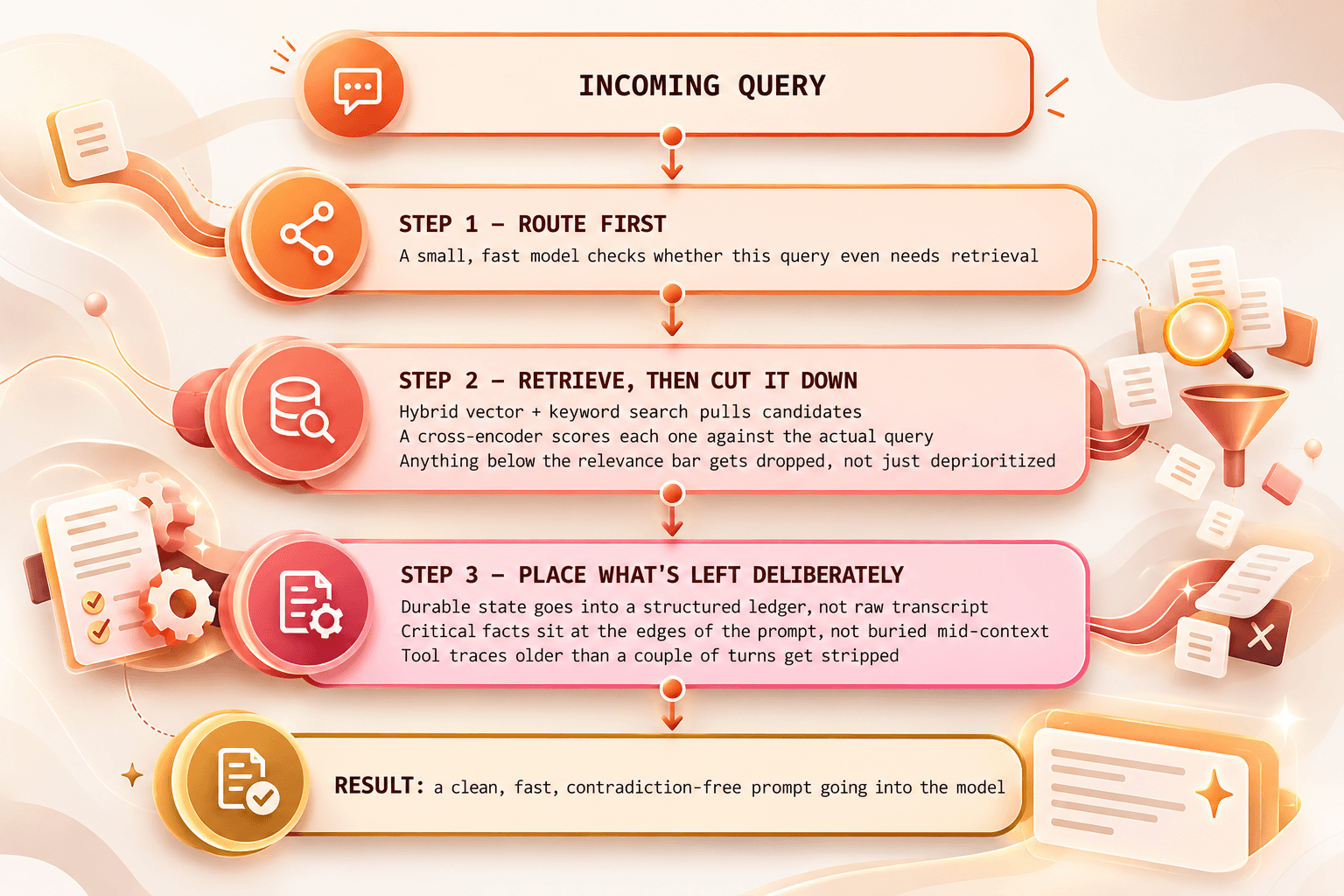
Route before you retrieve. Not every message needs a trip to the knowledge base. A greeting, a clarifying question, a simple confirmation - sending any of that through a full retrieval pipeline just burns tokens and gives the model more chances to hallucinate against irrelevant material. A lightweight classifier or embedding-based router can decide up front whether retrieval is even warranted.
Score before you inject. Cosine similarity tells you two things are topically close, not that one actually answers the other. A cross-encoder reranker evaluates the query and the candidate passage together, and anything that doesn't clear the bar gets thrown out - not down-weighted, thrown out. In practice, sending nothing beats sending something irrelevant almost every time.
Placement is not cosmetic. Because attention favors the start and end of a prompt, where you put things matters as much as what you put in. Authoritative instructions and primary sources belong at the edges. Background material and secondary context can sit in the middle, where the model is going to skim over it anyway.
Rules We Actually Apply When We Build These Pipelines
A few disciplines separate context pipelines that hold up under load from the ones that quietly degrade over weeks of production traffic.
Separate what the agent knows from what it said. Passing an ever-growing conversation log as your only source of state is fragile - every retry, every wrong turn, every dead end stays in there forever. Pull the confirmed facts, decisions, and variables out into a structured state object instead, and let the narrative transcript be summarized or dropped every few turns. The ledger carries forward; the chatter doesn't have to.
Don't let raw tool output ride along unedited. API responses and database calls come back full of headers, formatting, and boilerplate the model never needed in the first place. Pull out the specific values the agent actually asked for and drop the wrapper before it ever touches the context window.
Compress instead of just cutting. For interactions that need long-term continuity, a smaller auxiliary model can summarize completed segments -distilling the key decisions and numbers into a fraction of the original length. Done well, this cuts token volume by 70–90% without losing the facts that matter.
Measure it, don't guess. Track time-to-first-token, prompt-to-completion ratios, and reranker rejection rates across production traffic. If an application keeps needing bigger and bigger prompts to get consistent answers, that's almost never a sign you need more context - it's a sign your retrieval layer is leaking noise.
Where Teams Get This Wrong
The most common mistake is treating a large context window as a substitute for a real indexing strategy. Just because an entire manual technically fits doesn't mean the model will reason cleanly across every edge case inside it - long, unstructured payloads tend to produce slower, less reliable answers, not more thorough ones.
A close second: leaving conflicting document versions in the same context without deduplication. Old and current policies often sit side by side in enterprise data stores. Without version filtering, retrieval pulls from both, and the model has to reconcile the contradiction on its own - usually by inventing a hybrid that satisfies neither version and violates the actual policy in force.
Full agent trace logs are another recurring problem. If an agent tries three different tool calls before finding the right parameters, keeping every failed attempt and error message in the active prompt teaches the model, in effect, that those failed attempts were reasonable steps to take. It starts repeating them.
And plenty of teams simply don't watch the economics. Running 100,000-token prompts for routine, everyday questions is expensive and slow, and it gets worse - fast - the moment concurrent traffic goes up. At some point the architecture stops being sustainable regardless of how good the underlying model is.
How This Fits Into a Broader AI Strategy
At Pixenox, context management isn't something we treat as prompt-writing - it's infrastructure. We build autonomous AI systems and enterprise intelligence platforms around deterministic accuracy, sub-second response times, and cost profiles that actually scale.
That shows up in a few concrete pieces of how we build:
Pipeline architecture - sub-100ms rerankers, semantic deduplication, and pruning logic that typically cuts prompt payloads by up to 80% without losing information that matters. State handling that doesn't drift separating the durable facts an agent needs to know from the raw transcript of how it got there, so multi-step workflows don't accumulate their own mistakes as they run. Latency engineering - pairing lean, pruned prompts with tuned inference runtimes to keep complex workflows responding in well under a second. Observability that's actually useful - telemetry across every production run that tracks contamination signals, attention drift, and retrieval precision, not just uptime.
Whether the goal is retiring a fragile prototype agent or scaling an internal platform to handle millions of daily requests, the pattern holds: performance, accuracy, and engineering discipline have to move together, or the system eventually breaks under its own context.
Any questions about this blog?
Frequently Asked Questions
What is context window contamination, in plain terms?
It's what happens when irrelevant, duplicated, or contradictory content ends up inside a model's active prompt. That noise interferes with self-attention, and the practical result is a model that sounds confident while producing answers that are subtly or not so subtly wrong.
Why does a bigger context window sometimes make things worse, not better?
Because transformers don't attend evenly across long prompts. Content in the middle of a large window gets systematically less attention than content at the start or end, a pattern usually called "lost in the middle." The bigger the window, the more content ends up in that weak middle zone.
What's the real difference between pruning and compression?
Pruning is a filter - a cross-encoder scores retrieved chunks and throws out the ones that don't clear a relevance threshold, without touching the wording of what's kept. Compression is a rewrite - a secondary model summarizes larger stretches of text, distilling the key facts into a much shorter form before it goes into the main prompt.
How much does pruning actually help with latency?
Time-to-first-token scales with how many tokens the model has to process before it starts generating. Cut the input down - remove duplicates, drop irrelevant chunks - and you reduce that prefill load directly, which is where most of the latency gain comes from.
When should you prune conversation history versus keep it?
If the older turns fall outside what the current task actually needs, prune or summarize them. For short, transactional interactions, you can usually drop old turns outright. For longer multi-step workflows, compress the history into a structured state record that keeps the facts and preferences without hauling along every intermediate exchange.
Does a million-token context window mean you don't need RAG anymore?
No. A bigger window lets you fit more text in, but it doesn't solve retrieval precision, token cost, or latency on its own. RAG is still what decides which specific pieces of knowledge are worth injecting - the window size is just a ceiling, not a strategy.