

The Production Readiness Gap: A Technical Maturity Framework for AI Systems Before They Ship
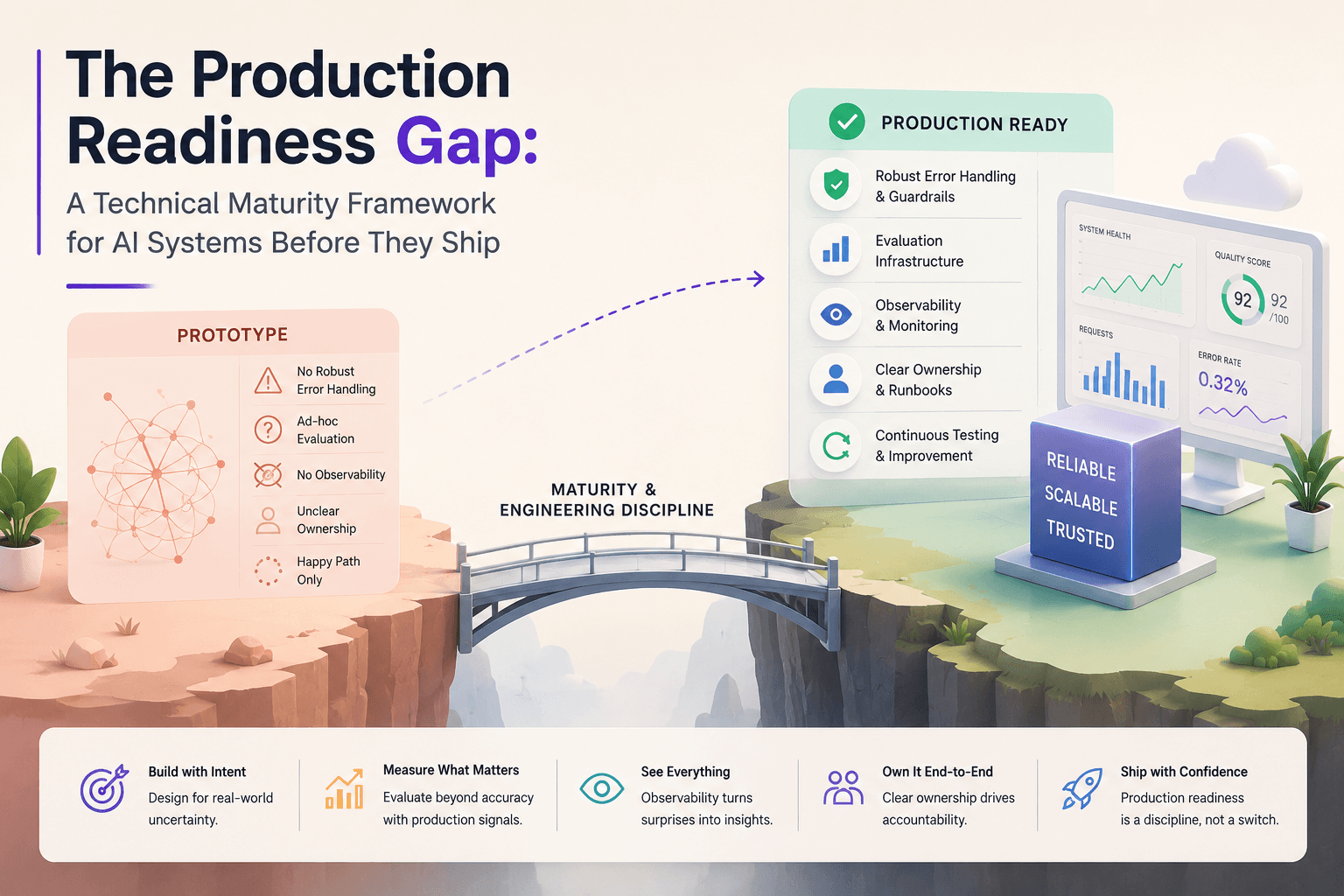
A technical maturity framework for evaluating whether an AI system is genuinely production-ready or still a prototype wearing production clothing - covering error handling, evaluation infrastructure, observability, and ownership.
Introduction
There's a specific moment that shows up in almost every AI engagement we take on for a client past the prototype stage: someone pulls up the original proof-of-concept, points at it, and says some version of "this already works, why can't we just launch it?" The honest answer is that it does work - for the narrow set of conditions it was built and tested under. Production is a different set of conditions entirely, and the architecture required to survive them is a separate engineering problem, not a polish pass on the same one.
This applies whether the system in question is a retrieval-augmented generation (RAG) pipeline, an AI agent that takes actions through external tools, or a customer-facing copilot built on top of a foundation model API. The interface changes. The underlying readiness problem doesn't.
This isn't a matter of opinion or preference. It's measurable. A system's production readiness can be evaluated against a specific set of technical dimensions - error handling, evaluation infrastructure, observability, data pipeline resilience, access control, and cost architecture and most prototypes score poorly on nearly all of them, for reasons that made complete sense during the proof-of-concept phase and stop making sense the moment real users and real data enter the picture.
What follows is the maturity framework we use internally when assessing whether a system someone describes as "basically done" is actually ready, or whether it's a working prototype dressed in production language.
Dimension One: Failure Handling Under Non-Deterministic Output
Traditional software assumes that identical input produces identical output, and most error handling gets designed around that assumption - validate the input, trust the deterministic logic, catch the exceptions you can anticipate. Systems built around large language models violate that assumption structurally. The same prompt can produce a well-formed response on one call and a malformed, incomplete, or subtly wrong one on the next, with no error thrown at the API level to flag the difference.
A mature system treats this as an architectural constraint rather than an occasional annoyance. That means schema validation on every model output before it reaches downstream logic, not just a check that the API call itself succeeded. It means retry logic that re-validates structure on each attempt rather than assuming a second try will automatically behave better than the first. And it means explicit, designed fallback paths - routing to a simpler deterministic process, or escalating to a human - for the cases where confidence in an output is genuinely low, rather than a binary between perfect success and unhandled failure.
Immature systems, almost without exception, treat model output the way they'd treat a database read: trusted, well-formed, safe to pass along untouched. That assumption survives testing and fails in production, usually within the first few weeks of real traffic.
Dimension Two: Evaluation as Continuous Infrastructure, Not a Launch Gate
Most teams run an evaluation pass before launch, feel satisfied with the results, and move on. The problem is that this measures the system against a static snapshot - a curated test set, a specific model version, a moment in time and every one of those variables changes after launch. Real user queries diverge from a curated test set within weeks. Underlying model providers update their models without advance notice. Behavior that scored well in a pre-launch evaluation can degrade silently, with nothing in a one-time test catching the drift.
A production-grade evaluation practice looks structurally different. It draws its test set from real, sampled production traffic on an ongoing basis, not exclusively from hand-picked examples generated during development. It runs automated regression checks against every meaningful change to a prompt or a retrieval pipeline, treating that logic with the same rigor as application code, because functionally, it behaves like code. And it includes a rolling sample of human review, particularly for outputs tied to higher-stakes decisions, since automated evaluation alone tends to miss the kind of subtle quality regression that a domain expert catches immediately.
This is, in our experience, the single most commonly skipped piece of infrastructure under deadline pressure and reliably the first thing that breaks down once usage volume increases past what the original test set represented.
Dimension Three: Observability Deep Enough to Explain, Not Just Record
Standard application logging answers one question well: did the request happen, and what came back. It has almost nothing to say about why a specific output was wrong, which is precisely the question that matters most during a real incident involving an AI system.
Mature observability for these systems requires full trace logging - the prompt, the retrieved context, any intermediate reasoning steps, and the final output -structured so that a specific incident can be reconstructed after the fact rather than reverse-engineered from guesswork. It requires cost and latency instrumentation broken down per component in a multi-stage pipeline, since the actual bottleneck or expense driver is rarely obvious from an aggregate request-level metric alone. And it requires drift detection running continuously against both the distribution of incoming inputs and the quality of outgoing outputs, so that degradation gets caught by a monitoring system before it gets caught by a customer complaint.
Without this depth of instrumentation, debugging becomes something closer to forensic archaeology than engineering - piecing together what probably happened from fragments, rather than reconstructing exactly what did.
Dimension Four: The Data Layer as a First-Class, Monitored Component
Engineering attention on AI systems concentrates, almost by reflex, on the model and the prompt. In the incidents we've actually been called in to diagnose across real deployments, the root cause traces back to the data and retrieval layer more often than to the model itself - a retrieval index that's silently fallen out of sync with its source of truth, an upstream schema change nobody flagged, embeddings generated against data that's since been updated or deleted.
Treating this layer as production-grade means versioning retrieval indexes the way you'd version any other critical artifact, monitoring ingestion jobs with the same seriousness applied to any other scheduled production process, and treating "the data is current" as a claim that gets verified continuously rather than an assumption that holds indefinitely once true at launch.
Dimension Five: Security Architected In, Not Bolted On
AI systems introduce genuinely new attack surfaces - prompt injection, unintended leakage of sensitive information through generated output - that don't have direct analogues in traditional application security, and treating them as an afterthought tends to produce exactly the kind of vulnerability that only surfaces once it's already been exploited.
A mature security posture enforces the separation between system instructions and user-supplied content at the architectural level, not through prompt wording that a sufficiently motivated user can work around. It filters outgoing responses for sensitive data categories before they leave the system boundary. And it applies least-privilege access to any external tool or API a model is permitted to invoke, since broad tool access effectively becomes a broad attack surface the moment a model is manipulated into misusing it.
Dimension Six: Cost Architecture That Scales Predictably
A system that looks economically trivial at pilot volume can become genuinely unsustainable at real scale if the underlying cost architecture was never deliberately designed and this is one of the more common reasons a technically functional system gets shelved, not because it stopped working, but because the unit economics stopped making sense.
Mature systems route requests through tiered models by default - cheaper, faster models handling the bulk of routine requests, with escalation to more capable and expensive models reserved for genuine complexity. They cache aggressively wherever correctness allows it, avoiding redundant model calls for repeated or semantically similar requests. And they apply real discipline to context window usage, sending only what a given request actually requires rather than maximizing context "just in case," a habit that quietly compounds cost and latency as usage grows.
| Maturity Dimension | Prototype Behavior | Production-Grade Behavior |
|---|---|---|
| Failure handling | Trusts model output as if deterministic | Validates, retries with schema checks, falls back gracefully |
| Evaluation | One-time pre-launch test | Continuous, traffic-sampled, regression-tested |
| Observability | Basic request/response logs | Full tracing, per-component cost tracking, drift detection |
| Data layer | Static snapshot, unmonitored | Versioned, monitored ingestion, continuously verified |
| Security | Prompt-level assumptions | Architecturally enforced separation and least-privilege access |
| Cost architecture | Unmeasured or measured once | Tiered routing, caching, deliberate context discipline |
Applying the Framework Honestly
The value of a framework like this isn't in producing a pass/fail verdict - very few systems score perfectly across all six dimensions even after a genuine hardening phase, and that's not necessarily a problem, provided the gaps are known and deliberate rather than accidental. The real value is in forcing an honest conversation before a rollout decision, rather than after an incident forces it.
In practice, this means walking through each dimension with the team that built the prototype and asking, specifically, what would need to change to move it one level up. Sometimes the answer is a few weeks of focused work. Sometimes it's a genuine second phase of engineering comparable in scope to the original build. Both answers are fine, as long as the stakeholders approving the timeline and budget for a production rollout are working from the honest one.
Any questions about this blog?
Frequently Asked Questions
What's the difference between an AI prototype and a production-grade AI system?
The difference isn't polish, it's architecture. A prototype is built and tested to prove a concept works under conditions its builders control. A production-grade system is architected to keep working under unexpected input, partial failures, model drift, and real usage volume, through explicit validation, continuous evaluation, and deep observability rather than assumption.
Why does non-deterministic output require different error handling?
Traditional software error handling assumes identical input produces identical output, which large language models don't guarantee. The same prompt can produce a well-formed or malformed response on different calls, so production systems need schema validation, structure-aware retries, and explicit fallback paths rather than relying on a single success/failure check.
Why is a one-time evaluation before launch not sufficient?
Real user queries diverge from a curated pre-launch test set within weeks, and underlying model providers update models without advance notice. A one-time evaluation can't catch degradation that happens after launch, which is why continuous evaluation against sampled production traffic is a core part of production readiness.
What does observability mean specifically in the context of AI systems?
It means full trace logging of prompts, retrieved context, intermediate steps, and outputs, so a specific incident can be reconstructed after the fact. It also includes per-component cost and latency tracking within multi-stage pipelines, and drift detection across both input patterns and output quality over time.
Why do data pipeline issues cause more production incidents than model issues?
Engineering attention tends to concentrate on the model and prompt layer by default, leaving the retrieval and data pipeline comparatively under-monitored. In practice, issues like a stale retrieval index or an unflagged upstream schema change are a frequent, often overlooked root cause of production failures.
What security risks are specific to AI systems that don't exist in traditional software?
Prompt injection and unintended exposure of sensitive information through generated output are two risks with no direct equivalent in traditional application security. Addressing them requires architecturally enforced separation between system instructions and user content, plus least-privilege access for any tools a model can invoke.
How does cost architecture affect whether an AI system can scale?
Without tiered model routing, caching, and deliberate context management, a system that looks inexpensive during a pilot can become economically unsustainable at real production volume, since token usage and model tier both compound directly with scale.
Should every AI system score perfectly across all six maturity dimensions before launch?
Not necessarily. The goal is an honest assessment of where the gaps are and a deliberate decision about which ones need to be closed before rollout, rather than discovering the gaps unexpectedly during a production incident.