

The Mechanics of AI Query Fan-Out: Reverse-Engineering How Generative Search Decomposes Enterprise Queries

Generative answer engines don't run single vector searches - they decompose complex enterprise queries into multiple parallel sub-queries. Here's how to structure your site to capture them.
What is AI Query Fan-Out in Practice?
To understand why traditional SEO fails here, you have to look at what actually happens inside the orchestrator when a complex query is submitted.
Imagine a CTO based in London opens an AI answer engine and asks: *"Compare the top HIPAA-compliant clinical data extraction pipelines that offer UK data sovereignty and sub-100ms latency."*
Legacy search engines would treat this as a long-tail keyword string, looking for a single webpage that contains all those words. An AI orchestrator does something entirely different. It decomposes the prompt into discrete, parallel retrieval tasks:
- Entity Identification: Retrieve a list of leading clinical data extraction engines.
- Compliance Verification: Filter that list strictly for explicit mentions of HIPAA compliance.
- Geographic / GEO Validation: Append the user's geographic context (London) and verify which of those vendors comply with UK data sovereignty laws (GDPR, localized VPC hosting).
- Performance Benchmarking: Cross-reference technical documentation or GitHub repositories to confirm the "sub-100ms latency" claim.
The models then retrieve candidate sources for each of these four sub-queries simultaneously. If your website features a beautifully written 2,000-word narrative about your "global clinical software," but buries your latency metrics in a PDF and fails to explicitly map your UK data residency using machine-readable schema, you fail the fan-out test. The model synthesizes the answer using a competitor whose infrastructure provided clear, distinct answers to all four sub-queries.
The Geographic Imperative: Why Global Brands Get Filtered Out
AI answer engines operate heavily on implicit context. When queries originate from major global enterprise hubs - whether in Silicon Valley, London, or Bengaluru -the models often apply implicit geographic filtering based on known regulatory requirements.
This is where Geographic Generative Engine Optimization (GEO) becomes critical. You cannot rely on a generic global landing page. When the orchestrator fans out a query looking for regional validity, your architecture needs nested JSON-LD schema graphs that explicitly map your corporate entities to verified geographic nodes.
If you serve enterprise clients in India, your schema must explicitly define compliance with the DPDP Act. If you serve Europe, your entity nodes must link to EU Cloud CoC or SOC 2 Type II certifications with regional validity. Without this localized entity anchoring, a generative engine evaluating a cross-border enterprise query will treat your platform as an unverified geographic risk and exclude you from the final output.
Why Your Current Architecture Fails the Orchestrator
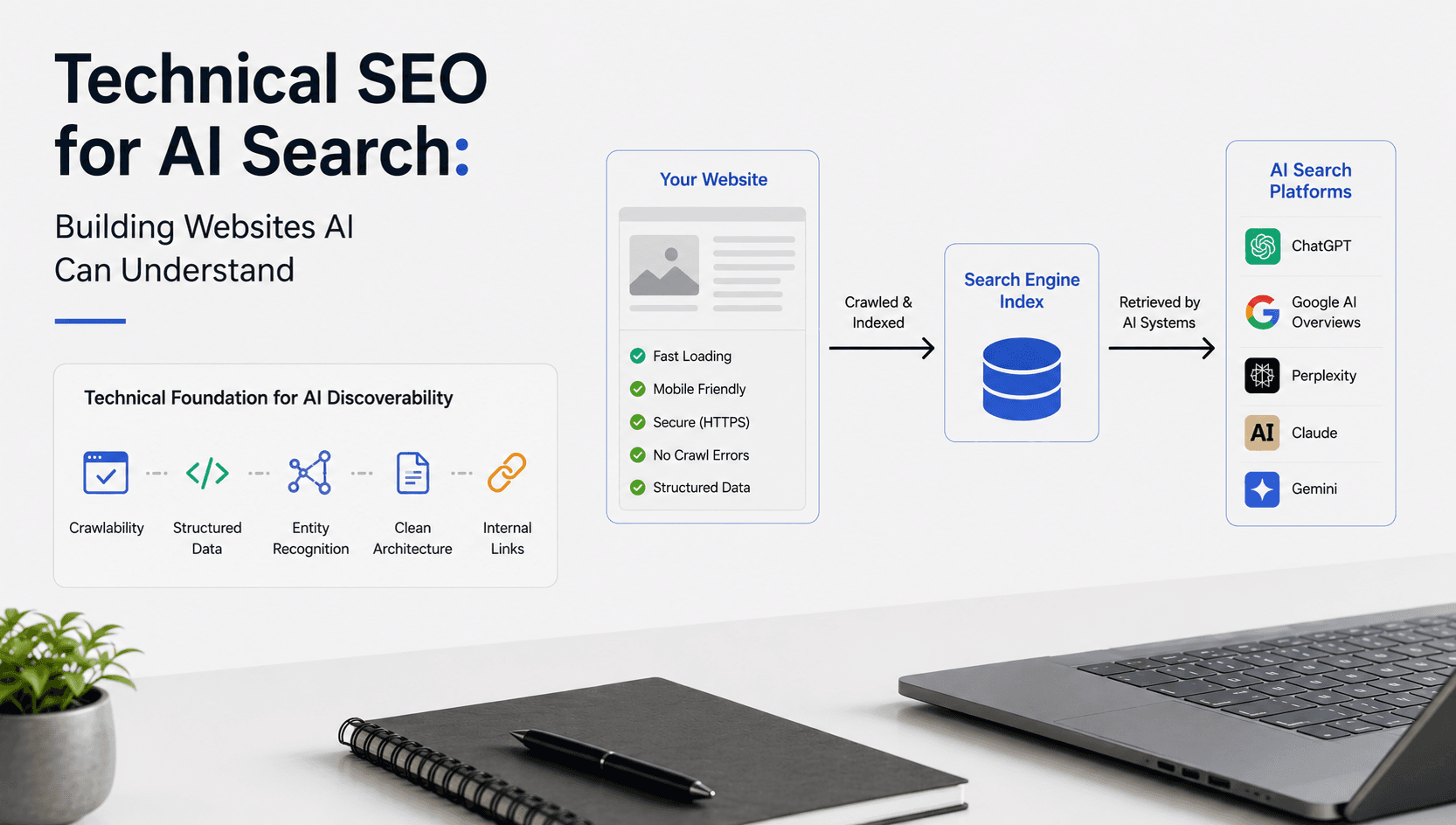
Most enterprise websites fail to capture AI visibility because they are built for human scrolling sessions, not for token-constrained machine extraction.
The Monolithic Content Trap Traditional SEO encouraged writing long, flowing paragraphs packed with LSI keywords. But AI crawlers operating under sub-second timeouts do not "read" your prose; they extract facts. When an orchestrator runs a sub-query looking for a latency benchmark, it wants a structured markdown table or a distinct semantic key-value pair, not a marketing paragraph it has to spend compute cycles parsing.
The Client-Side Rendering Bottleneck If your site relies on heavy JavaScript hydration before the content is visible, you are invisible to AI. Retrieval bots like `GPTBot` or `PerplexityBot` hit your site, expect a fully rendered DOM on the very first request, and drop the connection if they are handed an empty client-side shell.
Disconnected Schema Running a basic SEO plugin that slaps a generic "WebPage" schema on your site is useless for AI visibility. To an AI crawler, disconnected schema tags look like unrelated fragments. Real semantic schema engineering ties these together into a single graph, using nested JSON-LD with persistent node IDs (`@id`) that explicitly state how your publishing entity, your verified authors, and your specific technical capabilities relate to one another.
Legacy SEO vs. Generative Engine Optimization (GEO)
| Retrieval Metric | Legacy SEO (Googlebot) | Generative Engine Optimization (AI Fan-Out) |
|---|---|---|
| Query Processing | Matches text strings against a monolithic index | Orchestrator splits prompts into 4-6 parallel sub-queries |
| Source Validation | Relies heavily on PageRank, domain age, and backlink volume. | Evaluates semantic co-occurrence, structured entities, and factual density |
| Data Structure Focus | HTML tags (H1, H2), keyword density, and internal linking | Nested JSON-LD schema graphs linked to persistent Wikidata Q-IDs |
| Geographic Targeting | Relies on local directory listings and localized URL slugs | Requires machine-readable regulatory mapping (GDPR, DPDP) bound to corporate entities |
| Failure Mode | Slowly dropping to page 2 or 3 of search results over time | Immediate, complete exclusion from the generated consensus answer |
Engineering Your Stack for AI Visibility
Winning visibility in an AI-first search environment requires moving away from traditional content marketing and towards a structured "answering cluster" architecture.
1. Isolate and Map Technical Entities Stop writing generic feature pages. Map out the exact compound questions your buyers ask, and isolate the distinct technical sub-queries within them. Build componentized content blocks - explicit feature comparisons, verifiable benchmark tables, and direct compliance statements - that individually satisfy an orchestrator's sub-queries.
2. Anchor to Verified Knowledge Graphs When you write about a specialized technical subject, use schema properties like `about` and `mentions` to point directly to the correct Wikidata entity. If you claim to build "Vector Databases," anchor that term to its exact Q-ID. This removes the disambiguation burden from the LLM, increasing the likelihood it confidently cites your platform.
3. Optimize for Single-Pass Extraction Move critical factual data out of client-side rendering pipelines. Every claim, specification, and regional capability that matters must be present in the initial HTML payload your server hands back. Trim JavaScript execution, optimize your Time to First Byte (TTFB), and ensure your architecture respects the strict timeout budgets of retrieval agents.
How Pixenox Engineers Visibility
At Pixenox, we treat AI visibility as a core component of Enterprise Intelligence Engineering. We do not write SEO blogs; we architect semantic data layers. By mapping your proprietary enterprise capabilities into highly optimized, localized schema graphs, we ensure that when an AI orchestrator decomposes a complex query, your infrastructure provides the exact deterministic facts it needs to generate a citation.
Generative search is rapidly replacing the traditional enterprise software evaluation process. The organizations that hold onto authority in this new web won't be the ones publishing the most content. They will be the ones whose platforms are engineered to be the most machine-readable sources available the moment an answer engine goes looking.
Any questions about this blog?
Frequently Asked Questions
What exactly is an AI query fan-out?
It is the architectural mechanism where an LLM orchestrator takes a complex user prompt and splits it into multiple smaller, highly specific search queries run in parallel. The engine then synthesizes the disparate retrieved facts into one unified consensus response.
Why doesn't our high-ranking traditional SEO content appear in Perplexity?
Traditional SEO content is often written as long-form narrative prose. AI crawlers operate on strict token budgets and compute limits; they prioritize high-density, structured data (like markdown tables, JSON-LD, and explicit entity definitions) over narrative marketing filler that requires heavy reasoning to parse.
How does geographic location impact AI search visibility?
Models like Perplexity Enterprise and Claude Search filter sources based on the geographic and compliance constraints of the user's prompt (or IP context). If your site architecture does not explicitly state regional data sovereignty capabilities in machine-readable schema, the model will skip you for enterprise queries originating in highly regulated zones like the EU, UK, or India.
Can we rank in AI search without semantic schema?
It is technically possible but highly inefficient. Without schema, the model has to infer your authority, your geographic footprint, and your technical capabilities purely from unstructured text. Nested JSON-LD graphs hand the orchestrator pre-verified facts, drastically reducing its computational overhead and increasing your citation rate.
What is the difference between client-side rendering and single-pass extraction?
Client-side rendering hands a crawler an empty HTML shell and relies on JavaScript to load the content later. AI retrieval agents (like GPTBot) operate on single-pass extraction—they grab the initial HTML and leave. If your facts aren't in that first payload, the AI assumes your page is blank.