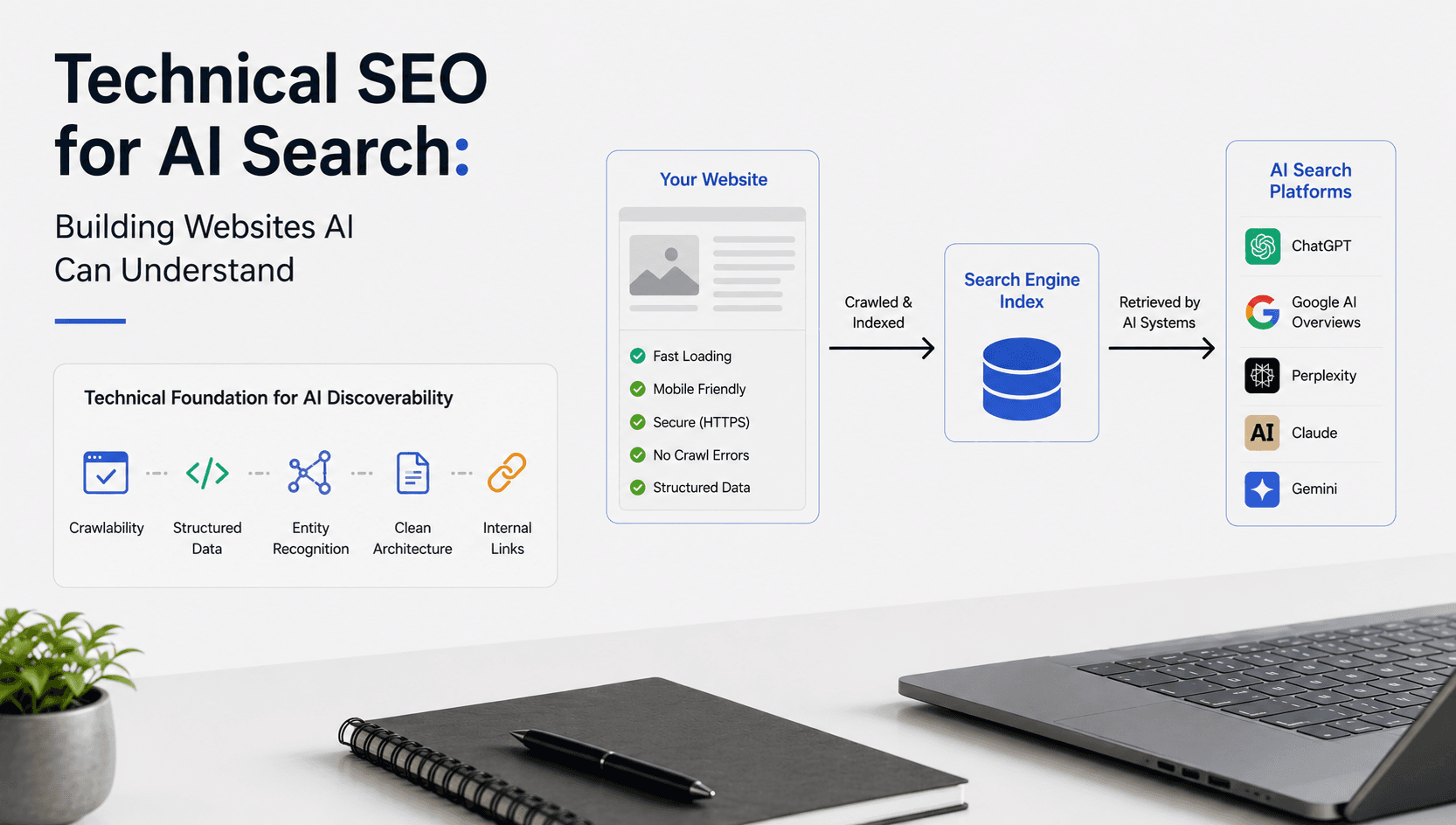


Structured Data vs Knowledge Graphs: Why AI Needs Both to Understand Your Business

Learn how structured data and knowledge graphs work together to improve AI visibility, entity recognition, and retrieval across ChatGPT, Google AI Overviews, Gemini, Claude, and Perplexity.
Introduction
Most businesses treat structured data as an SEO feature. They implement Schema.org markup to qualify for rich results, validate it using Google's Rich Results Test, and consider the task complete. While this approach supports traditional search, it captures only a small part of structured information's role in modern AI search.
Large language models do not retrieve information based solely on keywords or HTML content. They build relationships between entities, attributes, documents, organizations, and external sources. Structured data provides explicit descriptions of these entities, while knowledge graphs connect them into a machine-readable network that enables reasoning rather than simple matching.
This distinction explains why two websites with similar content can produce different outcomes in AI search. One provides isolated pages with basic schema markup. The other creates a consistent network of entities that extends across documentation, service pages, authors, products, and external references. AI systems can interpret the second website with far greater confidence because it provides both structured information and meaningful relationships.
For organizations investing in AI Visibility, structured data and knowledge graph engineering should be viewed as complementary disciplines rather than separate SEO tasks. One describes information. The other organizes knowledge.
This guide explains how they work together, why AI retrieval depends on both, and how businesses can engineer websites that are easier for machines to understand.
Structured Data Describes Information, Knowledge Graphs Connect It
Structured data and knowledge graphs are frequently discussed together because both organize information for machines. Their purposes, however, are fundamentally different.
Structured data adds explicit metadata to individual pages. It identifies that a piece of text represents an organization, an author, a software application, a service, or an article. Instead of forcing search engines to infer meaning, Schema.org markup communicates these facts directly through standardized vocabulary.
A knowledge graph operates at a higher level. Rather than describing one page, it models relationships between entities across an entire ecosystem. It represents that an organization offers a service, employs specific experts, publishes articles on defined topics, develops software products, and is referenced by trusted publications. These relationships create a graph of connected knowledge instead of isolated documents.
Think of structured data as defining nouns and their attributes. Knowledge graphs define how those nouns relate to one another. AI systems require both. Without structured data, entity identification becomes less reliable. Without knowledge graphs, individual entities lack the context necessary for reasoning and retrieval.
This relationship becomes increasingly important in AI-powered search because retrieval systems prioritize understanding over pattern matching. Machines need to know not only what an entity is but also how it fits within a broader network of information.
Why AI Retrieval Depends on Entity Relationships
Large language models generate answers by assembling information from multiple sources rather than relying on a single webpage. During retrieval, the system evaluates semantic similarity, factual consistency, and relationships between entities before selecting supporting evidence.
Suppose a user asks, "Which companies specialize in AI Visibility engineering?" The retrieval system does not simply search for pages containing that exact phrase. Instead, it looks for organizations connected to entities such as Technical SEO, Entity SEO, Structured Data, Knowledge Graphs, AI Search Optimization, Generative Engine Optimization, Retrieval-Augmented Generation, and AI Retrieval.
A website that clearly establishes these relationships becomes easier to retrieve because the surrounding context reinforces the organization's expertise. Conversely, pages that mention AI Visibility without supporting semantic connections provide weaker evidence.
Entity relationships also improve ambiguity resolution. If an organization publishes services related to AI search, software engineering, and cloud infrastructure, AI systems need contextual signals to distinguish between these areas. A knowledge graph supplies those signals by connecting services to relevant technologies, industries, and supporting resources.
This contextual understanding reduces uncertainty during retrieval, allowing AI systems to recommend organizations based on demonstrated expertise rather than isolated keyword occurrences.
How Schema Markup Feeds Knowledge Graph Construction
One of the biggest misconceptions in SEO is that Schema.org markup automatically creates a knowledge graph. In reality, schema provides structured evidence that contributes to graph construction, but it is only one of many inputs used by search engines and AI systems.
When a crawler encounters valid Organization, Person, Service, Article, and BreadcrumbList markup, it gains explicit information about entities and their attributes. These structured signals are combined with page content, internal links, external citations, business profiles, authoritative references, and historical data to build a richer representation of the organization.
For example, an Organization schema might identify the company's name, website, logo, and social profiles. A Person schema connects authors to published articles. A Service schema links the organization to offerings such as AI Visibility Engineering or Knowledge Graph Engineering. Internal links reinforce these relationships, while external mentions validate them.
Over time, these signals accumulate into a graph representing the organization's digital identity. Search engines and AI platforms continuously refine this graph as they encounter additional evidence across the web.
Schema therefore acts as structured input rather than the finished product. Its greatest value lies in reducing ambiguity during entity recognition, making it easier for machines to incorporate the information into broader knowledge networks.
Knowledge Graph Engineering for AI Search
Knowledge graph engineering is the process of intentionally designing, organizing, and connecting entities so machines can understand an organization's expertise with minimal ambiguity. Unlike traditional SEO, which often focuses on optimizing individual pages, knowledge graph engineering focuses on building a coherent semantic network across an entire digital presence.
Every organization already has a graph—whether it is accurate or fragmented depends on the quality of its digital signals.
For example, an AI engineering company may have:
Service pages describing AI Visibility Engineering. Technical blogs explaining Structured Data. Documentation covering Schema.org implementation. Author profiles publishing research. Case studies demonstrating client outcomes. GitHub repositories containing open-source tools. LinkedIn profiles identifying technical leadership. Industry mentions from trusted publications.
Viewed independently, these assets appear unrelated. From a knowledge graph perspective, they become interconnected entities describing one organization with expertise in AI search engineering.
Effective knowledge graph engineering ensures these relationships are explicit rather than implied.
Instead of isolated content, AI systems discover a structured ecosystem where:
Authors publish articles. Articles reference services. Services connect to technologies. Technologies belong to broader domains. Case studies validate expertise. Organizations own products. Products solve industry problems.
The result is stronger entity confidence, higher retrieval quality, and greater visibility across AI-powered search experiences.
Entity Resolution: How AI Knows Everything Belongs Together
One of the biggest challenges in AI retrieval is determining whether multiple references describe the same real-world entity.
This process is known as entity resolution.
Imagine an organization appears online under several variations:
AI Visibility Labs AI Visibility Engineering AI Visibility Pvt Ltd AI Visibility Solutions
Humans recognize these names as likely referring to the same business.
Machines cannot safely make that assumption.
If company names, logos, URLs, descriptions, addresses, and author affiliations differ across platforms, retrieval systems lose confidence. Instead of building one strong entity, they may construct multiple weaker entities.
Entity resolution combines numerous signals, including:
Official website Organization schema Consistent business descriptions Social profiles Wikidata references Industry directories Press mentions Author affiliations Citation patterns Internal linking
The more consistent these signals become, the easier it is for AI systems to consolidate them into a single authoritative entity.
This consistency also improves retrieval quality because AI models spend less effort resolving ambiguity and more effort understanding expertise.
For engineering-focused organizations, entity resolution should be considered part of technical infrastructure rather than branding alone.
Designing an Entity-First Information Architecture
Traditional websites are often organized around navigation menus.
Entity-first websites are organized around knowledge.
Instead of asking:
"Where should this page appear in the menu?"
they ask:
"Which entities should this page strengthen?"
Consider a company specializing in AI Visibility.
A keyword-first structure might produce dozens of loosely related articles targeting similar phrases.
An entity-first architecture instead creates distinct knowledge hubs.
For example:
Core Entity
AI Visibility Engineering
↓
Supporting entities:
Technical SEO Structured Data Knowledge Graph Engineering Entity SEO Semantic SEO AI Retrieval Optimization Generative Engine Optimization Answer Engine Optimization Information Architecture Vector Search Embeddings RAG
Each supporting topic becomes its own authoritative resource while linking naturally to related concepts.
This architecture benefits AI retrieval because machines can identify semantic relationships without relying solely on keyword similarity.
It also improves user experience.
Visitors navigating between related resources develop a deeper understanding of the subject while search engines recognize increasing topical authority across the cluster.
Over time, these interconnected pages become significantly stronger than isolated keyword-focused content.
Beyond Schema.org: Engineering Machine-Readable Content
Many organizations believe structured data begins and ends with Schema.org markup.
In reality, machine-readable content extends much further.
AI systems consume information from multiple structured and semi-structured sources simultaneously.
These include:
JSON-LD Open Graph metadata XML sitemaps RSS feeds Product feeds API documentation Markdown documentation Semantic HTML Breadcrumb structures Canonical URLs Internal link graphs
Every one of these contributes additional context.
For example, API documentation often contains highly structured definitions that AI systems can interpret with exceptional accuracy.
Developer documentation consistently follows predictable formatting patterns, making concepts easier to extract than long-form marketing pages.
Similarly, semantic HTML provides structural hierarchy through headings, sections, tables, lists, figures, and captions.
While humans notice the visual presentation, machines recognize information hierarchy.
Knowledge graph engineering therefore extends beyond schema implementation.
It involves designing every machine-readable signal so that retrieval systems encounter consistent definitions regardless of where information originates.
Common Structured Data and Knowledge Graph Mistakes
Many structured data implementations provide little practical value because they prioritize validation over usefulness.
Passing Google's Rich Results Test does not necessarily improve AI understanding.
One common mistake is excessive schema implementation.
Organizations frequently add every available schema type regardless of relevance. This creates noisy markup with overlapping entities that contribute little additional meaning.
Another issue is inconsistent entity naming.
A service called "AI Visibility Engineering" on one page may become "AI Search Optimization" elsewhere and "LLM SEO" on another.
Humans understand these variations.
Machines often interpret them as separate concepts.
Disconnected author profiles create another weakness.
Publishing high-quality technical content without linking authors to organizations, expertise, research, and publications limits opportunities for expertise recognition.
Many businesses also ignore external entity validation.
Knowledge graphs become stronger when multiple trusted sources independently confirm organizational information.
Relying exclusively on first-party content limits confidence.
Finally, structured data often becomes outdated after redesigns.
Company names change.
Service offerings evolve.
Author information expands.
Yet schema remains unchanged for years.
Knowledge graph engineering requires continuous maintenance because organizational knowledge constantly evolves.
Measuring Success Beyond Rich Results
For years, structured data success was measured by rich snippets.
That metric is no longer sufficient.
AI retrieval requires broader evaluation.
Useful indicators include:
Entity Recognition
Can AI systems accurately describe your organization without hallucinating missing information?
Relationship Accuracy
Do AI models correctly connect your services, technologies, products, and expertise?
Citation Frequency
Does your organization appear as a trusted source across AI search platforms?
Knowledge Consistency
Are descriptions consistent across Google, ChatGPT, Gemini, Claude, Perplexity, and other retrieval systems?
Semantic Coverage
Does your website comprehensively represent the entities within your industry?
Topical Authority
Does every major concept reinforce a broader knowledge network instead of existing independently?
These measurements provide a far more accurate assessment of AI Visibility than structured data validation alone.
Ultimately, success means machines understand your organization correctly—not simply that your markup contains valid syntax.
The Future of Structured Data and Knowledge Graph Engineering
The next generation of AI search will rely increasingly on machine-readable knowledge rather than document retrieval alone.
Search engines are evolving from indexing pages to modeling real-world entities.
This transition changes how organizations should think about digital visibility.
Instead of asking how to rank individual pages, businesses should ask how to become authoritative entities within their industry's knowledge ecosystem.
Knowledge graphs will continue expanding beyond search engines into enterprise AI, autonomous agents, recommendation systems, digital assistants, and Retrieval-Augmented Generation pipelines.
Organizations with consistent entity relationships, reliable structured information, and comprehensive topical coverage will become preferred sources for these systems.
At the same time, AI models will become increasingly sophisticated at identifying inconsistencies.
Contradictory business descriptions, fragmented author identities, outdated schema, and disconnected content will reduce retrieval confidence.
Engineering machine-readable knowledge is therefore becoming a long-term competitive advantage rather than an optional SEO enhancement.
The organizations that invest today in structured data, entity architecture, and knowledge graph engineering will be significantly better positioned as AI search continues replacing traditional keyword-based discovery.
Any questions about this blog?
Frequently Asked Questions
What is the difference between structured data and a knowledge graph?
Structured data describes individual entities and their attributes using standardized markup such as Schema.org. A knowledge graph connects those entities into a network of relationships that AI systems use to understand context, meaning, and expertise.
Does Schema.org create a knowledge graph?
No. Schema.org provides structured signals that contribute to knowledge graph construction, but search engines also use page content, internal links, citations, business listings, public databases, and trusted external references to build knowledge graphs.
Why is knowledge graph engineering important for AI search?
AI retrieval systems prioritize understanding relationships between entities rather than matching keywords alone. Knowledge graph engineering helps AI models identify organizations, services, technologies, authors, and topics with greater confidence, increasing the likelihood of accurate retrieval and citation.
Which Schema.org types are most valuable for AI Visibility?
For most B2B and SaaS organizations, high-value schema types include Organization, Person, Article, Service, BreadcrumbList, FAQPage, WebSite, and WebPage. The exact implementation should reflect the website's content and business model rather than using every available schema type.
Can structured data improve ChatGPT or Perplexity visibility?
Structured data does not directly guarantee citations, but it improves machine understanding by reducing ambiguity around entities and relationships. Combined with strong content, technical SEO, and consistent external signals, it supports better AI retrieval.
How often should structured data be audited?
Structured data should be reviewed whenever websites are redesigned, services change, new content types are introduced, or organizational information is updated. Regular technical audits also help identify invalid markup, missing properties, and inconsistencies that may weaken entity recognition.
What is entity resolution?
Entity resolution is the process of determining whether multiple references point to the same real-world entity. AI systems use consistent names, URLs, identifiers, schema, citations, and contextual relationships to consolidate fragmented information into a single authoritative representation.
Is knowledge graph engineering only for large enterprises?
No. Small and medium-sized businesses can benefit significantly because clear entity relationships and consistent structured information help AI systems understand niche expertise. Well-engineered knowledge often allows specialized organizations to compete effectively against much larger brands.