

Semantic SEO for AI Search: Why Meaning Matters More Than Keywords

Learn how Semantic SEO helps AI systems understand your content through entities, context, topical authority, and knowledge relationships, improving visibility across ChatGPT, Google AI Overviews, Gemini, Claude, and Perplexity.
Introduction
Search engines have spent years moving beyond exact keyword matching. What began as simple lexical search has evolved into systems capable of understanding language, intent, context, and relationships between concepts. Large Language Models (LLMs) have accelerated this evolution even further. Instead of searching for documents that contain particular phrases, AI systems increasingly search for information that accurately represents meaning.
This shift has transformed the role of SEO. Optimizing for individual keywords is no longer sufficient when AI platforms generate answers by combining knowledge from multiple trusted sources. They need to understand what a page is truly about, how its ideas relate to one another, and whether it demonstrates genuine expertise within a subject area. The more clearly a website communicates meaning, the easier it becomes for AI systems to retrieve, interpret, and trust its content.
Semantic SEO addresses this challenge. Rather than treating content as isolated pages targeting individual keywords, Semantic SEO organizes information into interconnected knowledge that machines can understand at a conceptual level. It focuses on entities, relationships, contextual relevance, and comprehensive topic coverage instead of repetitive keyword optimization.
As AI-powered search continues replacing traditional search journeys, semantic optimization is becoming one of the most important foundations of digital visibility. Organizations that embrace semantic thinking will not only improve their search performance today but also prepare their websites for the next generation of AI-driven discovery.
Understanding Semantic SEO
Semantic SEO is the practice of optimizing content around meaning instead of isolated search terms. Its objective is to help search engines and AI systems understand the concepts, entities, and relationships represented within a document rather than simply identifying repeated keywords.
When humans read an article, they naturally connect related ideas. An experienced engineer immediately recognizes that concepts such as structured data, knowledge graphs, entity recognition, embeddings, and Retrieval-Augmented Generation all belong within the broader field of AI search. Modern AI systems attempt to build this same conceptual understanding.
Instead of interpreting every page independently, they analyze how topics connect across an entire website. They identify recurring entities, recognize subject matter expertise, evaluate contextual consistency, and determine whether the website demonstrates comprehensive knowledge rather than fragmented information.
Semantic SEO therefore focuses on helping machines develop an accurate mental model of a business and its expertise. This deeper understanding allows AI systems to retrieve content more confidently when answering complex user questions.
Why Keywords Alone No Longer Define Relevance
Keywords remain useful because they provide initial signals about page topics, but they are no longer the primary mechanism through which AI systems determine relevance.
A user searching for information about AI visibility may use entirely different terminology than another user researching the same concept. One person might ask about "LLM optimization," another about "AI search SEO," and another about "Generative Engine Optimization." Although these phrases differ linguistically, they often represent closely related concepts.
Modern retrieval systems recognize these semantic similarities through embeddings, entity relationships, and contextual analysis. Rather than searching for exact phrase matches, they evaluate conceptual proximity.
This evolution reduces the importance of mechanical keyword repetition. Instead, AI systems reward documents that thoroughly explain a topic using natural language, relevant terminology, supporting concepts, and clear relationships between ideas.
Consequently, organizations should think less about optimizing individual phrases and more about ensuring every important concept within a subject is clearly represented throughout their content.
The Role of Entities in Semantic SEO
At the heart of Semantic SEO lies the concept of entities. An entity is a uniquely identifiable person, organization, product, technology, location, event, or concept that exists independently of the words used to describe it. Unlike keywords, which are simply text strings, entities represent real-world objects and ideas that AI systems can connect through relationships.
Consider the phrase "AI Visibility Engineering." Different authors may refer to it as AI search optimization, LLM optimization, or AI discoverability. Although the wording varies, AI systems attempt to determine whether these phrases refer to the same underlying concept. If sufficient contextual evidence exists, they treat these variations as related entities rather than unrelated keywords.
This ability allows AI models to understand information much more like humans do. They recognize that organizations provide services, authors publish articles, technologies solve problems, and products belong to companies. Every connection strengthens their understanding of a subject.
For businesses, this means content should consistently describe important entities using clear terminology, structured data, contextual explanations, and logical relationships. The stronger these entity signals become, the easier it is for AI systems to recognize expertise and retrieve relevant information.
Topical Authority Is Built Through Relationships
Topical authority is often misunderstood as publishing a large number of articles around a particular keyword. In reality, AI systems evaluate whether a website demonstrates a deep and connected understanding of an entire subject.
Imagine two websites discussing AI search.
The first publishes fifty short articles, each targeting a different keyword variation such as "AI SEO," "LLM SEO," "ChatGPT SEO," and "AI rankings." Although the content covers many phrases, each article exists largely in isolation.
The second website publishes fewer articles, but each explores a different aspect of the same knowledge domain. One explains structured data, another covers entity SEO, another examines retrieval optimization, while additional resources discuss knowledge graphs, semantic search, technical SEO, and AI visibility. Every article references related concepts, creating a coherent knowledge network.
The second website sends much stronger semantic signals because its content demonstrates breadth, depth, and meaningful relationships. AI systems recognize this interconnected expertise, increasing confidence that the organization understands the subject comprehensively.
Topical authority therefore emerges from knowledge architecture rather than publication volume.
How Internal Linking Creates Semantic Context
Internal linking has traditionally been viewed as a method for distributing page authority throughout a website. While this remains valuable, AI search gives internal links an additional role: explaining semantic relationships.
Every internal link communicates that two topics are related. When an article discussing Retrieval-Augmented Generation naturally links to another explaining vector embeddings, AI systems receive another piece of evidence describing how these concepts connect.
Over time, these relationships form an internal knowledge graph that helps machines understand the structure of a website's expertise.
Effective semantic linking is not about maximizing the number of links on a page. Instead, it focuses on connecting concepts that naturally reinforce one another. A guide about technical SEO should reference structured data because both contribute to machine understanding. A discussion of knowledge graphs should connect to entity SEO because entities form the foundation of graph construction.
These contextual links improve navigation for users while simultaneously strengthening semantic understanding for AI systems.
Semantic Content Clusters for AI Search
Content clusters have become an essential strategy because they mirror the way AI systems organize knowledge. Rather than treating every page independently, semantic clusters present an entire subject as an interconnected ecosystem.
A well-designed cluster begins with a comprehensive pillar page introducing the primary topic. Supporting articles then explore individual concepts in greater technical depth while continuously referencing the broader subject.
For example, a pillar page about AI Visibility Engineering might connect to detailed articles on Structured Data, Knowledge Graph Engineering, Semantic SEO, Entity SEO, AI Retrieval Optimization, Technical SEO for AI Search, and Generative Engine Optimization.
Each article contributes unique expertise while reinforcing the authority of the entire cluster. As AI systems repeatedly encounter these semantic relationships, they gain greater confidence in the website's topical expertise.
This approach also benefits readers by providing logical pathways through increasingly advanced concepts instead of forcing them to search for disconnected information across multiple websites.
Why Context Improves AI Retrieval
Context is one of the defining characteristics of modern AI retrieval. Large language models rarely evaluate isolated sentences. Instead, they examine surrounding information to understand how ideas relate to one another before deciding whether a document is relevant.
A page that merely defines "structured data" provides limited context. A page explaining structured data within the broader framework of AI visibility, knowledge graphs, semantic search, and entity recognition provides substantially richer information. The retrieval system gains a deeper understanding of why the concept matters and how it connects to related topics.
Context also improves factual confidence. When multiple sections within a document reinforce the same idea using different perspectives, AI systems have more evidence supporting their interpretation. This reduces ambiguity and increases the likelihood that the content contributes to generated responses.
Organizations should therefore avoid creating pages that answer only narrow questions. Instead, they should provide sufficient surrounding information to help both humans and machines understand the complete picture.
Common Semantic SEO Mistakes
Many organizations adopt Semantic SEO in theory while continuing to optimize content using outdated keyword-focused practices.
One common mistake is producing multiple articles that target slightly different keyword variations but offer nearly identical information. This creates unnecessary duplication without expanding semantic coverage.
Another frequent issue is inconsistent terminology. Referring to the same service by several unrelated names without explanation introduces ambiguity that weakens entity recognition. Consistent naming helps AI systems understand that different pages describe the same underlying concept.
Some businesses also neglect relationships between topics. Publishing excellent individual articles without connecting them through internal links limits the development of topical authority. AI systems may understand each page independently but struggle to recognize the broader knowledge ecosystem.
Another challenge arises from shallow content. Pages that define concepts without explaining implementation, benefits, limitations, related technologies, or practical applications often fail to demonstrate comprehensive expertise. AI retrieval systems increasingly reward contextual completeness over superficial coverage.
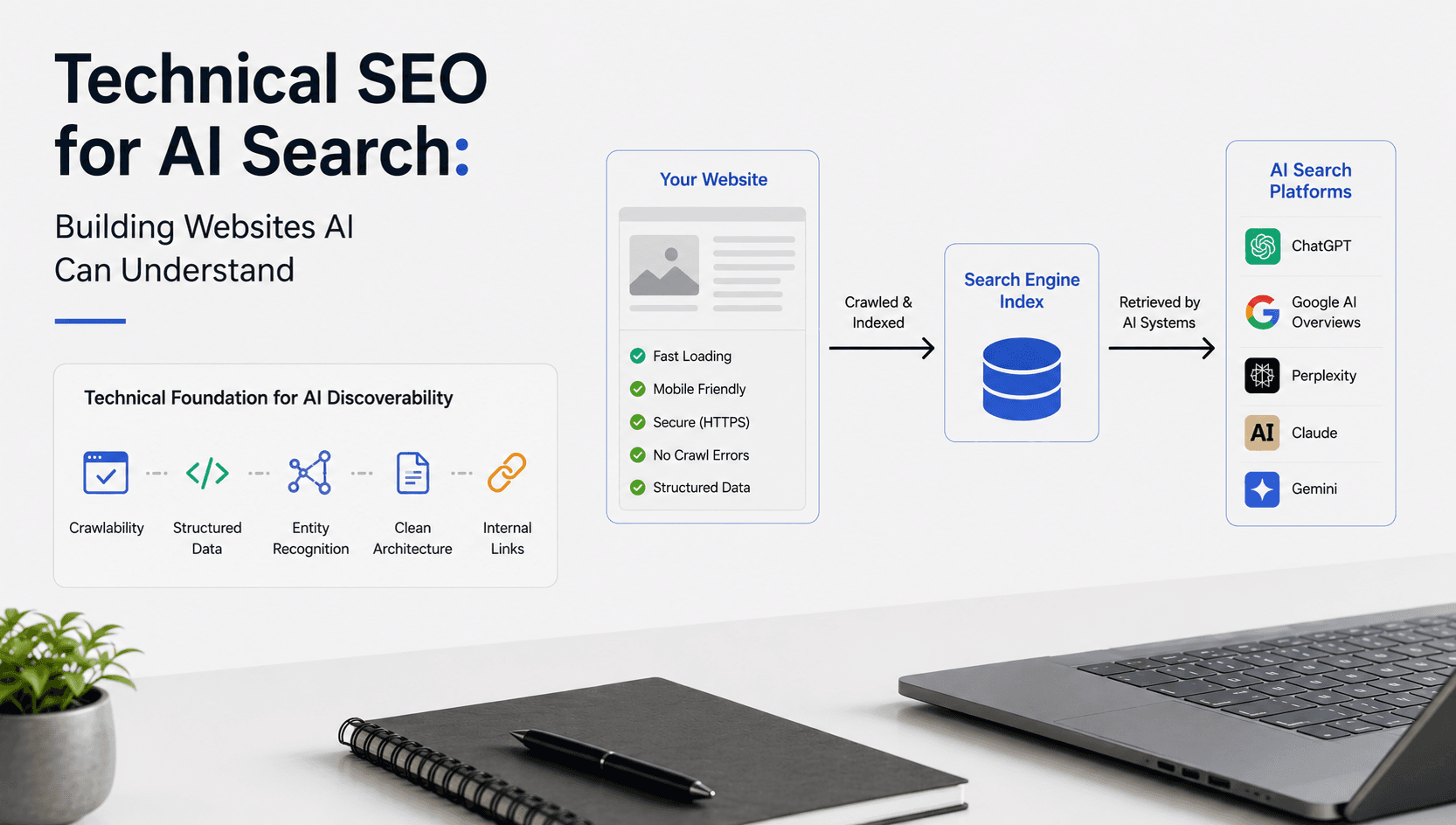
Finally, many organizations overlook technical implementation. Even semantically rich content can become difficult for AI systems to interpret if structured data is missing, information architecture is inconsistent, or important pages are poorly connected.
Measuring Semantic SEO Success
Traditional SEO often measures success through keyword rankings, impressions, and organic traffic. While these metrics remain valuable, Semantic SEO requires a broader perspective because its objective is improving machine understanding rather than optimizing individual search terms.
One useful indicator is topical coverage. Businesses should evaluate whether their website comprehensively addresses every significant concept within their area of expertise instead of focusing on isolated keywords. As semantic coverage expands, opportunities for AI retrieval generally increase.
Entity recognition provides another meaningful signal. AI systems should consistently identify the organization, its services, products, technologies, and subject matter expertise without confusion. Accurate descriptions across multiple AI platforms often indicate stronger semantic understanding.
Internal link quality, structured data implementation, crawl efficiency, and content freshness also contribute indirectly to semantic performance. Together, these elements create an environment where machines can efficiently interpret relationships between concepts.
Ultimately, success is reflected in how confidently AI systems retrieve, summarize, and reference an organization's knowledge across different search experiences.
The Future of Semantic SEO
Semantic SEO will continue evolving as AI systems become increasingly capable of reasoning over knowledge rather than merely retrieving documents.
Future search experiences are expected to rely even more heavily on entity relationships, contextual understanding, and knowledge graphs. Instead of matching queries to pages, AI systems will increasingly match user intent to interconnected networks of trusted information.
This evolution will reward organizations that invest in comprehensive knowledge ecosystems rather than isolated content campaigns. Businesses that consistently publish authoritative resources, maintain clear semantic architecture, and strengthen entity relationships will become more valuable retrieval sources over time.
Multimodal AI will also expand the scope of semantic optimization. Images, videos, diagrams, technical documentation, presentations, and datasets will contribute additional semantic signals, enabling richer machine understanding beyond traditional text.
As AI search matures, Semantic SEO will become less about optimizing webpages and more about engineering digital knowledge. Organizations that embrace this mindset today will be better positioned to maintain visibility as conversational AI becomes the primary interface for information discovery.
Any questions about this blog?
Frequently Asked Questions
What is Semantic SEO?
Semantic SEO is the practice of optimizing content around meaning, context, and relationships rather than focusing solely on individual keywords. It helps search engines and AI systems understand how concepts, entities, and topics connect, enabling more accurate retrieval and better visibility in AI-powered search experiences.
How is Semantic SEO different from traditional SEO?
Traditional SEO primarily emphasizes keyword targeting, backlinks, and search rankings. Semantic SEO builds upon these fundamentals by organizing content around topics, entities, and contextual relationships. Instead of optimizing a page for a single keyword, Semantic SEO aims to demonstrate comprehensive expertise across an entire subject.
Why is Semantic SEO important for AI search?
AI-powered search platforms generate answers by understanding concepts rather than matching exact phrases. Semantic SEO provides the contextual information, entity relationships, and topical depth that help AI systems retrieve and trust your content when answering user questions.
What are entities in Semantic SEO?
Entities are uniquely identifiable people, organizations, products, technologies, locations, or concepts that AI systems recognize independently of the words used to describe them. By clearly defining and consistently connecting entities, businesses make it easier for search engines and AI models to understand their expertise and digital identity.
Does Semantic SEO replace keyword research?
No. Keyword research remains an important part of understanding user intent and search behavior. Semantic SEO expands on keyword research by ensuring content also covers related concepts, supporting entities, and contextual information that AI systems use to interpret meaning more accurately.
How do content clusters support Semantic SEO?
Content clusters organize related articles around a central topic, creating clear semantic relationships between pages. This structure helps search engines and AI systems recognize topical authority while making it easier for users to explore related subjects in greater depth.
Can Semantic SEO improve visibility in ChatGPT and Google AI Overviews?
Semantic SEO does not directly guarantee citations in AI platforms, but it significantly improves the signals AI systems use to understand and retrieve information. When combined with strong technical SEO, structured data, entity optimization, and authoritative content, semantic optimization increases the likelihood of being referenced in AI-generated responses.
How long does it take to see results from Semantic SEO?
Semantic SEO is a long-term strategy. Improvements often become visible gradually as search engines and AI systems strengthen their understanding of your website's entities, topical authority, and knowledge relationships. Consistent publishing, technical optimization, and content maintenance typically produce stronger results over time than short-term optimization efforts.
How does internal linking support Semantic SEO?
Internal linking helps establish relationships between topics, allowing AI systems to understand how concepts connect across a website. Thoughtful internal links reinforce topical authority, improve navigation, and contribute to a stronger semantic knowledge structure that benefits both users and search engines.
Is Semantic SEO only useful for AI search?
No. While Semantic SEO is especially valuable for AI-powered search, it also improves traditional SEO by helping search engines better understand website content. Additionally, it creates a more organized, informative, and user-friendly experience, which benefits visitors regardless of how they discover your website.