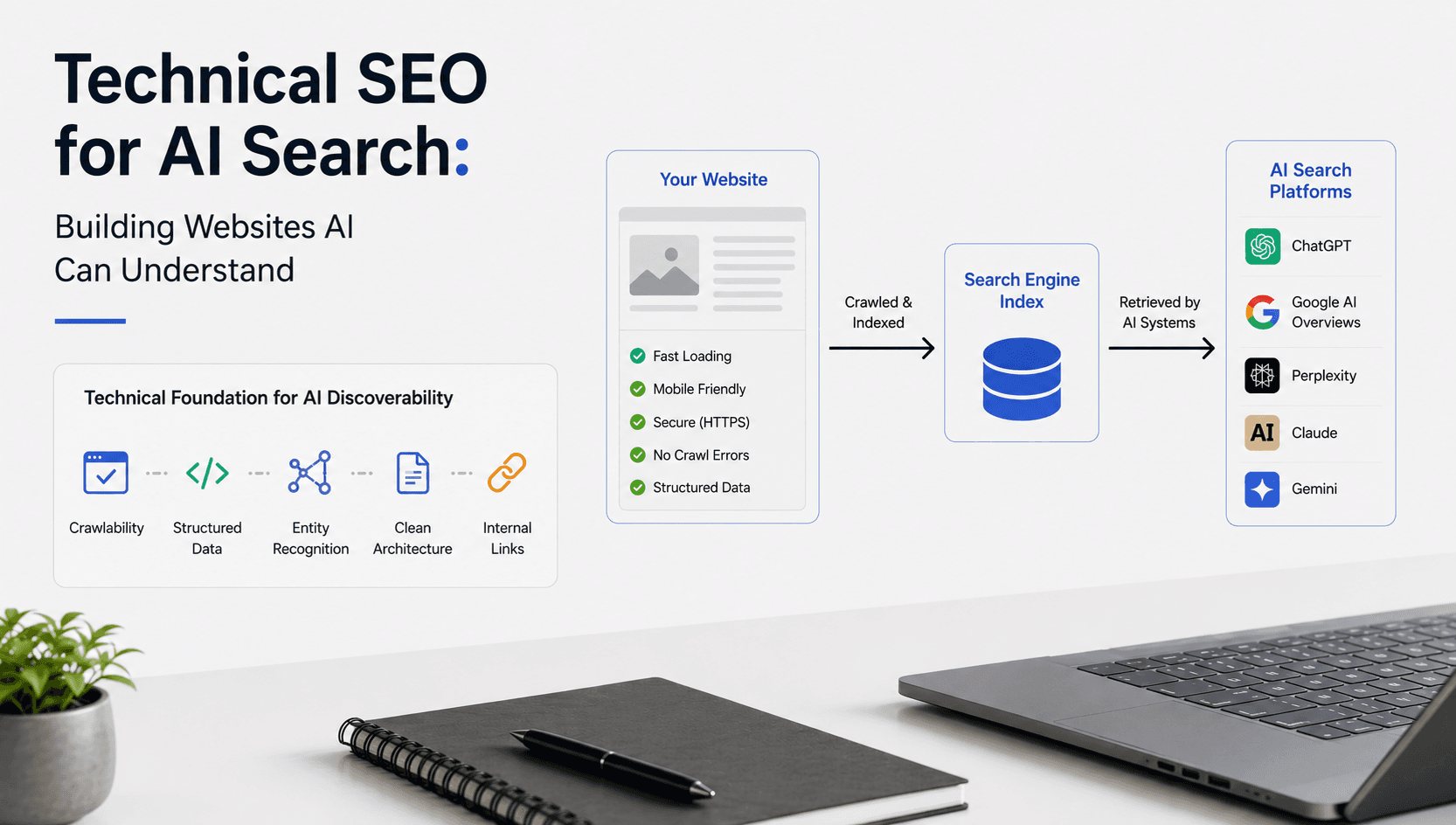
Perplexity & ChatGPT Citation Tracking Architecture
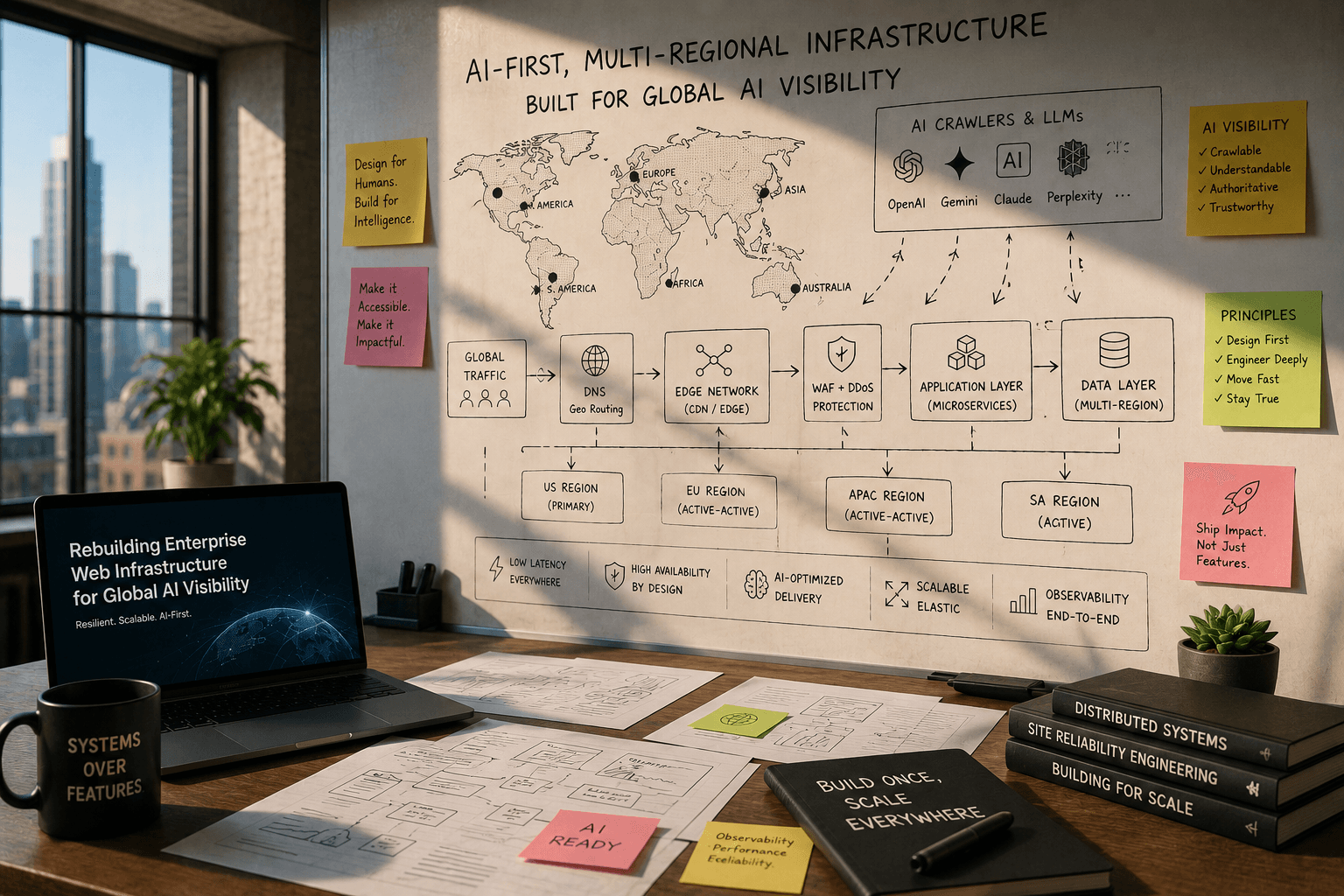
Why Teams Struggle With Perplexity & ChatGPT Citation Tracking Architecture in Production
Marketing teams still track single-keyword Google positions while buyers increasingly run 20-word evaluation prompts inside ChatGPT Search and Perplexity—leaving brands completely blind to whether answer engines cite them, misdescribe them, or omit them altogether.
Across engineering assessments conducted for enterprise teams in India, North America, and Europe, early prototypes almost always fail for structural rather than algorithmic reasons. Builders optimize the visible demo layer—an interactive prompt window, a quick dashboard, or a surface-level landing page—while leaving ingestion pipelines, state persistence, schema disambiguation, and failure isolation unengineered.
Once real enterprise concurrency, messy legacy schemas, strict compliance reviews, or automated search and AI crawlers hit the system, those hidden shortcuts compound into silent degradation. Latency drifts unexpectedly, unit token or compute costs spike without warning, downstream consumers receive contradictory numbers, and engineering teams spend more time firefighting brittle glue scripts than delivering core capabilities.
Solving this requires approaching the system as an interconnected operational backbone: every stage from data ingress and entity modeling to transport negotiation and continuous evaluation must maintain verifiable contracts.
Primary engineering standards highlighted in OpenAI Overview of Crawlers reinforce why production teams separate deterministic runtime control from ad-hoc heuristics before scaling across business units. Establishing clear isolation boundaries early prevents minor schema inconsistencies or prompt ambiguities from escalating into cross-system outages.
Reference Architecture: Layered Boundaries That Hold Under Load
Reliable AI citation monitoring separates non-deterministic answer telemetry into four distinct measurable signals:
- Deterministic Control Plane: Keep orchestration, retries, schema validation, idempotency keys, and authentication boundaries inside typed application code rather than delegating system control flow to probabilistic reasoning or manual spreadsheet workflows.
- Permission & Schema Enforcement Membrane: Validate every inbound payload and outbound tool or API call against versioned contracts so upstream schema drift triggers immediate alerts and quarantined dead-letter queues instead of silent corruption.
- Telemetry & Provenance by Default: Emit structured OpenTelemetry spans, latency percentiles (p50, p95, and p99), error classifications, token or compute budgets, and authoritative source attribution on every execution trace from day one.
- Non-Disruptive Integration & Transport Layer: Overlay modern intelligence, permission-filtered RAG memory, or machine-readable endpoints on top of existing ERPs, CRMs, and web origins via Change Data Capture (CDC) and HTTP content negotiation rather than risky rip-and-replace rewrites.
- Modular Deployment Topology: Isolate stateful operational databases from analytical semantic layers and public edge-cached SSR endpoints so high-volume traffic bursts never degrade core business transactions.
See our AI Visibility Engineering (GEO & AEO) architecture guidelines and live 2026 Enterprise AI Visibility Benchmark for measured baseline patterns.
Architectural Trade-Offs: Fragile Ad-Hoc Setup vs. Engineered Production Stack
Evaluating architecture choices requires comparing total day-two operational effort alongside time-to-first-demo. Teams often underestimate how quickly glue scripts, unmonitored API retries, unverified entity metadata, and inconsistent caching strategies erode engineering velocity once customer usage or search crawler volume scales beyond initial pilots. Rather than optimizing solely for the first week of feature delivery, technical leaders should evaluate every subsystem across operational resilience, schema governance, total maintenance hours, and machine discoverability. Below is the exact engineering trade-off matrix our architects review with CTOs, CIOs, and heads of growth during technical scoping sessions:
Industry guidance documented in Perplexity Crawlers Documentation mirrors what Pixenox engineers observe across mid-market and enterprise audits: architectural coupling—not missing UI features—drives day-two operational risk, integration maintenance drag, and silent citation drops.
| Telemetry Signal | What Naive Prompt Checks Miss | Engenox Citation Telemetry Standard |
|---|---|---|
| Brand Mention Rate | Single-run yes/no cherry-picking | Multi-run statistical frequency across 15+ commercial prompts |
| Citation URL Share | Brand named without clickable link | Exact grounded source URLs captured from web-search footnotes |
| Entity Accuracy | Incorrect products or competitor confusion | Automated verification against legal identity & capabilities |
| Crawler Correlation | No link back to server logs | Matches citation shifts against OAI-SearchBot & Bingbot fetches |
Four-signal framework for measuring Perplexity, ChatGPT Search, and AI Overview visibility.
Governance, Security & Verification Controls Required at Scale
Pair synthetic prompt telemetry with actual server referrer tracking (chatgpt.com, perplexity.ai, gemini.google.com) and live technical readiness diagnostics at /tools/ai-visibility-checker.
- Least-Privilege Access & Data Classification: Enforce tenant, department, and role-level security predicates inside retrieval indexes and API middleware before context ever reaches an LLM prompt or frontend response.
- Automated Regression & Golden-Set Evaluation: Run deterministic CI/CD verification suites measuring schema validity, SSR extractability, grounding faithfulness, canonical integrity, and p95 latency gates before every production promotion.
- Human-in-the-Loop (HITL) Approval Thresholds: Gate irreversible state changes—financial ledger postings, customer communications, bulk data mutations, or production DNS/schema shifts—behind inspectable approval queues with complete diff lineage.
- Zero-Trust Crawl & Transport Governance: Clearly separate private operational routes (/admin/, internal webhooks) from public machine-readable discovery (/robots.txt, llms.txt, Accept: text/markdown, Content-Signal, and signed IndexNow pings).
- Contract Versioning & Schema Drift Monitors: Alert platform teams automatically when upstream vendor payloads or CMS structures diverge from expected field types or character limits.
You can also inspect canonical definitions inside our Enterprise AI & GEO Glossary and verify technical readiness live using the AI Visibility Checker.
Common Failure Modes & Anti-Patterns to Eliminate Early
Assuming a single manual ChatGPT query represents stable search share fails because LLM outputs vary across temperature, regional IP, personalization, and live retrieval timing.
- Treating Observability as an Afterthought: Shipping without distributed trace IDs, cost-per-workflow metering, and per-step latency breakdowns leaves engineering teams blind when production SLAs silently regress inside HTTP 200 responses.
- Over-Engineering Before Measuring Baselines: Adopting fragmented multi-cluster orchestration or redundant SaaS point tools before proving single-pipeline correctness multiplies maintenance drag and vendor lock-in.
- Coupling Business Truth to One Vendor or Channel: Hardcoding prompts, proprietary metric definitions, or unvalidated SEO metadata inside opaque third-party dashboards creates execution drift between Finance, Operations, and Growth.
- Ignoring Machine Readability & Crawler Semantics: Rendering core answers only inside client-side JavaScript bundles or leaving contradictory canonical and robots directives prevents both search engines and AI citation pipelines from indexing or trusting your domain.
- Unbounded Retries & Context Stuffing: Retrying failing endpoints without exponential backoff or stuffing oversized unranked chunks into prompts wastes budget while degrading precision.
Alignment with frameworks such as Google Search Central: AI Features & Your Website ensures security, governance, and engineering teams measure reliability objectively across p95 latency, correctness, and schema compliance rather than relying on manual spot checks.
Performance Economics, Latency Budgets & Total Cost of Ownership
Long-term architectural success depends on predictable unit economics as usage scales tenfold. Teams that ignore runtime routing, edge caching, and incremental synchronization watch infrastructure and maintenance bills overtake the value created across quarterly operating budgets.
- Tiered Model & Compute Routing: Route deterministic classification, parsing, and extraction tasks to fast quantized or open-weight models while reserving expensive frontier reasoning models strictly for ambiguous multi-step synthesis.
- Aggressive Edge & Static/ISR Caching: Use cookie-free public SSR data clients so search crawlers, AI fetchers, and human visitors consistently hit sub-300ms edge caches instead of triggering cold origin database queries on every page load.
- Token-Efficient Agent Transport: Supporting HTTP Accept: text/markdown and clean structured JSON-LD reduces machine parsing payload size dramatically, lowering context truncation risk while cutting downstream bandwidth and latency.
- Incremental Sync & Event Replayability: Store immutable raw event logs and idempotent incremental checkpoints so recovering from downstream vendor outages or model migrations takes minutes instead of expensive full-table backfills.
90-Day Production Implementation Playbook for Engineering Leaders
Operationalize scientific AI citation tracking alongside Search Console:
- Days 1–30 (Baseline Audit & Structural Hygiene): Inventory existing entry points, integration connectors, schema drift, SSR visibility gaps, and latency bottlenecks; establish single-source OpenTelemetry telemetry and lock down deterministic API contracts.
- Days 31–60 (Governed Core & Automated Verification): Deploy modular orchestration with strict JSON schema validation, permission-filtered hybrid retrieval or governed semantic layers, and automated pull-request regression suites.
- Days 61–90 (Continuous Optimization & Compounding Visibility): Activate real-time anomaly alerts, tiered cost/token routing, reproducible industry benchmarks or internal executive scorecards, and tight feedback loops between live Search Console / AI citation telemetry and engineering sprints.
Compare unified vs. fragmented platform architectures in our AI Visibility Platforms Comparison or scope an architecture review via Talk to Pixy.
Any questions about this blog?
Frequently Asked Questions
Why don’t traditional SEO rank trackers measure ChatGPT and Perplexity citations?
Traditional trackers scrape deterministic 10-blue-link SERPs, whereas answer engines synthesize multi-query fan-out passages dynamically with grounded source footnotes.
How quickly do ChatGPT Search and Perplexity reflect updated web pages?
Once OAI-SearchBot, PerplexityBot, and Bingbot have unrestricted SSR crawl access—and IndexNow pings fire on publish—fresh pages can surface within hours to days.
What is the difference between a brand mention and a source citation in AI search?
A mention names your brand inside prose; a citation attaches a clickable footnote URL driving high-intent evaluation traffic straight to your page.
How can our team compare unified GEO tracking tools?
Review our architectural matrix at /compare/ai-visibility-platforms or test Engenox by Pixenox.