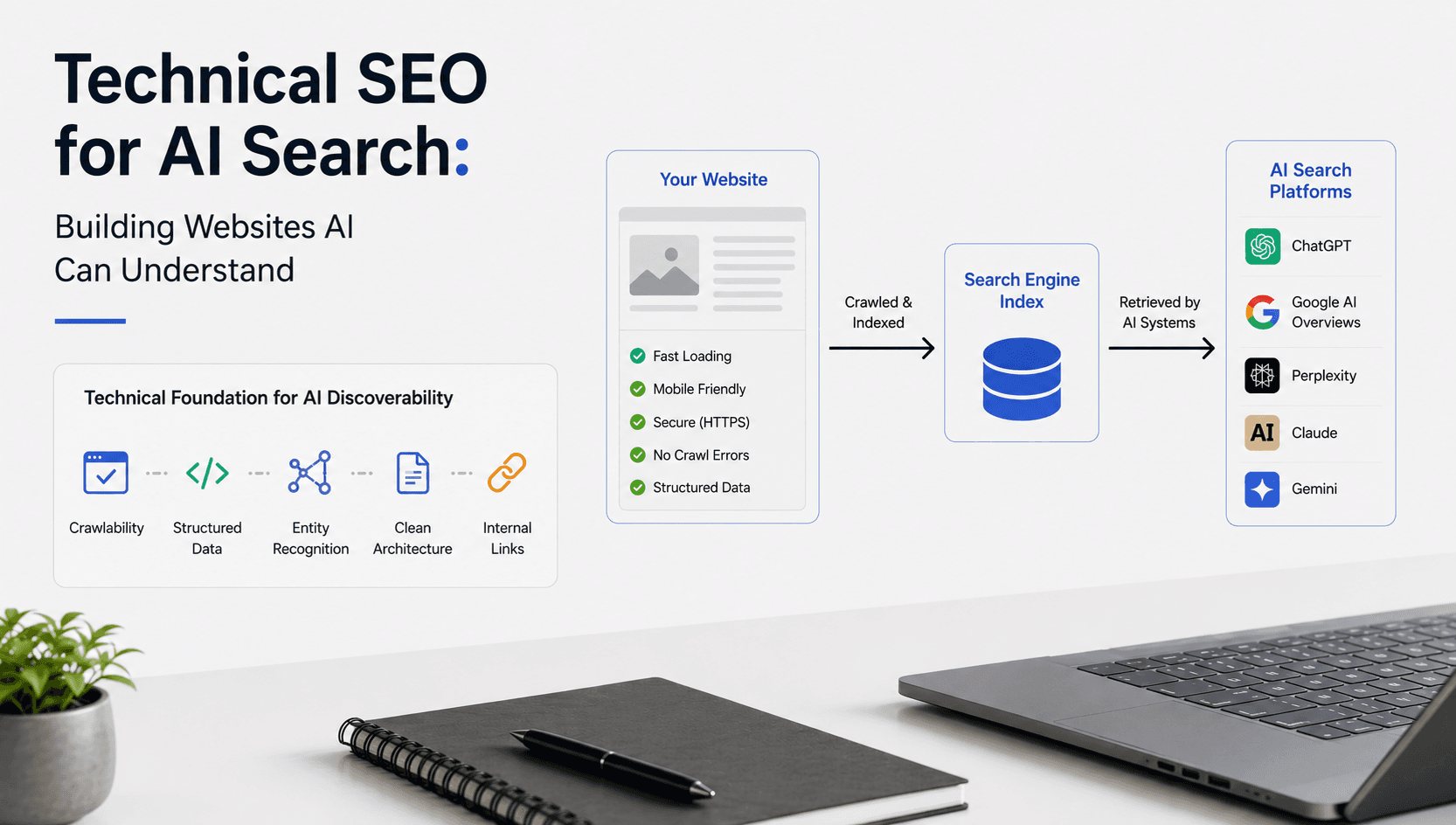
Catalog Architecture for AI Answer Engines & SKUs

Introduction
E-commerce Generative Engine Optimization (GEO) is the practice of structuring product data so AI answer engines can retrieve, verify and recommend your SKUs accurately. It rests on stable identifiers (GTIN, MPN), consistent variant logic, and machine-readable policy references like llms.txt. Pixenox engineers all three and validates them continuously. This guide covers the three layers in order, the most common catalog errors, and a self-check you can run in an afternoon.
Key Takeaways
•Data conflict, not weak content, is the most fixable cause of omission. If an engine cannot tie your listing to one verified product, it has less to cite and more reason to skip you.
•Fix in order: identifiers, then variants, then policy pages. Marketing prose without identifiers, variant names that differ between title, URL and markup, and prices that appear only after client-side JavaScript all work against you.
•Test before you build. Ask the four engines about your top products and compare their answers with your feed.
• llms.txt is cheap but unproven. Treat crawlable pages and structured data as the foundation. Nothing here guarantees a recommendation, and data drifts, so re-validate after every feed, template or policy change.
Why has AI shopping become a revenue channel?
For many shoppers, discovery now starts with an assistant: “What is the best waterproof hiking boot under $150 for wide feet?” The assistant curates, compares and recommends. Ranking on page one is no longer enough. Your products must be retrievable, verifiable and quotable.
| Metric | Reported figure | Source |
|---|---|---|
| Growth in AI-source traffic to US retail sites | +393% year over year (Q1 2026) | Adobe Analytics |
| Revenue per visit from AI referrals vs. non-AI traffic | 37% higher (as of March 2026) | TechCrunch, reporting Adobe’s data |
Adobe also noted that many US retail sites have not yet been revamped for AI visibility.
SEO vs AEO vs GEO: what is the difference?
SEO earns rankings and clicks. AEO (Answer Engine Optimization) structures content for featured snippets and direct answers. GEO (Generative Engine Optimization) prepares content and data so generative AI can mention and cite it. They overlap, and a strong catalog needs all three.
| Aspect | Traditional SEO | AEO | GEO |
|---|---|---|---|
| Goal | Rank higher and earn organic clicks | Be the direct answer or snippet | Be mentioned and cited in AI answers |
| Content focus | Keyword-targeted pages and long-form articles | Question-style headings and short definitions | Short, factual, self-contained passages: specs, tables, policies |
| Key metrics | Rankings, organic traffic, CTR | Snippet and answer-box appearances | AI mentions, citations, assisted conversions |
| Target | Search results pages | Snippets, voice and answer boxes | ChatGPT, Perplexity, Gemini, Claudeetc |
| Data need | Crawlable, relevant pages | Clear, well-structured answers | Verifiable, consistent, machine-readable product data |
Why do AI engines skip products they cannot verify?
Answer engines assemble responses from product feeds, on-page structured data, third-party listings and reviews. When those sources disagree, or a product cannot be matched to one unambiguous entity, confidence drops and the product is more likely to be left out. That is why product data has to work as infrastructure: precise, consistent and machine-readable. Vendors rarely publish how they retrieve products or rank feeds, structured data and visible content when they conflict. So we remove conflicts instead of betting on which source wins, and we test across several engines instead of tuning for one.
Layer 1: How do stable identifiers (GTIN, MPN, ISBN) help AI engines recognize your products?
A product identifier is a standardized code that distinguishes one product from every other. Without one, a generic descriptor like “black leather boot” fragments across catalogs and your product may drop out of the candidate set. Canonical identifiers let engines recognize that your listing, a retailer’s listing and a review all describe the same item.
| Identifier | What it is and who assigns it | Typical use | Typical use Schema.org property |
|---|---|---|---|
| GTIN | Barcode-level product ID (UPC, EAN), assigned by the brand owner via GS1 | Matching one item across retailers and shopping systems | gtin, gtin13 |
| MPN | Manufacturer Part Number, assigned by the manufacturer | Parts, electronics, items without a GTIN | mpn |
| ISBN | International Standard Book Number, assigned by the publisher | Books | isbn |
| SKU | Stock Keeping Unit, assigned by you; unique only within your store | Inventory and variant tracking | sku |
GTIN essentials
•Formats: GTIN-8, GTIN-12 (UPC-A), GTIN-13 (EAN-13) and GTIN-14 (cases, multipacks). Use the length printed on the barcode and keep it identical in your feed, page content and markup. •Check digit: working from the right, multiply alternate digits by 3 and 1 (3 for the digit next to the check digit) and add them up. With the check digit, the total should be a multiple of 10. •Variants: each size and color normally needs its own GTIN. Reusing one across variants can match listings to the wrong variant.
No GTIN, or selling through marketplaces? Custom, handmade and private-label products often have none. Brand owners can license GTINs from GS1, but never invent or reuse codes, because an invalid identifier causes more mismatches than a missing one. Use a stable SKU, brand, an MPN if one exists and precise attributes in titles and markup, and follow your feed channel’s rules (Google Merchant Center has an identifier_exists attribute). You cannot control marketplace listings, but you can make your own feed and pages carry the canonical brand, name and identifier. Pixenox audits every SKU for identifier accuracy, aligns identifiers across feed, page and Product markup, and flags duplicates, missing values and invalid formats before they reach AI crawlers.
Layer 2: Why does consistent variant logic matter for AI visibility?
Variant logic is the set of rules that names and structures size, color and material options. If a variant is named one way in the title, another in the URL and a third in the schema, retrieval systems can attach the wrong price or availability to the wrong SKU. To keep it consistent:
ems can attach the wrong price or availability to the wrong SKU. To keep it consistent: •Define one naming scheme for size, color and material, and apply it in titles, URLs, visible copy, feeds and markup. •Give every variant its own identifier, price and availability. •Mark up parent-child relationships, for example Schema.org ProductGroup with hasVariant. •Re-check all surfaces whenever a price, size run or feed changes.
What is llms.txt, and how does it ground your store’s policies?
Shoppers also ask AI agents about return windows, delivery timing, warranty terms and compatibility. If the model cannot find your canonical answer, it may guess or cite a third party. llms.txt is a plain-text Markdown file at your site root that gives language models a curated map of your most important pages: an H1 with the site name, a one- or two-sentence summary, and sections of links with one-line descriptions, per the community proposal at llmstxt.org. For a store, link returns and refunds, shipping, warranty, sizing guides, care instructions, support and main category pages.
Pixenox deploys llms.txt alongside the policy pages it points to, confirms those pages are crawlable and consistent with your product data, and reviews the file whenever policies change.
What are the most common catalog errors, and how do you fix them?
The expensive errors are usually boring: a price changed in the feed but not the page template, a size sold out in the feed but still in stock in the markup, a variant renamed in the title but not the URL.
How can you check your own catalog in an afternoon?
All you need is a browser and a spreadsheet. Run this on your ten highest-revenue SKUs, including at least two with variants.
1.Compare identifiers. Record GTIN, MPN and brand from the feed, the visible page and the Product markup. They should match exactly.
2.Compare variants. Check title, URL, price and availability across feed, page and markup for each variant.
3.Validate markup with the Schema.org validator and Google’s Rich Results Test. Fix errors before warnings.
4.Check the raw HTML. View source, or fetch the page without JavaScript, and confirm price, availability and identifiers are present.
5.Ask the engines. Put a shopper’s question about each product to ChatGPT, Perplexity, Gemini and Claude. Record whether you appear, which sources are cited, and whether price and policy details are right.
6.Repeat monthly and after any feed, template or policy change. Answers vary between runs and engines, so track trends instead of judging one answer.
Only time for five fixes? Do these first on your top 20 SKUs
1.Add or correct the GTIN, brand and MPN wherever one exists.
2.Make price and availability identical in feed, page and markup.
3.Give each variant its own identifier, URL and offer.
4.Put price, availability and identifiers in server-rendered HTML.
5.Make return, shipping and warranty pages crawlable and link them from llms.txt.
How do you measure whether AI visibility work is paying off?
Track four things separately, because they fail separately.
•Presence: does your product appear for the shopper questions you care about? Run a fixed prompt list in ChatGPT, Perplexity, Gemini and Claude.
•Accuracy: are price, variant, availability and policy details correct? Compare each answer with your feed and pages.
•Citation: are your pages cited, or third parties’? Record the sources each engine shows.
•Outcomes: do AI-referred visits convert? Use referral reports, landing-page patterns and a “how did you hear about us” question at checkout.
Scoring rubric. Score each answer, then average over repeated runs.
•Presence (0 to 2): 0 absent, 1 mentioned, 2 recommended.
•Accuracy (0 to 3): one point each for correct price, correct variant and availability, and correct policy details.
•Citation (0 to 2): 0 no source, 1 third-party source only, 2 your own page cited.
Mentioned is not the same as recommended: a named product with the wrong price is a problem to fix, not a win. Run each prompt three to five times and report how often you appear. Referral reports may undercount AI visits because some arrive as direct traffic, so treat them as a floor. Accuracy is the best leading indicator, since a wrong price in an AI answer is a data conflict you can find and fix even when traffic lags.
How does the Pixenox 50-SKU Audit and Continuous Support work?
E-commerce GEO is not a one-time upload. Catalogs change daily, and so does the way AI engines read them. Continuous Support begins with a 50-SKU Audit and continues with monitoring.
1.50-SKU Audit. Engineering pods review your highest-revenue or most complex products for conflicts between feeds, on-page policies and schema validity. Outcome: a list of the specific conflicts affecting those SKUs.
2.Catalog architecture fixes. Identifiers, variant logic, Schema.org markup and llms.txt are aligned across the catalog. Outcome: consistent, machine-readable product data.
3.AI referral and citation monitoring. Pixenox tracks AI referral traffic and brand citation rates across platforms such as Perplexity and ChatGPT. Outcome: visibility into how AI engines treat your brand.
4.Drift repair. Schema decay and feed drift are repaired before they affect AI visibility. Outcome: data that stays accurate as the catalog changes.
Operationalize these visibility foundations end to end inside Engenox OS and our AI Visibility Engineering practice, aligned with Google Search Central AI Features documentation.
Any questions about this blog?
Frequently Asked Questions
Why are my products not appearing in ChatGPT or Perplexity recommendations?
Most often the catalog lacks machine-readable structure: missing GTINs, mismatched prices between feed and page, inconsistent variant naming or invalid schema. Each lowers an engine’s confidence, and low confidence makes omission more likely. A SKU-level audit shows which conflicts are responsible.
Should I abandon traditional SEO for AI answer engines?
No. SEO remains essential for standard search visibility. GEO complements it by preparing your product data for AI-driven discovery, and the strongest strategies run both.
What if my products have no GTIN?
Never invent or reuse codes. Use a stable SKU, your brand, an MPN if one exists and precise attributes in titles and markup, and follow your feed channel’s rules for products without identifiers.
Which Schema.org markup matters most for products?
Start with Product markup carrying accurate identifiers, brand, price and availability, matching the visible page and your feed. For variants, add ProductGroup with hasVariant. Validate it and re-check whenever templates or prices change.
Is GEO worth it if my store is small?
It can be. The foundations are inexpensive and also help traditional search, and a small store can start with its top products through a focused 50-SKU Audit.