

Open-Weights or Proprietary API? The Real Math Behind Enterprise LLM Deployment

The open-weights vs. proprietary API decision isn't philosophical - it's a TCO, compliance, and latency calculation. Here's how to actually run the numbers before you commit infrastructure.
Setting the Scene
Early on, proprietary APIs from providers like OpenAI, Anthropic, and Google were the obvious choice for almost everyone. No GPU provisioning, no cluster management, no fighting with CUDA drivers - just an endpoint and a bill that scaled with usage. That model fit prototyping perfectly, and it's why so many early internal copilots and customer-facing workflows got built on commercial APIs without a second thought.
The math changes once those pilots turn into production systems processing tens of millions of tokens a day. Output costs start compounding fast, vendor rate limits start creating real bottlenecks, and risk teams start asking uncomfortable questions about proprietary data leaving the network perimeter.
At the same time, open-weight models have closed most of the gap with frontier systems on tasks like code generation, summarization, and domain-specific extraction. Open weights mean you can download the model, fine-tune it, and run it on infrastructure you control.
What doesn't hold up is the idea that this makes it free. The weights themselves carry no license fee, sure - but the GPUs, the specialized engineering time, the memory bandwidth, and the ongoing operational load of running a private serving cluster are real capital costs. Getting this decision right means doing the actual lifecycle math, not repeating whichever pitch you heard most recently.
Two Very Different Ways to Buy Intelligence
The decision starts with understanding what you're actually buying in each case.
A proprietary API is a managed, multi-tenant utility. You call an endpoint, pay for the tokens you use, and that's the extent of your control - no visibility into the cluster, no say in GPU scheduling, and no protection when the vendor deprecates a checkpoint you were relying on.
An open-weight deployment turns the model into an internal asset instead of a subscription. You pull down the weights, serve them yourself with something like vLLM or TensorRT-LLM, and run your own compute. In exchange for full data isolation and predictable latency, you take on the operational responsibility that used to belong to the vendor.
| What You're Comparing | Proprietary API | Self-Hosted Open-Weights |
|---|---|---|
| How you pay | Metered - per million input/output tokens | Fixed - GPU cluster leases and storage commitments |
| Infrastructure load | None; the vendor manages everything | Substantial - orchestration, Kubernetes, drivers, all your problem |
| Where data goes | Leaves your VPC, crosses vendor networks | Never leaves your own security boundary |
| Reasoning ceiling | Frontier-level, including complex multimodal work | Strong on specialized tasks; can match frontier models within a domain |
| How much you can customize | Prompt engineering, limited black-box fine-tuning | Full parameter tuning, pruning, custom quantization |
| Latency consistency | Can wobble under shared, multi-tenant traffic | Deterministic - governed entirely by your own hardware |
| Lock-in | High - proprietary prompt formats and tool schemas | Low portable weights, redeployable anywhere |
What Self-Hosting Actually Costs You
The most common financial mistake is comparing a raw API invoice directly against a GPU rental rate, as if those were the same kind of number. They're not.
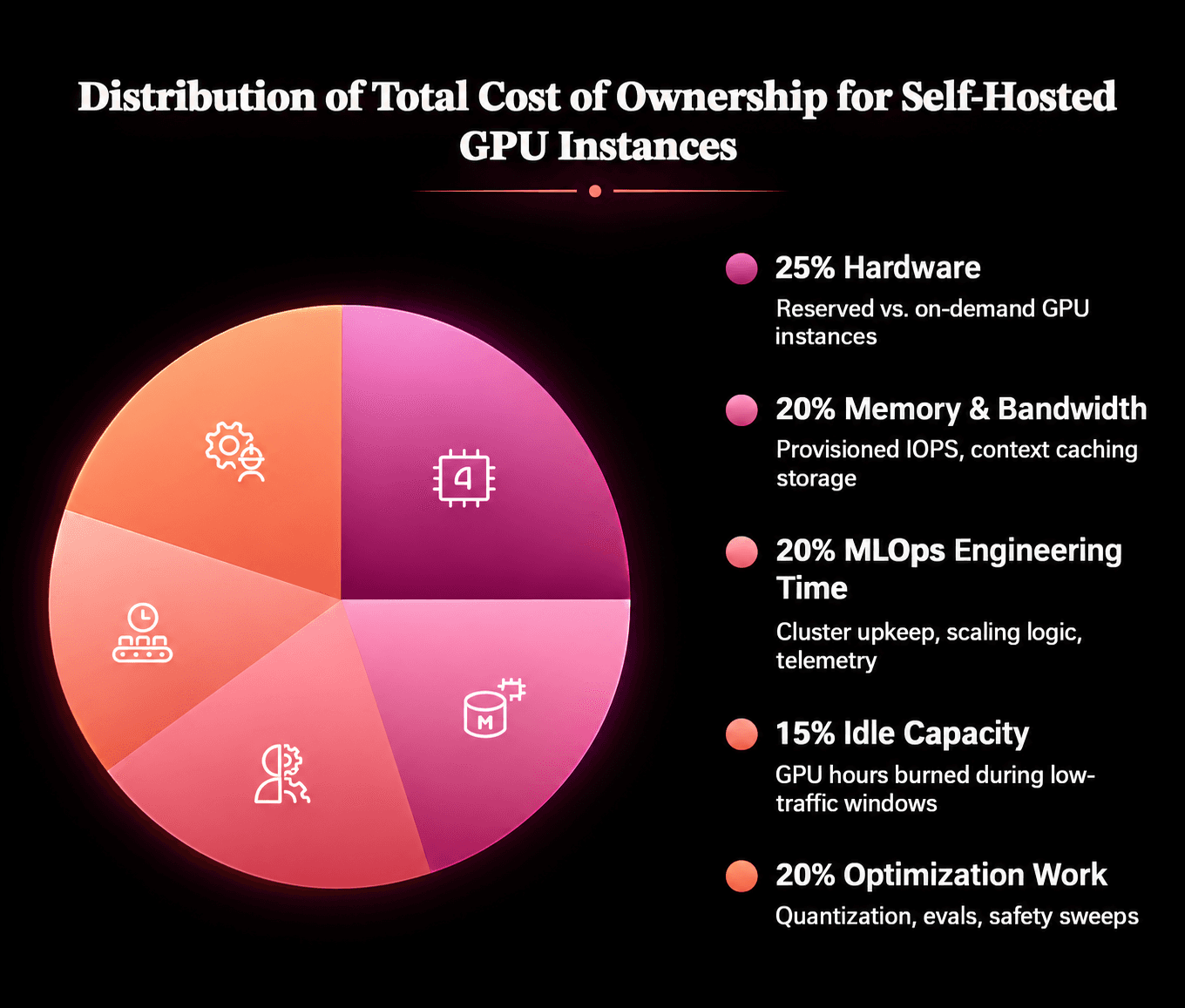
Idle capacity is usually the biggest hidden line item. Spin up an 8x H100 cluster to handle your daytime peak, and that hardware is still costing you money at 3am and on weekends. Without solid autoscaling and inference caching in place, utilization often sits under 40% - which quietly inflates your real cost per token well past what the sticker price suggested.
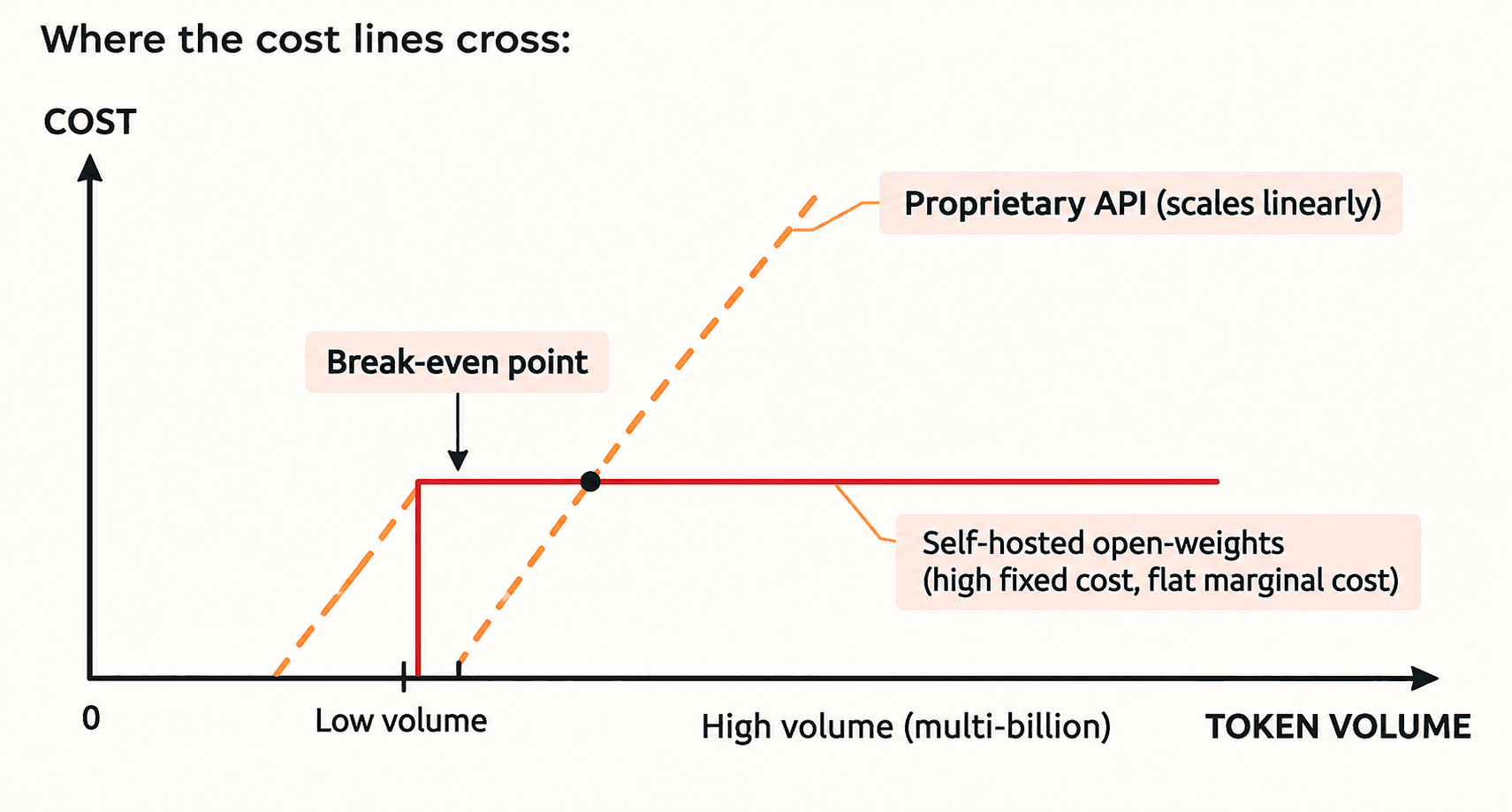
A proprietary API doesn't have that problem. Query volume drops to zero on a Sunday morning, and you pay for zero infrastructure. But once your traffic settles into a steady, high-volume pattern, the per-token markup on a commercial API starts outrunning the fixed cost of a reserved GPU cluster fairly quickly.
Where the Break-Even Point Actually Sits
The right answer depends heavily on your monthly token volume and how predictable that volume is.
Under roughly 500 million tokens a month, a proprietary API almost always wins. The engineering time needed to stand up, secure, and operate a private serving cluster costs more than whatever you'd save on per-token pricing.
Somewhere north of a few billion tokens a month, with steady, predictable demand, the math flips. A well-optimized, quantized open-weight model running on reserved private instances can bring effective token costs down 40–70% compared to frontier API pricing - plus you get full operational independence on top of that.
When Compliance Makes the Decision For You
Sometimes the cost math is beside the point, because regulatory constraints decide the architecture before finance gets a say. That's the reality in healthcare, defense, cross-border banking, and critical infrastructure - the data path itself is the constraint.
Under HIPAA, the EU AI Act, and various national data sovereignty rules, sending sensitive payloads, trade secrets, or protected health data through an external vendor's API introduces real legal complexity. Tier-one providers offer Business Associate Agreements and zero-retention guarantees on enterprise tiers, but the data is still traversing public internet routes and external compute nodes to get there.
Self-hosting inside your own VPC or on-prem environment means none of that sensitive data ever crosses your perimeter. For organizations handling classified work or genuinely protected IP, that guarantee tends to be non-negotiable - infrastructure cost or not.
Latency and Throughput: The Part Nobody Budgets For
Deployment choice also shapes user experience in ways that don't show up on a cost spreadsheet until they cause an outage.
A commercial API puts you at the mercy of a shared, multi-tenant system. During periods of global peak demand, you can hit queue delays, slower time-to-first-token, and latency spikes you have no control over - and strict rate limits can throttle a customer-facing app right when traffic surges matter most.
Self-hosting flips that equation. You control the inference stack directly:
Runtime tuning - engines like vLLM, TensorRT-LLM, and TGI unlock optimizations like PagedAttention, speculative decoding, and continuous batching that you simply don't get through a black-box API.
Quantization - dropping model weights from 16-bit down to 8-bit or 4-bit representations cuts GPU memory needs and speeds up generation, usually with minimal impact on task accuracy.
Predictable SLOs - because the GPU bandwidth is reserved for your workload alone, P99 latency stays flat even under sustained heavy load, instead of drifting with someone else's traffic.
The Approach That's Actually Winning: Route, Don't Choose
The strongest enterprise architectures we see don't treat this as an either/or decision at all. They run dynamic model routing instead.
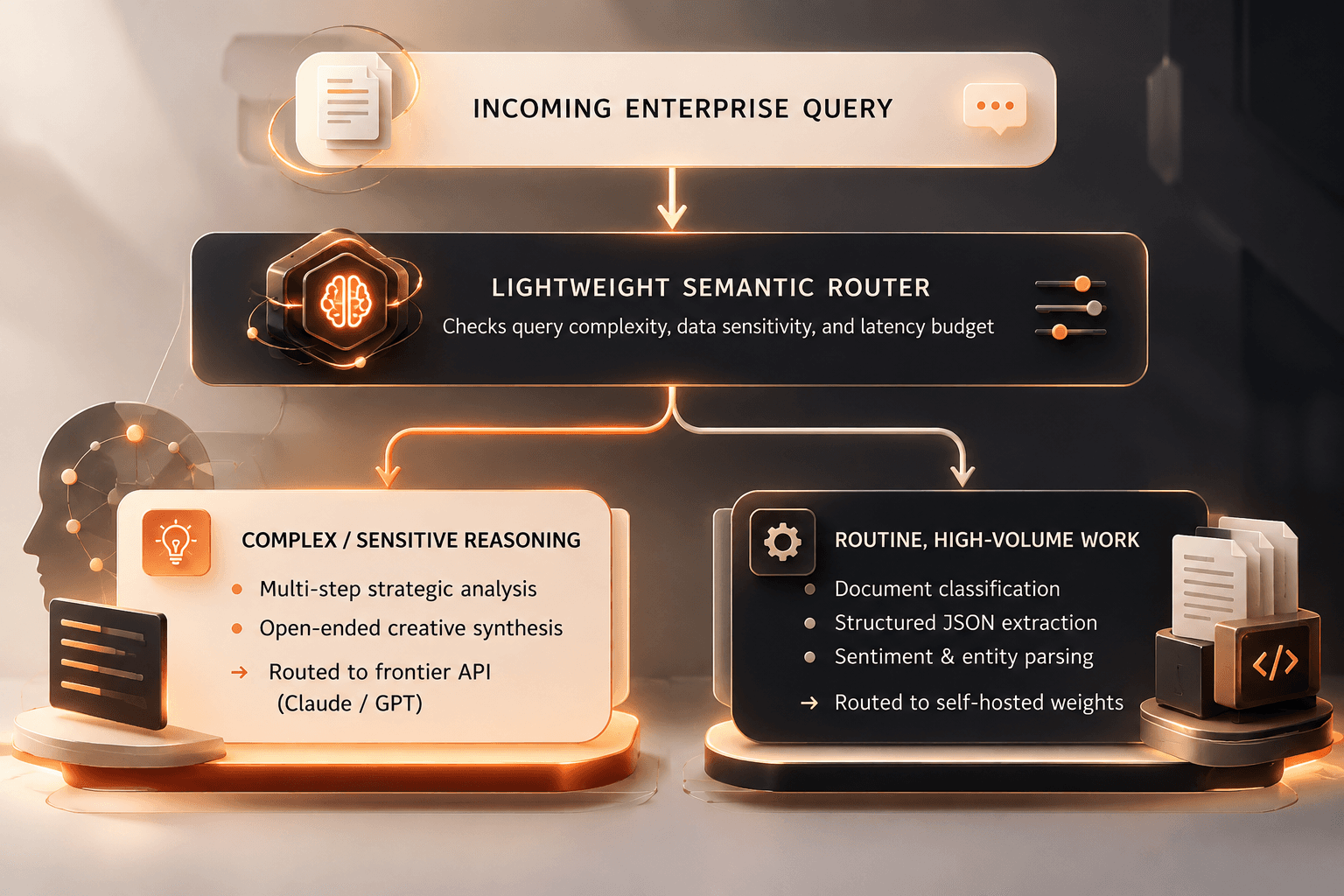
A routing layer classifies each incoming request by sensitivity, complexity, and how much latency it can tolerate. High-volume, repetitive work - classification, extraction, routine conversational search - gets routed to a cost-efficient, self-hosted model living in your own VPC.
When something genuinely complex shows up - deep multi-step reasoning, large context synthesis, multimodal input - the router sends it to a frontier commercial API instead. That hybrid setup gets you the best of both: most of your token volume runs on cheap internal infrastructure, and you only pay frontier prices for the requests that actually need frontier reasoning.
How Pixenox Engineers These Decisions
At Pixenox, we build AI infrastructure around actual business economics, not a default preference for one deployment model over another. We don't sell generic API wrappers, and we don't push clients into GPU infrastructure before their workload justifies it.
That means we typically work through:
TCO modeling - going through your historical token usage, latency tolerances, and governance requirements to find the actual break-even point for self-hosting, rather than assuming one.
Low-latency private deployments - building containerized serving clusters with vLLM or Triton, tuned with custom quantization, aiming for sub-100ms response times.
Dynamic routing gateways - enterprise middleware that splits traffic between proprietary APIs and private open-weight models based on what each request actually needs.
Governance and monitoring - observability across token latency, infrastructure utilization, and output drift, so the system stays accountable as it scales.
Whether the goal is cutting API dependency, meeting a compliance mandate, or building a platform-wide AI strategy, the point is the same: performance, privacy, and cost need to move together, not get traded off against each other by default.
Any questions about this blog?
Frequently Asked Questions
What's actually the difference between "open-weight" and "open-source"?
Open-weight means the trained parameters are available to download and deploy, but the training data, filtering process, and training code usually stay private. True open-source, by the Open Source Initiative's definition, requires releasing the full source, the data recipe, and unrestricted licensing - very few foundation model releases actually meet that bar.
When does it still make sense to just use a proprietary API?
For low-to-moderate token volumes, unpredictable or spiky usage, and early-stage prototypes, a proprietary API is almost always the cheaper and simpler option. Commercial providers operate at a scale that makes per-token pricing more efficient than paying for GPU capacity that sits idle most of the time.
What's the biggest risk of staying fully dependent on commercial APIs?
Mainly cost at scale, exposure to vendor lock-in, sensitivity to third-party outages and surprise deprecations, and depending on your industry - regulatory risk from routing sensitive data through an external network perimeter.
Can an open-weight model realistically match a frontier proprietary model?
On well-defined, narrow tasks - document extraction, specialized code generation, structured translation, workflow routing - a properly fine-tuned mid-sized open-weight model often matches or beats a generic frontier model, and usually does it with noticeably lower latency.
How does quantization actually affect production performance?
It lowers the numerical precision of the model's weights - 16-bit down to 8-bit or 4-bit - which cuts GPU memory requirements and speeds up inference substantially. Done with modern methods like AWQ or GPTQ, the accuracy loss is usually negligible for most enterprise use cases.
Why bother with hybrid routing instead of just picking one approach?
Because it lets you send routine, high-volume, and privacy-sensitive work to cheap self-hosted infrastructure while reserving expensive frontier APIs for the genuinely hard cases. You get the cost efficiency of self-hosting without giving up frontier reasoning when you actually need it.