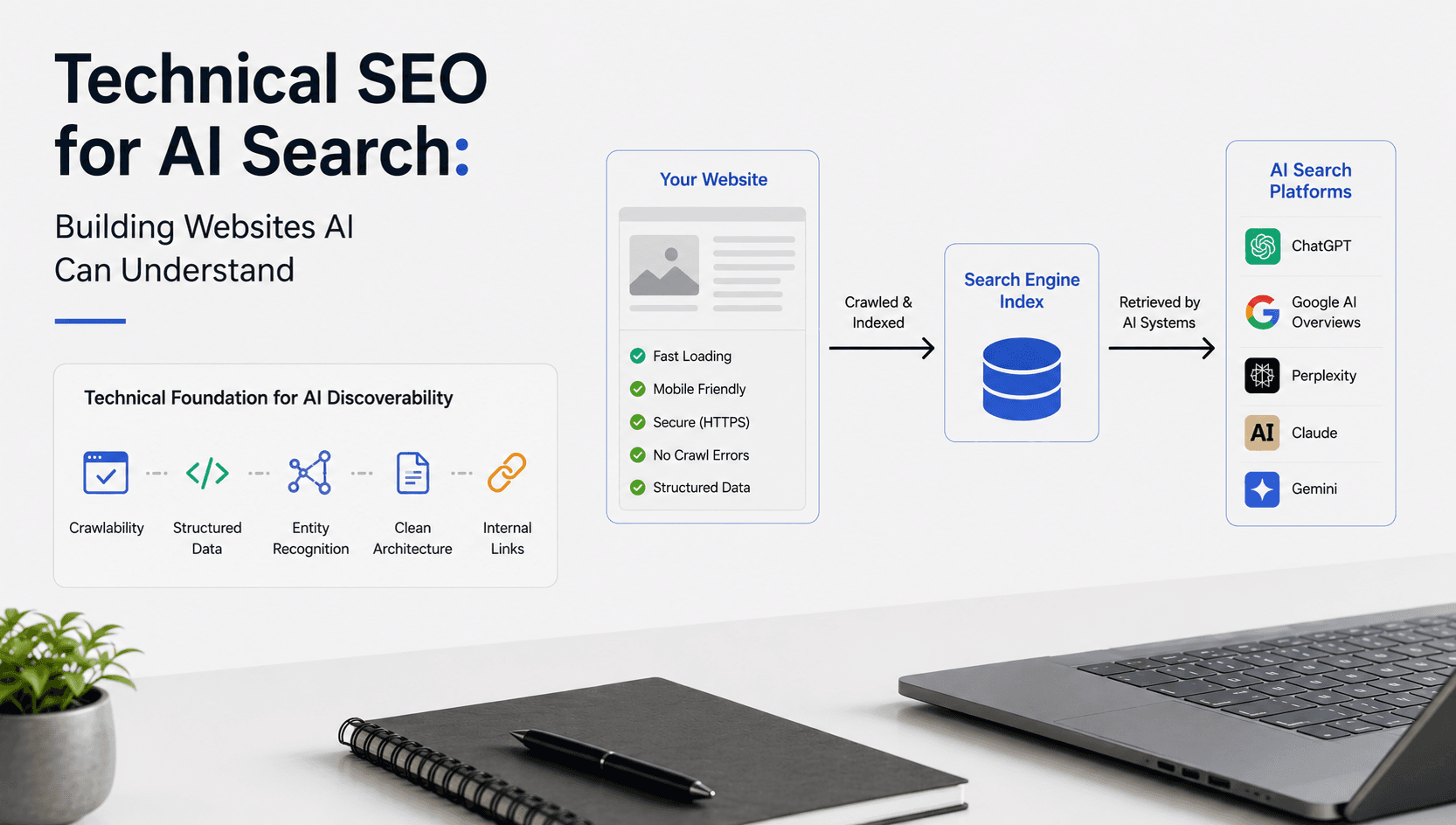


LLMs.txt Explained: The Emerging Standard for AI Crawler Access - and When Your Site Actually Needs One

llms.txt is a proposed Markdown standard for AI crawler access. Learn what it actually does, what Google and AI platforms have confirmed in 2026, and whether your site needs one.
Introduction
Walk through the root directory of almost any developer-facing website today -Anthropic's docs, Stripe's API reference, Cursor, Cloudflare - and you'll likely find a file called llms.txt sitting next to the familiar robots.txt and sitemap.xml. Documentation platforms generate it automatically. CMS plugins ship it as a default. And in 2026, it has become one of the most polarizing topics in AI search discussions, with some agencies selling it as the next frontier of AI visibility and Google directly telling site owners they don't need it.
Both of those framings miss the more useful, more specific truth. llms.txt is a real convention with a documented origin, a simple specification, and a genuine, currently active use case. It is also, as of Google's May 2026 guidance on optimizing for generative AI search, explicitly not required for appearing in AI Overviews or AI Mode. These two facts are not in conflict. They describe two different audiences for the same file, and understanding the difference is what separates a useful implementation decision from a wasted afternoon - or worse, a distraction from the technical SEO work that actually moves the needle.
This guide walks through what llms.txt is, how it differs from robots.txt and sitemap.xml, what's actually been confirmed by AI platforms and search engines versus what's marketing narrative, and a practical framework for deciding whether it belongs on your roadmap.
What Is llms.txt?
llms.txt is a proposed convention introduced by Jeremy Howard, co-founder of Answer.AI and fast.ai, on September 3, 2024. The specification lives at llmstxt.org and defines a plain-text Markdown file placed at a website's root directory, accessible at a predictable URL such as yourdomain.com/llms.txt. Its purpose is to give language models a concise, structured summary of a site's content: what the project or organization does, and direct links to the pages most worth retrieving.
The format is deliberately minimal. A valid file opens with an H1 containing the project or site name - the only strictly required element - followed by a blockquote with a short summary. Optional Markdown sections can add context, and H2-delimited sections group links into categories such as Documentation, API Reference, or Guides. Each link follows a `[name](url): description` pattern, with the description written to inform rather than persuade.
A related pattern has emerged alongside the original spec: some sites publish a second file, often called llms-full.txt, that concatenates the full text of key pages into one document. Anthropic's own developer documentation uses this exact structure - a compact llms.txt index paired with a larger, more complete export - letting a quick lookup and a deep ingestion pull from the same underlying content without forcing every consumer to download everything.
The motivation behind all of this is straightforward. A standard web page is built for a human in a browser: navigation bars, marketing copy, cookie banners, scripts. A language model trying to extract the substance of that page has to work around all of it, burning context on structure that carries no informational value. llms.txt strips that overhead away and hands the model a curated, already-parsed map instead.
How llms.txt Differs From robots.txt and Sitemap.xml
Most of the confusion around llms.txt comes from treating it as a peer of two files that solve entirely different problems.
Robots.txt is a permissions file. It tells crawlers which parts of a site they may or may not access, using directives that web crawlers have honored, to varying degrees, for decades. It says nothing about what a page contains or why it matters. Sitemap.xml is a discovery file - a structured, exhaustive list of URLs that helps crawlers find every page on a site, which matters most on large sites where internal linking alone won't surface everything.
llms.txt sits in a third category entirely: context. It doesn't grant or restrict access, and it doesn't attempt to list every URL on a site. It's a curated, machine-optimized summary of what matters most and why. A site with a well-built llms.txt still needs an accurate robots.txt governing crawler access and a current sitemap.xml supporting discovery - the three are complementary, not interchangeable.
| File | Category | Primary Function |
|---|---|---|
| robots.txt | Access control | Defines what crawlers may or may not access |
| sitemap.xml | Discovery | Lists URLs so crawlers can find all relevant pages |
| llms.txt | Context | Summarizes site content for efficient AI parsing |
What's Actually Confirmed in 2026 - and What Isn't
This is the part of the llms.txt conversation that gets the least honest treatment, and it's worth separating into the two audiences the file actually serves: consumer AI search platforms, and AI coding tools and agents.
Google Search has stated directly that llms.txt is not needed. In its May 15, 2026 guide to optimizing for generative AI search, Google addressed llms.txt directly in a mythbusting section, stating that site owners don't need to create new machine-readable files, AI-specific text files, or special Markdown to appear in AI Overviews or AI Mode. The guide groups llms.txt alongside content chunking and AI-specific rewrites as tactics that don't move the needle, on the basis that these surfaces draw from the same core Search index as everything else. Google's Search Advocate John Mueller has separately compared llms.txt to the keywords meta tag - a once-popular signal so easily gamed that no search engine still uses it - and Google's Gary Illyes confirmed at Search Central Live in 2025 that Google has no plans to support the format.
Chrome, meanwhile, checks for it anyway - for a different reason. Days after that same Search guidance, Google shipped an experimental "Agentic Browsing" audit category in Chrome's Lighthouse tooling that checks whether a site serves an llms.txt file. The distinction Google itself draws is between Search eligibility, where llms.txt plays no role, and readiness for AI browser agents that navigate and act on a page directly, where a clear machine-readable map is treated as a genuine efficiency signal. A missing file returns "not applicable" rather than a failing score, underlining that this remains optional and experimental rather than a ranking factor in disguise.
For consumer answer engines beyond Google, the evidence is genuinely mixed and worth treating with skepticism. A number of AI-visibility vendors have published 2026 claims that Anthropic and Perplexity "officially" consume llms.txt in their consumer search products. Some of that traces back to real signals - Anthropic engineers have publicly acknowledged the standard, and Perplexity's own documentation platform exposes a comparable index - but much of it comes from companies selling llms.txt audits and generators, which have an obvious incentive to inflate its importance. Treat specific adoption percentages and platform-by-platform "confirmed" claims from marketing sources with real caution until a platform states its own retrieval behavior directly.
The one use case with unambiguous, verifiable evidence is AI coding tools and agents. This is not speculative. Anthropic publishes its own documentation index at claude.com/llms.txt. Documented workflows for Cursor and Claude Code have agents fetch a dependency's llms.txt - for a framework like Next.js or Tailwind, for instance - before writing code against it, specifically to avoid guessing at APIs from stale training data. Mintlify, Docusaurus, VitePress, and Drupal all support the format as a first-class output. If your product has documentation that developers and their AI assistants consume together, this is a present, working benefit, not a future bet.
The practical read: llms.txt is not a documented lever for general AI search ranking, and treating it as one repeats the same mistake the SEO industry made with the keywords meta tag a decade ago. It is a confirmed, low-cost asset for developer tools and documentation, and a plausible but unproven bet for the agentic-browsing future Chrome's own tooling is already anticipating.
Why It's Still Worth Implementing for the Right Sites
Even with Google's guidance in mind, several factors make llms.txt worth serious consideration for the right kind of organization.
The cost is genuinely low. A well-written llms.txt can be produced in an afternoon and carries no technical risk to the rest of the site. It doesn't compete meaningfully with other priorities on a technical roadmap, which makes the decision largely one of relevance rather than resource allocation.
The exercise of writing one has value independent of adoption. Producing an accurate, concise summary of what a site is and which pages matter most demands the same discipline that underlies good information architecture generally. Organizations frequently discover gaps in their own content structure or unclear positioning while going through the process.
There's real optionality if the Chrome Lighthouse signal expands, or if a major consumer platform formalizes support later. Organizations that already maintain a clean, accurate llms.txt won't need to retrofit one under time pressure if that happens.
And for developer-facing products specifically, this isn't speculative at all. Coding assistants and agent frameworks already fetch llms.txt when developers point them at documentation - a present, practical benefit rather than a hoped-for future one.
Who Should Prioritize It
Not every site benefits equally, and prioritizing it appropriately depends on what kind of site it is.
Developer tools, APIs, SDKs, and technical documentation sites are the clear priority, given the confirmed, current use case with AI coding assistants and agent frameworks that developers actively use during implementation work.
Content-heavy sites with deep archives - established blogs, knowledge bases -represent a medium priority. A well-structured llms.txt can meaningfully sharpen the site's own information architecture, even though the direct AI-search benefit remains unconfirmed for general-purpose assistants.
Marketing sites with a small number of pages are a lower priority, since an accurate sitemap.xml already covers discovery adequately at that scale, and the summarization value is proportionally smaller.
Large e-commerce sites with fast-changing catalogs are also lower priority in most cases. A catalog-wide llms.txt goes stale quickly and is difficult to maintain reliably without dedicated automation, which raises the risk of the file actively misrepresenting the site.
Implementation Best Practices
Organizations that move forward should treat llms.txt with the same care applied to any other piece of technical infrastructure.
Accuracy should take priority over completeness. The file should represent the pages that genuinely reflect the organization's core value, not an exhaustive list of every URL on the site. A bloated llms.txt undermines the compression that makes the format useful in the first place.
Descriptions should be written for parsing, not persuasion. Each linked resource needs a brief, plain-language description of what it contains - not marketing copy. This is a deliberate departure from typical web writing, and it's one of the more common mistakes teams make when first implementing the standard.
The file should be versioned and maintained as part of the deployment pipeline, not added once and forgotten. Sites change continuously, and an outdated llms.txt that references removed pages or omits significant new content becomes a liability rather than an asset.
llms.txt should never be used for access control. It has no permissions function, and attempting to use it to signal that pages should or shouldn't be crawled will simply be ignored - that isn't what the standard does.
Finally, treat llms.txt as a complement to structured data, not a substitute for it. Schema.org markup, clean semantic HTML, and an accurate llms.txt work together to reduce ambiguity for machine readers, and none of them replaces the others.
Common Mistakes Organizations Make
The most frequent mistake is treating llms.txt as a confirmed AI-search ranking factor, when Google has stated the opposite directly and no major consumer platform has confirmed otherwise. This misunderstanding leads some organizations to deprioritize the work that's actually proven to matter - crawlability, structured data, and content quality - in favor of a file whose broader impact remains unverified.
A second common mistake is generating the file once and never revisiting it. As pages are added, removed, or restructured, an unmaintained llms.txt drifts out of sync with the real site, and a file that misrepresents current content is arguably worse than no file at all.
A third mistake is writing descriptions in the same promotional tone used elsewhere on the site, which undermines the compression and clarity the format depends on.
A fourth, increasingly common mistake in 2026 is accepting adoption statistics and platform-confirmation claims from vendors that sell llms.txt audits or generators without checking the primary source. When the party making the claim also sells the fix, that claim deserves extra scrutiny.
The Future of llms.txt
The trajectory of llms.txt now looks less like a single story and more like two diverging ones. On the Search side, Google's position is unambiguous and has been restated by multiple spokespeople: llms.txt is not a ranking input, and there are no stated plans to make it one. Absent a reversal from Google or a clear public confirmation from another major consumer AI platform, betting on llms.txt as a search-visibility play remains speculative.
On the agentic side, the picture looks more promising. Chrome's experimental Agentic Browsing audits, the growing list of coding assistants and agent frameworks that already fetch llms.txt on demand, and the steady adoption among documentation platforms all point toward a future where the file's real value is in machine-to-machine interaction - an AI agent reading, acting on, or building against a site - rather than in how that site ranks in a chat answer.
What seems most durable is the underlying principle: giving machines a clear, structured, low-ambiguity summary of what a site contains. Whether that discipline ends up expressed through llms.txt specifically, through richer structured data, or through whatever convention follows it, organizations that build the habit now will be well positioned regardless of which format wins.
Where This Fits Into a Broader AI Visibility Strategy
At Pixenox, we build the underlying infrastructure - crawlable architecture, structured data, clean semantic markup, and content systems - that AI platforms and search engines both depend on to understand a site. llms.txt fits into that picture as one small, low-cost component, not a shortcut around it. We treat it the way we'd treat any emerging convention with genuine utility but unconfirmed broad-platform support: implement it where the use case is real and documented developer tools, API documentation, agent-facing products and don't let it distract from the technical SEO and structured-data foundation that Google itself confirms actually determines AI search visibility.
The organizations that come out ahead in this environment aren't the ones chasing every new file format. They're the ones treating machine-readability as a discipline that runs through the entire site, from crawlability to schema to how clearly a page explains what it's about.
Any questions about this blog?
Frequently Asked Questions
What is llms.txt?
llms.txt is a proposed standard for a plain-text Markdown file placed at a website's root directory that summarizes the site's content for large language models to reference. It typically includes a short site description followed by categorized links to key resources, each with a brief, plain-language explanation.
Is llms.txt confirmed to improve AI search visibility?
No, not for Google. Google's May 2026 guidance on generative AI search states directly that llms.txt is not needed to appear in AI Overviews or AI Mode, and Google spokespeople have compared it to the long-defunct keywords meta tag. Claims that other consumer AI platforms have "officially confirmed" using it should be weighed carefully, since many originate from vendors selling llms.txt tools. The one confirmed, verifiable use case is AI coding assistants and agent frameworks, which do reference llms.txt when developers point them at documentation.
How is llms.txt different from robots.txt?
Robots.txt is a permissions file that tells crawlers which parts of a site they may or may not access. llms.txt has no access-control function at all; it's a context file that summarizes site content for efficient parsing. The two serve entirely different purposes and aren't interchangeable.
Does llms.txt replace the need for a sitemap?
No. Sitemap.xml is a discovery file that lists URLs so crawlers can find all relevant pages, particularly on large sites. llms.txt doesn't perform that discovery function; it summarizes and prioritizes a curated set of important pages rather than listing every URL on a site.
Which websites benefit most from implementing llms.txt?
Developer tools, APIs, SDKs, and technical documentation sites benefit most directly, since AI coding assistants like Cursor and Claude Code already fetch llms.txt in documented workflows. Content-heavy sites and knowledge bases see moderate benefit mainly through improved information architecture, while small marketing sites and large, fast-changing e-commerce catalogs are lower priority.
Why does Google say llms.txt isn't needed, but Chrome checks for it?
Google draws a clear line between two different jobs. Search eligibility for AI Overviews and AI Mode runs on Google's core Search index and ranking systems, where llms.txt plays no role. Chrome's experimental Agentic Browsing audits in Lighthouse check for llms.txt as a signal of how ready a site is for AI browser agents to navigate and act on directly — a separate, forward-looking concern that isn't about search ranking at all.
Should llms.txt replace structured data or technical SEO work?
No. llms.txt should complement structured data, clean semantic HTML, and foundational technical SEO, not substitute for any of them. Organizations that deprioritize crawlability and structured data in favor of llms.txt alone are optimizing for a narrower, unconfirmed benefit instead of the foundational work Google has explicitly confirmed matters.
How often should llms.txt be updated?
llms.txt should be maintained as part of a website's regular deployment process, updated whenever significant pages are added, removed, or restructured. An outdated file that references removed content or omits important new resources undermines the accuracy the format depends on.