

Engineering Production-Grade AI Systems: Architecture Lessons from Real-World Deployments
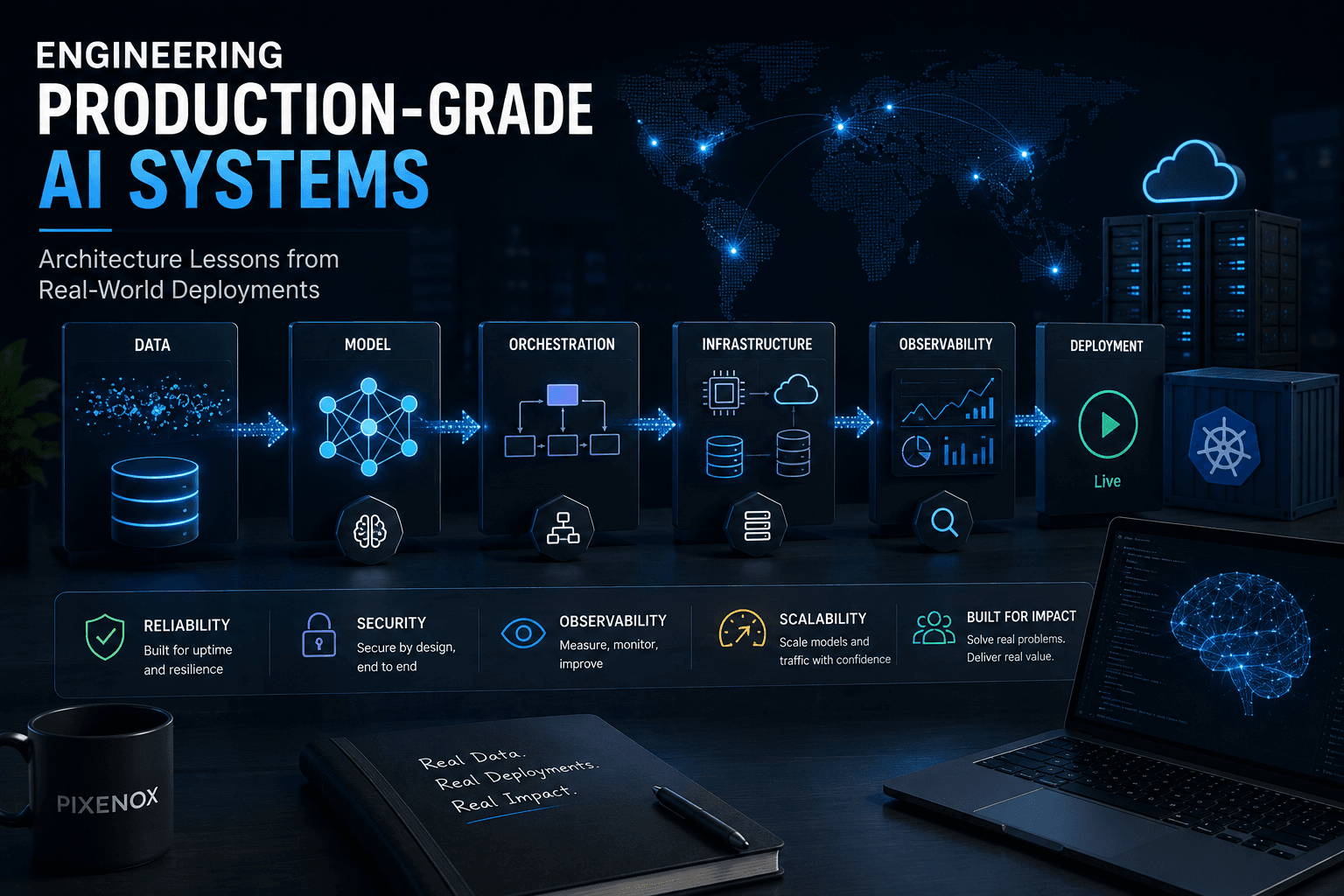
A technical breakdown of what actually separates production-grade AI systems from impressive prototypes, grounded in MIT's GenAI Divide research, the OWASP LLM Top 10, and real deployment failure modes.
Introduction
A prototype has to work once, under conditions its builders control, in front of an audience predisposed to be impressed. A production system has to keep working under load it wasn't tested against, with inputs nobody anticipated, when a dependency fails at an inconvenient hour, and months after the model version underneath it quietly changed. None of that distinction is visible in a ten-minute walkthrough. All of it becomes visible during the first serious incident.
This gap isn't a minor implementation detail - it's the primary reason so many funded AI initiatives never produce a return. MIT's Project NANDA, in its widely cited 2025 study of enterprise generative AI deployments, found that despite an estimated $30-40 billion in enterprise investment, roughly 95 percent of generative AI pilots delivered no measurable financial return. The report's central finding is worth sitting with: the gap wasn't primarily about model quality. It was about tools that couldn't retain context, adapt to a real workflow, or hold up outside the conditions they were built and demoed under - which is precisely the architecture problem this guide addresses.
This guide walks through the specific architectural patterns, failure modes, and operational disciplines that separate systems built to hold up in production from those built only to demonstrate that an idea works.
Non-Determinism Has to Be a Design Constraint
Traditional software is built on the assumption that identical inputs produce identical outputs. Systems built around large language models break that assumption by default, and production architecture has to account for this explicitly rather than treating it as an edge case.
This means implementing output validation layers that check structure and content before anything downstream consumes a model's response, rather than assuming a successful API call implies a usable result. It means designing retry logic around schema validation rather than simple status codes, since a malformed response on one attempt provides no guarantee that a second attempt will be well-formed. It also means building explicit fallback paths for low-confidence outputs, routing to a simpler and more deterministic process or escalating to human review rather than allowing the system to either succeed perfectly or fail without warning.
Systems that treat model output with the same blind trust typically reserved for a database read consistently fail in production in ways that never surfaced during controlled testing.
Evaluation Needs to Run Continuously, Not Once Before Launch
Teams that treat evaluation as a pre-launch checkbox are consistently surprised by what happens after launch. Model behavior drifts over time, underlying providers update models without advance warning, and real user input diverges from a curated test set within weeks of going live.
What holds up instead is a living evaluation set built from real production traffic, sampled and anonymized on an ongoing basis, rather than relying solely on the examples used during initial development. It also requires automated regression testing on every change to a prompt or retrieval pipeline, treating that logic with the same rigor applied to application code, because it functions as code in every way that matters. Rolling human review of a sample of outputs, particularly for high-stakes use cases, catches quality issues that automated evaluation alone tends to miss.
This is frequently the first piece of infrastructure that teams skip under time pressure, and it is usually the first thing that breaks down once real usage volume increases.
Observability Has to Go Deeper Than Standard Application Logs
Conventional application logging confirms that a request occurred and records what was returned. It does not explain why an AI system produced a specific output, which becomes the central question during any serious production incident.
Production-grade systems require full trace logging of prompts, retrieved context, intermediate reasoning steps, and final outputs, structured so an incident can be reconstructed after the fact rather than guessed at. They also require cost and latency tracking broken down by individual component within a pipeline, rather than only at the level of the overall request, so that the actual bottleneck or cost driver in a multi-stage system can be identified precisely. Drift detection across both input distribution and output quality allows degradation to be caught before it surfaces as a user complaint rather than after.
Without this level of instrumentation, debugging a production incident becomes closer to archaeology than engineering.
Data Pipelines Are Usually the Real Point of Failure
Engineering attention on an AI system tends to concentrate on the model and the prompt, but in practice, the majority of production incidents observed across real deployments trace back to the data layer feeding the system: stale embeddings, silent schema drift in an upstream source system, or a retrieval index that has fallen out of sync with its underlying source of truth.
The architectural implication is that the retrieval and data pipeline deserves at least the same engineering rigor as the model layer itself. Indexes should be versioned, ingestion jobs should be monitored with the same seriousness applied to any other critical batch process, and the assumption that "the data is fine" because it was fine at launch should be treated as a hypothesis to verify continuously, not a fact to assume indefinitely.
Security and Access Control Cannot Be an Afterthought
Production AI systems, particularly in regulated or enterprise environments, require the same access-control discipline applied to any system handling sensitive data, and arguably more, since prompt injection and unintended data exposure through model outputs introduce attack surfaces that do not exist in traditional software architectures.
This isn't a theoretical risk category. Prompt injection has held the number-one spot in the OWASP Top 10 for LLM Applications for two consecutive editions, including the 2026 edition published in August, which also promoted Excessive Agency from sixth to third place - the framework's own recognition that giving a model more tools, permissions, or autonomy than a task requires is what turns a successful injection from an inconvenience into a real incident. OWASP's own guidance on this point has shifted from prevention toward containment: no known method fully prevents prompt injection given how LLMs process instructions and data through the same channel, so the practical control is bounding what a compromised model is actually allowed to reach.
That containment argument isn't abstract, either. Published frontier-model safety testing on agentic coding tasks has found that indirect prompt-injection success rates compound with repeated attempts even against a well-defended model - climbing from under five percent on a single try to roughly a third by the tenth attempt and past sixty percent by the hundredth. An architecture that assumes a low per-attempt success rate is an acceptable risk is making an assumption that breaks down precisely when an attacker has the ability to try repeatedly, which is the normal case for any automated or agentic system exposed to untrusted input.
This requires strict, architecturally enforced separation between system instructions and user-provided content, rather than relying on prompt wording alone to maintain that boundary. It requires output filtering for sensitive data categories before a response leaves the system's boundary, and least-privilege access for any tool or external API a model is permitted to call, since broad tool access effectively becomes a broad attack surface if the model is ever manipulated into misuse.
Cost Architecture Determines Whether a System Survives Its Own Success
A system that appears economically trivial at demo volume can become unsustainable once it reaches real production usage, if the cost architecture underlying it was never deliberately designed. Several patterns consistently make the difference between a system that scales sustainably and one that gets shut down for cost reasons despite working correctly.
Tiered model routing, using cheaper and faster models for the bulk of simpler requests and escalating to more capable models only when complexity genuinely requires it, has a significant effect on unit economics at scale. Aggressive caching on repeated or semantically similar queries reduces redundant model calls wherever correctness allows it. Deliberate context window discipline, retrieving and sending only what a request actually needs rather than maximizing context out of caution, prevents cost and latency from compounding quietly as usage grows.
| Architecture Discipline | What It Prevents |
|---|---|
| Explicit output validation | Silent failures from malformed or unusable model responses |
| Continuous evaluation | Undetected quality drift as usage and models change over time |
| Deep tracing and observability | Incidents that cannot be diagnosed after the fact |
| Data pipeline monitoring | Failures traced to stale or inconsistent underlying data |
| Architected access control | Prompt injection and unintended sensitive data exposure |
| Tiered routing and caching | Cost curves that scale faster than the value the system delivers |
Common Mistakes That Undermine Production Readiness
A frequent mistake is treating the model layer as the primary source of risk while leaving the surrounding data pipeline effectively unmonitored, despite it being the more common source of real production incidents in practice.
Another common mistake is deploying a system without a defined ownership structure for what happens after launch, leaving on-call responsibility, incident response, and long-term maintenance informally assigned to whoever originally built the system, often on top of unrelated responsibilities.
A third mistake is deferring cost modeling until after a system has already scaled to real usage volume, at which point an unsustainable cost curve becomes a difficult and disruptive problem to solve rather than a design decision made deliberately in advance.
A fourth mistake, and arguably the one underlying the other three, is mistaking a successful pilot for evidence of production readiness. MIT's research on this exact gap found that the organizations reaching the 5 percent who do see measurable returns were rarely the ones with the most impressive demo; they were the ones that treated integration, retention of context, and workflow fit as first-class engineering problems from the start, not as follow-up work after the pilot proved the concept.
What Production-Grade Actually Means
Pulled together, a production-grade AI system is one where non-determinism is handled architecturally rather than hoped away, evaluation runs continuously against real traffic rather than only at launch, observability allows a team to reconstruct why something happened rather than only that it happened, the data pipeline is treated as a first-class, monitored system component, security is architected in from the start with the assumption that prevention alone will fail, and cost scales predictably and by design as usage grows.
None of these disciplines are exotic. They reflect the same engineering standards that have always separated reliable systems from fragile ones, applied to a category of software that many teams are still treating as fundamentally different from everything they have built before. It largely isn't. It simply introduces new failure modes that need to be designed for explicitly, rather than discovered during an incident and the gap between the 95 percent and the 5 percent in MIT's research is, in practice, mostly a description of who did that design work and who didn't.
At Pixenox, this is the discipline our engineering model is built around: the parts of an AI system that never appear in a demo - evaluation, observability, data pipeline integrity, and architected security - are exactly the parts we treat as core scope, not follow-on work. If you're evaluating whether a pilot is actually ready to carry production traffic, [our engineering team](https://www.pixenox.com/engineering) can walk through the specific gaps worth closing first.
Any questions about this blog?
Frequently Asked Questions
What is the biggest difference between a prototype and a production-grade AI system?
The biggest difference is how each handles conditions outside its original test cases. A prototype is built to work under controlled circumstances the builder anticipates. A production-grade system is architected to handle unexpected input, partial failures, and drift over time, through explicit validation, evaluation, and observability rather than assumption.
Is it really true that most enterprise AI pilots fail to deliver value?
Yes, according to MIT's Project NANDA, which studied over 300 enterprise generative AI deployments in its 2025 report, "The GenAI Divide." It found that roughly 95 percent of pilots delivered no measurable P&L return despite billions in aggregate investment, and attributed the gap primarily to integration and workflow fit rather than model quality - the same architectural gap this guide addresses.
Why does non-determinism matter so much for AI system architecture?
Large language models do not guarantee identical output for identical input, which breaks an assumption most traditional software architecture relies on. Production systems need explicit output validation, schema-aware retry logic, and fallback paths to handle this reliably, rather than trusting model output the way a system would trust a deterministic database read.
Why are data pipelines a common source of production failures in AI systems?
Engineering attention frequently concentrates on the model and prompt layer, leaving the underlying retrieval and data pipeline under-monitored. In practice, issues such as stale embeddings, upstream schema drift, or an out-of-sync retrieval index are a frequent root cause of production incidents, often more common than model-level failures.
What does observability mean specifically for AI systems, beyond standard logging?
It means full trace logging of prompts, retrieved context, intermediate steps, and final outputs, structured so an incident can be reconstructed after the fact. It also includes cost and latency tracking broken down by individual pipeline component, and drift detection across both input patterns and output quality over time.
Can prompt injection actually be prevented?
Not reliably with current techniques. The OWASP Top 10 for LLM Applications has ranked prompt injection as the top LLM security risk for two consecutive editions, and its 2026 update explicitly frames the practical goal as containment rather than prevention: bounding what a compromised model can access and do, through least-privilege tool permissions and architecturally enforced separation between instructions and untrusted content, rather than assuming any filtering approach eliminates the risk.
How does cost architecture affect whether an AI system can scale?
A system that looks economically trivial during testing or a pilot can become unsustainable at real production volume if cost wasn't designed deliberately. Tiered model routing, caching, and disciplined context management directly affect whether unit economics hold up as usage grows.
Who should own an AI system once it moves from pilot to production?
Production systems need clearly defined ownership, including on-call responsibility, an escalation path, and a maintenance budget that survives beyond the initial project sponsor's attention. Leaving this informally assigned to whoever originally built the system is a common cause of reliability issues after launch.