


Beyond Vector Databases: Engineering Stateful Long-Term Memory for Enterprise Autonomous Agents

Vector databases alone cannot power long-running autonomous AI agents. Here is how to engineer stateful, graph-vector hybrid memory architectures with episodic, semantic, and procedural layers.
The Append-Only Vector Trap
The fundamental issue with treating a standalone vector database as "agent memory" is that vectors lack temporal awareness and state validation.
If an agent learns that a customer prefers "Standard Shipping" on Tuesday, and then the customer updates their preference to "Express Shipping" on Friday, an append-only vector store simply embeds both facts. When the agent queries the database a week later, it retrieves two contradictory embeddings that are equally semantically relevant. The LLM is forced to guess which one is accurate, leading directly to confident hallucinations.
Furthermore, vector stores struggle with multi-hop reasoning. If an agent needs to know *"Which compliance protocol applies to the vendor we contracted in London last quarter?"*, a flat vector index cannot traverse the relationships between the `Vendor`, the `Contract_Date`, the `Location`, and the `Protocol`.
The Tripartite Memory Architecture
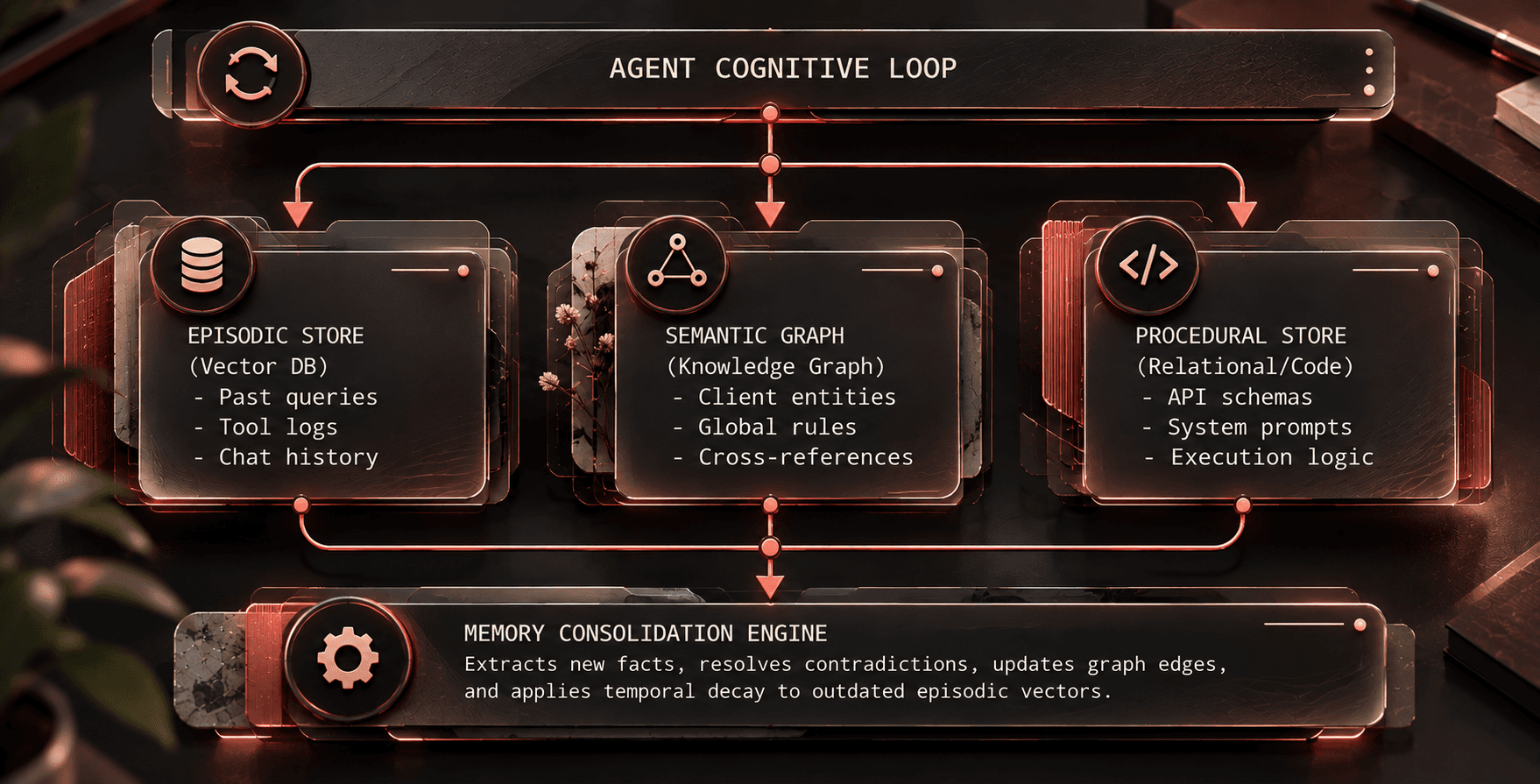
To build agents that maintain coherence across hundreds of interactions, we break memory down into three distinct operational layers-borrowed directly from cognitive science and formalized for LLMs.
1. Episodic Memory (The Audit Trail) This stores the sequential history of events, tool calls, and user interactions. Episodic memory is highly temporal; it allows the agent to answer, *"What did the user ask me to do yesterday?"*. Vector databases are useful here for fast similarity lookups of recent conversations.
2. Semantic Memory (The Knowledge Graph) This is the agent's internalized ledger of facts, entities, and relationships. It is unmoored from the specific conversation where the fact was learned. Semantic memory requires strict entity resolution and multi-hop traversal (e.g., *Customer A belongs to Organization B which holds License C*).
3. Procedural Memory (The Rulebook) This dictates *how* the agent executes tasks. It contains tool schemas, operational guardrails, and system prompts. Crucially, procedural memory allows an agent to optimize its own workflows based on past feedback-refining a complex SQL query structure after a previously failed execution attempt.
| Capability | Flat Vector Database | Graph-Vector Hybrid Memory |
|---|---|---|
| Retrieval Focus | Fuzzy semantic similarity | Exact entity relationships + semantic relevance |
| Temporal Awareness | None (Retrieves older and newer facts equally) | Built-in temporal decay and timestamped edges |
| Data Consolidation | Append-only; duplicates stack up | Merges conflicting facts; updates state |
| Multi-Hop Reasoning | Highly inaccurate | Natively supported via graph traversal |
| Best Used For | Basic document RAG and short chats | Long-running autonomous agents and complex workflows |
Engineering the Graph-Vector Hybrid
The dominant pattern for enterprise autonomous agents is a composite architecture: a graph-vector hybrid (often utilizing tools like Neo4j alongside Milvus or Qdrant) combined with a relational state manager.
When the agent receives a prompt, it queries the Episodic Store to retrieve immediate conversational context, and simultaneously traverses the Semantic Graph to pull the exact, immutable relationships surrounding the named entities.
Crucially, this architecture features a Consolidation Engine. This asynchronous background process continuously scans the episodic vector logs, extracts durable facts, writes them into the semantic graph, and aggressively prunes or down-weights the original, messy conversational text to prevent context window contamination.
Rules We Actually Apply When We Build These Pipelines
1. Enforce Temporal Decay on Vectors Not all stored facts are equally useful six months later. Implement scoring systems where the retrieval weight of a vector decays over time unless it is continually reinforced. This prevents agents from making decisions based on deeply buried, deprecated policies.
2. Never Rely on Vectors for State Agent working memory and in-flight task progression require strict transactional guarantees. If an agent in London is halfway through provisioning an AWS cluster, that state must live in a relational or transactional key-value store (like Redis or Postgres), not as a similarity embedding.
3. Write Procedural Memory Updates Offline While agents can learn to improve their own prompts or tool usage, you should rarely allow them to overwrite their procedural memory in real time. Queue agent self-reflections and execute procedural updates via a background LLM-as-a-judge process, ensuring the agent aligns with a representative sample of successful workflows rather than over-indexing on one failed edge case.
How Pixenox Engineers Agentic Memory
At Pixenox, we do not rely on basic vector retrieval to power enterprise operations. Our Enterprise Intelligence Engineering team builds stateful, graph-vector hybrid architectures designed for long-term autonomy. By combining episodic vector logs with strict semantic knowledge graphs and deterministic procedural memory, we deploy AI systems that remember context accurately, respect regional compliance boundaries, and execute complex workflows without context window contamination.
Any questions about this blog?