

Beyond ETL: Engineering Enterprise Data Platforms That Scale With Business Growth

Most organizations don't struggle because they lack data—they struggle because their data ecosystems evolve faster than their operating models. As applications multiply, analytics demands grow, and AI initiatives accelerate, traditional pipelines become increasingly difficult to govern, scale, and trust. Modern enterprise data platforms address these challenges by treating data as shared organizational infrastructure rather than isolated engineering projects. This article examines the architectural decisions, implementation trade-offs, governance models, and platform engineering principles that distinguish resilient enterprise data platforms from collections of disconnected pipelines.
Introduction
Enterprise data platforms rarely fail because of storage limitations. They fail because organizations underestimate the complexity of managing data across dozens of operational systems, multiple cloud environments, diverse business domains, and rapidly changing regulatory requirements.
Many organizations begin with a handful of ETL jobs moving data into a warehouse. Initially, the architecture appears manageable. As business units demand real-time dashboards, machine learning workloads, customer analytics, regulatory reporting, and self-service access, those simple pipelines gradually evolve into hundreds—or even thousands—of interconnected workflows.
The challenge is no longer moving data from one system to another. It becomes maintaining trust in the data, understanding its lineage, enforcing governance consistently, enabling domain ownership, and delivering reliable analytics without slowing innovation.
An enterprise data platform is therefore not simply a technology stack. It is a combination of architecture, governance, platform engineering, operating models, metadata management, and organizational collaboration designed to ensure data remains a strategic asset rather than an operational burden.
Platform Engineering Begins Where Pipelines Stop
Many organizations equate building pipelines with building a data platform. In practice, pipelines are only one layer of a much larger ecosystem.
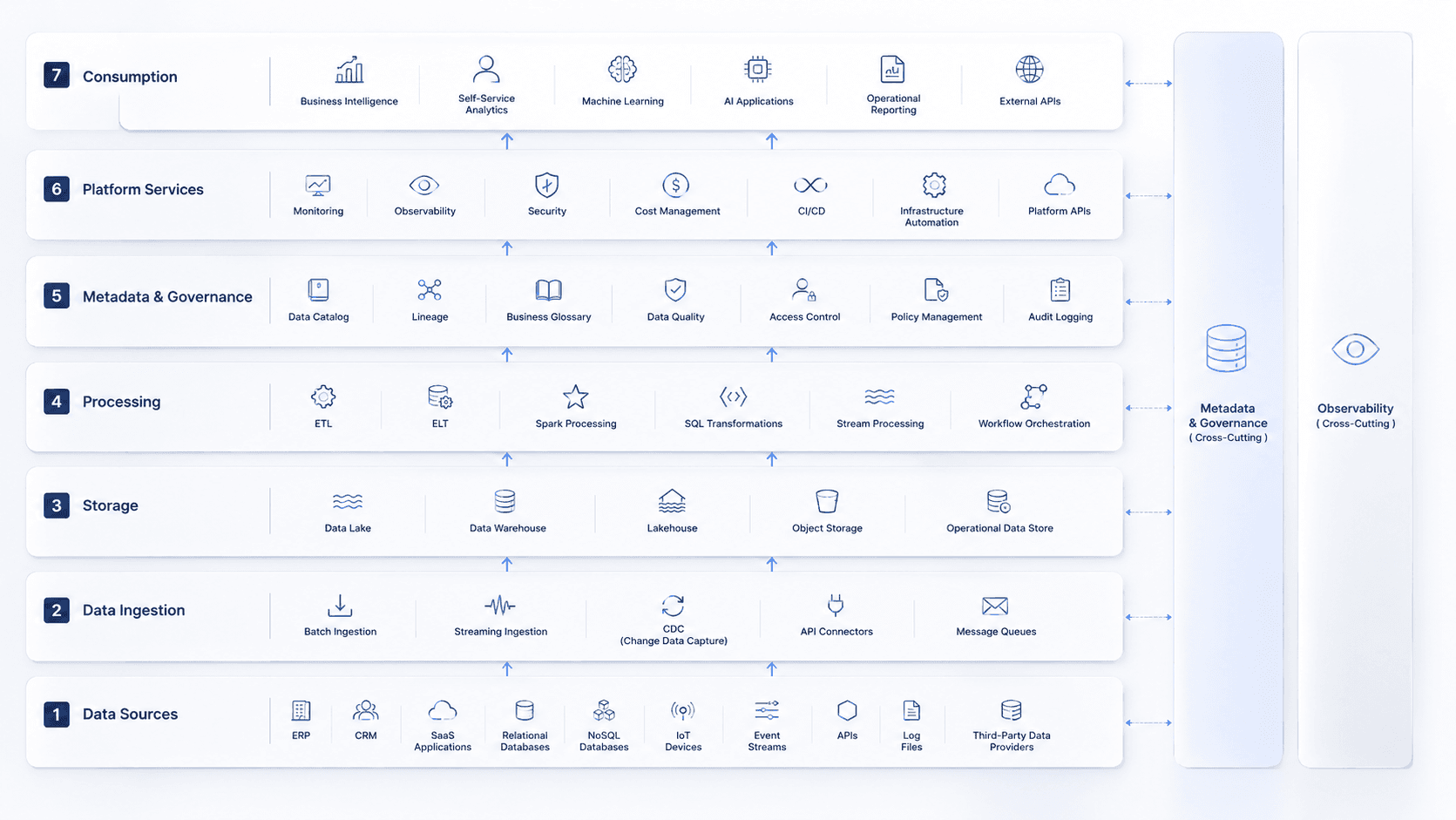
A mature platform provides standardized capabilities that allow engineering teams to build, deploy, monitor, and govern data products consistently. Instead of every project reinventing ingestion frameworks, transformation logic, security controls, and monitoring dashboards, the platform exposes reusable services that reduce operational overhead while improving reliability.
The transition from pipeline-centric thinking to platform-centric engineering often represents the most significant architectural shift in an organization's data journey.
Enterprise Insight
Platform teams should optimize for developer experience as much as infrastructure performance. Internal data engineers are platform customers, and reducing friction directly improves delivery velocity.
Implementation Observation
Successful platforms provide:
Standardized ingestion frameworks Reusable transformation templates Centralized authentication Metadata automation Data quality validation Lineage tracking Cost monitoring Infrastructure provisioning
These shared capabilities reduce duplication across engineering teams.
Decision Framework
| Topic | Description | Business Impact | Engineering Perspective | Enterprise Recommendation |
|---|---|---|---|---|
| Individual Pipelines | Teams build independently | Fast initial delivery | High maintenance cost | Suitable only for small environments |
| Shared Platform Services | Central engineering capabilities | Consistent governance | Reduced operational complexity | Preferred for enterprise-scale platforms |
The Organizational Cost of Fragmented Data Ownership
Technology rarely causes the biggest data problems. Organizational boundaries do.
Finance maintains one definition of revenue. Marketing calculates customer acquisition differently. Sales uses separate customer identifiers. Operations stores product data independently. Analytics teams spend more time reconciling inconsistencies than generating insights.
As organizations grow, duplicated business logic becomes increasingly expensive.
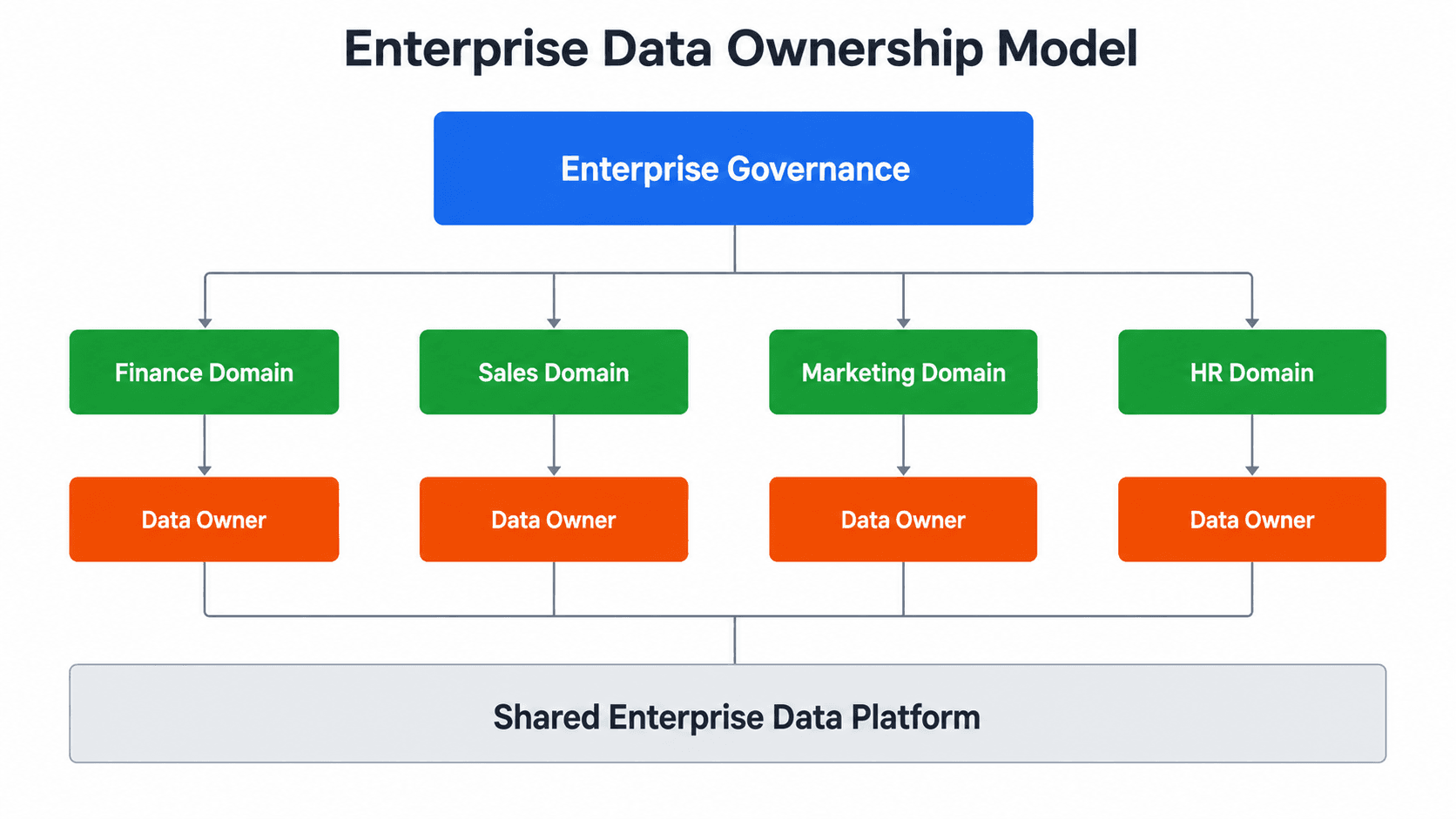
The solution isn't simply creating a centralized warehouse. It requires clearly defining ownership responsibilities across domains while establishing enterprise-wide governance standards.
Ownership should answer questions such as:
Who owns customer data? Who approves schema changes? Who validates business definitions? Who maintains data quality? Who resolves incidents? Who communicates breaking changes?
Without these responsibilities, even technically sophisticated platforms accumulate semantic inconsistencies that undermine trust.
Enterprise Insight
Organizations with strong data governance typically define ownership before selecting technology.
Real-World Trade-off
Highly centralized governance delivers consistency but can become a bottleneck.
Fully decentralized ownership increases agility but often introduces inconsistent standards.
Many enterprises adopt a federated governance model that balances both approaches.
Governance Comparison
| Topic | Description | Business Impact | Engineering Perspective | Enterprise Recommendation |
|---|---|---|---|---|
| Centralized Governance | Single governing authority | High consistency | Lower agility | Best for regulated industries |
| Federated Governance | Shared ownership model | Balanced scalability | Suitable for large enterprises | Suitable for large enterprises |
| Fully Decentralized | Domain autonomy | Faster innovation | Higher governance risk | Appropriate only with strong platform standards |
Metadata Is the Platform's Operating System
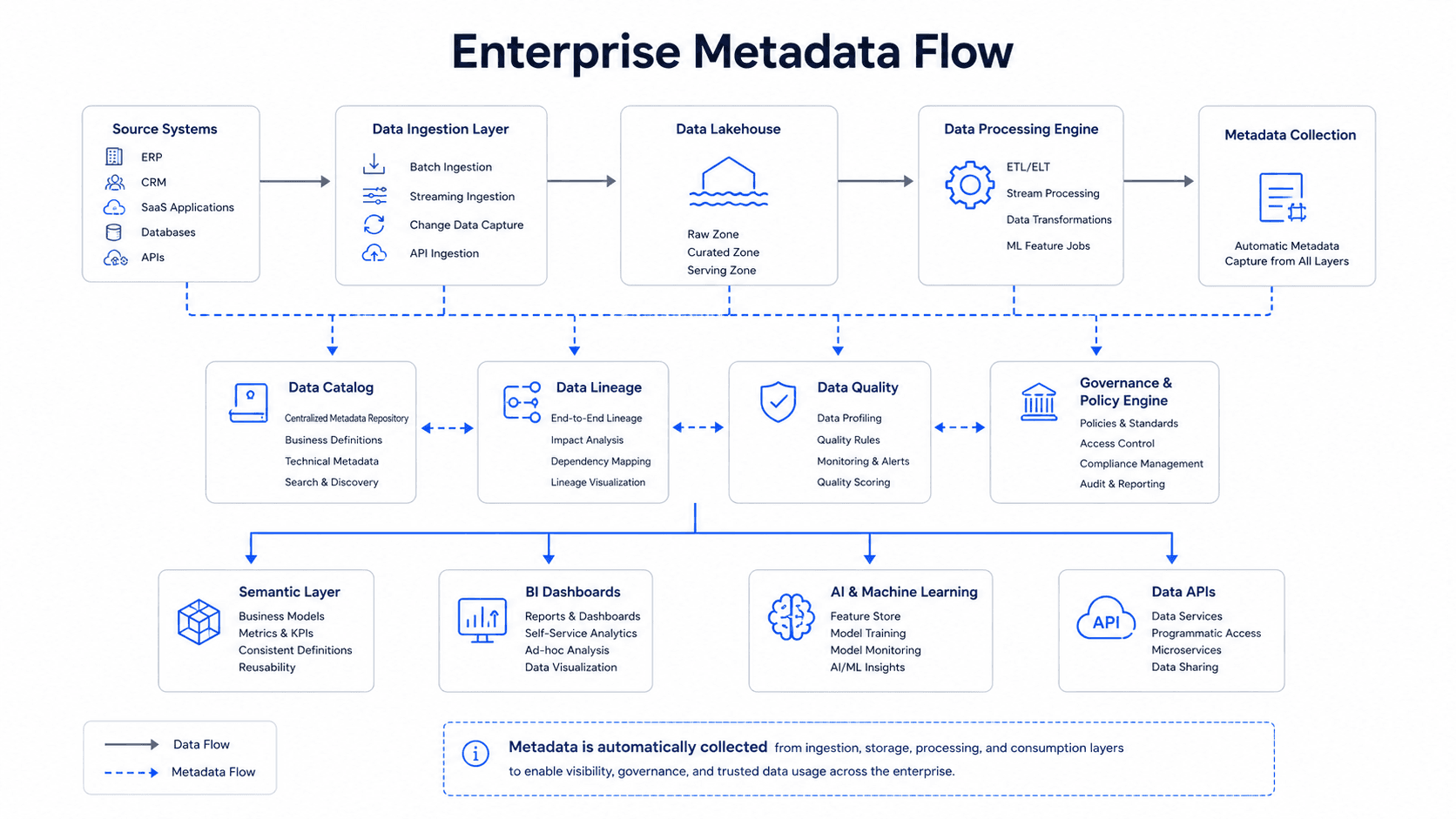
Modern platforms generate enormous volumes of metadata. Yet many organizations continue to treat metadata as documentation rather than operational infrastructure.
Metadata enables engineers to answer critical questions:
Where did this dataset originate? Which downstream reports depend on it? Who owns it? When was it last updated? Which transformations were applied? Which business definition governs this metric?
Without metadata, every incident becomes a manual investigation.
With automated metadata collection, impact analysis becomes significantly more efficient, reducing downtime and accelerating root-cause analysis.
Enterprise Insight
Organizations investing early in metadata management typically experience faster onboarding, easier governance, and improved platform scalability.
Implementation Observation
High-value metadata includes:
Technical metadata Business metadata Operational metadata Security classifications Lineage relationships Quality metrics Usage statistics Ownership information Metadata Maturity Comparison
| Topic | Description | Business Impact | Engineering Perspective | Enterprise Recommendation |
|---|---|---|---|---|
| Manual Documentation | Human-maintained metadata | Quickly becomes outdated | High maintenance effort | Avoid for enterprise environments |
| Automated Metadata | Platform-generated catalog | Higher trust and discoverability | Lower operational burden | Recommended for scalable platforms |
Building Trust Through Data Quality and Observability
Reliable analytics depends less on sophisticated dashboards than on confidence in the underlying data.
Data quality issues rarely originate from a single failure. They emerge from schema changes, incomplete source records, delayed pipelines, incorrect transformations, infrastructure outages, or evolving business rules. Without continuous monitoring, these problems often reach executives before engineering teams become aware of them.
Modern data observability extends beyond infrastructure monitoring. It measures the health of datasets, validates freshness, detects anomalies, tracks schema evolution, and alerts teams when business-critical metrics deviate unexpectedly.
Organizations that embed observability into every stage of the data lifecycle reduce incident resolution times and improve confidence in analytics, machine learning models, and executive reporting.
Enterprise Insight
Reactive troubleshooting is expensive. Proactive observability shifts engineering effort from firefighting to continuous improvement.
Decision Framework
| Topic | Description | Business Impact | Engineering Perspective | Enterprise Recommendation |
|---|---|---|---|---|
| Reactive Monitoring | Issues discovered after failures | Delayed business decisions | High operational effort | Suitable only for low-criticality workloads |
| Data Observability | Continuous validation of pipelines and datasets | Increased trust and faster recovery | Requires platform-wide instrumentation | Essential for enterprise-scale platforms |
Scaling Beyond Pipelines: Orchestration as a Platform Capability
As enterprise data ecosystems mature, orchestration becomes far more than scheduling jobs. Modern orchestration coordinates dependencies across ingestion pipelines, transformation workflows, machine learning feature generation, reverse ETL, reporting, and operational systems.
A common anti-pattern is allowing each engineering team to manage orchestration independently. One team relies on cron jobs, another uses cloud-native schedulers, while others adopt workflow engines with inconsistent retry policies and monitoring standards. Over time, operational visibility disappears.
A platform-centric approach standardizes orchestration through reusable workflows, centralized scheduling, dependency management, and automated failure recovery. Rather than monitoring hundreds of isolated jobs, platform teams gain a unified operational view of the entire data estate.
Enterprise Insight
The objective of orchestration is not simply running jobs on time—it is ensuring business processes receive trustworthy data when they need it.
Real-World Trade-offs
| Topic | Description | Business Impact | Engineering Perspective | Enterprise Recommendation |
|---|---|---|---|---|
| Independent Scheduling | Every team manages workflows separately | Faster project delivery initially | Difficult monitoring and troubleshooting | Avoid as the platform grows |
| Centralized Orchestration | Shared workflow management | Higher operational reliability | Easier dependency tracking | Recommended for enterprise platforms |
Designing for Self-Service Without Losing Governance
Business users increasingly expect immediate access to trusted data. Waiting weeks for engineering teams to deliver datasets is no longer acceptable.
However, unrestricted self-service frequently results in duplicated datasets, conflicting metrics, and inconsistent business definitions.
Successful enterprise platforms enable self-service within governed boundaries. Instead of granting unrestricted database access, organizations provide curated data products, certified datasets, semantic models, reusable metrics, and governed APIs.
This approach allows analysts to innovate while ensuring executive reports, regulatory submissions, and AI models are built upon consistent business definitions.
Implementation Observations
Effective self-service platforms typically include:
Enterprise data catalog Certified datasets Semantic layer Business glossary Role-based access control Automated lineage Dataset quality scores Usage analytics
The objective is not restricting access—it is increasing confidence.
Self-Service Maturity Comparison
| Topic | Description | Business Impact | Engineering Perspective | Enterprise Recommendation |
|---|---|---|---|---|
| Open Access | Direct database exploration | High flexibility | Governance challenges | Suitable only for technical teams |
| Governed Self-Service | Certified data products | Faster analytics with trust | Requires metadata investment | Best practice for large organizations |
Lakehouse, Data Mesh, and Data Fabric: Choosing the Right Pattern
Technology trends often become industry buzzwords long before organizations understand where they create value.
A lakehouse addresses the gap between traditional data lakes and warehouses by combining scalable storage with structured data management. It is particularly effective for organizations supporting analytics, machine learning, and mixed workloads.
A data mesh is not a technology platform but an organizational operating model. It distributes ownership of data products to business domains while relying on shared platform capabilities. Organizations with weak governance or limited platform maturity often struggle when adopting mesh principles prematurely.
A data fabric emphasizes integration through metadata, automation, and intelligent data discovery across distributed environments. It complements rather than replaces existing architectures.
Rather than choosing one trend over another, mature organizations evaluate which architectural pattern addresses their specific business constraints.
Decision Matrix
| Topic | Description | Business Impact | Engineering Perspective | Enterprise Recommendation |
|---|---|---|---|---|
| Lakehouse | Unified analytics storage | Simplifies architecture | Strong analytical performance | Ideal for mixed analytical workloads |
| Data Mesh | Domain-oriented ownership | Improves business alignment | Requires organizational maturity | Adopt incrementally |
| Data Fabric | Metadata-driven integration | Better discoverability | Depends on metadata quality | Valuable in distributed enterprises |
Architectural Lesson
Operating model decisions typically influence long-term success more than technology choices.
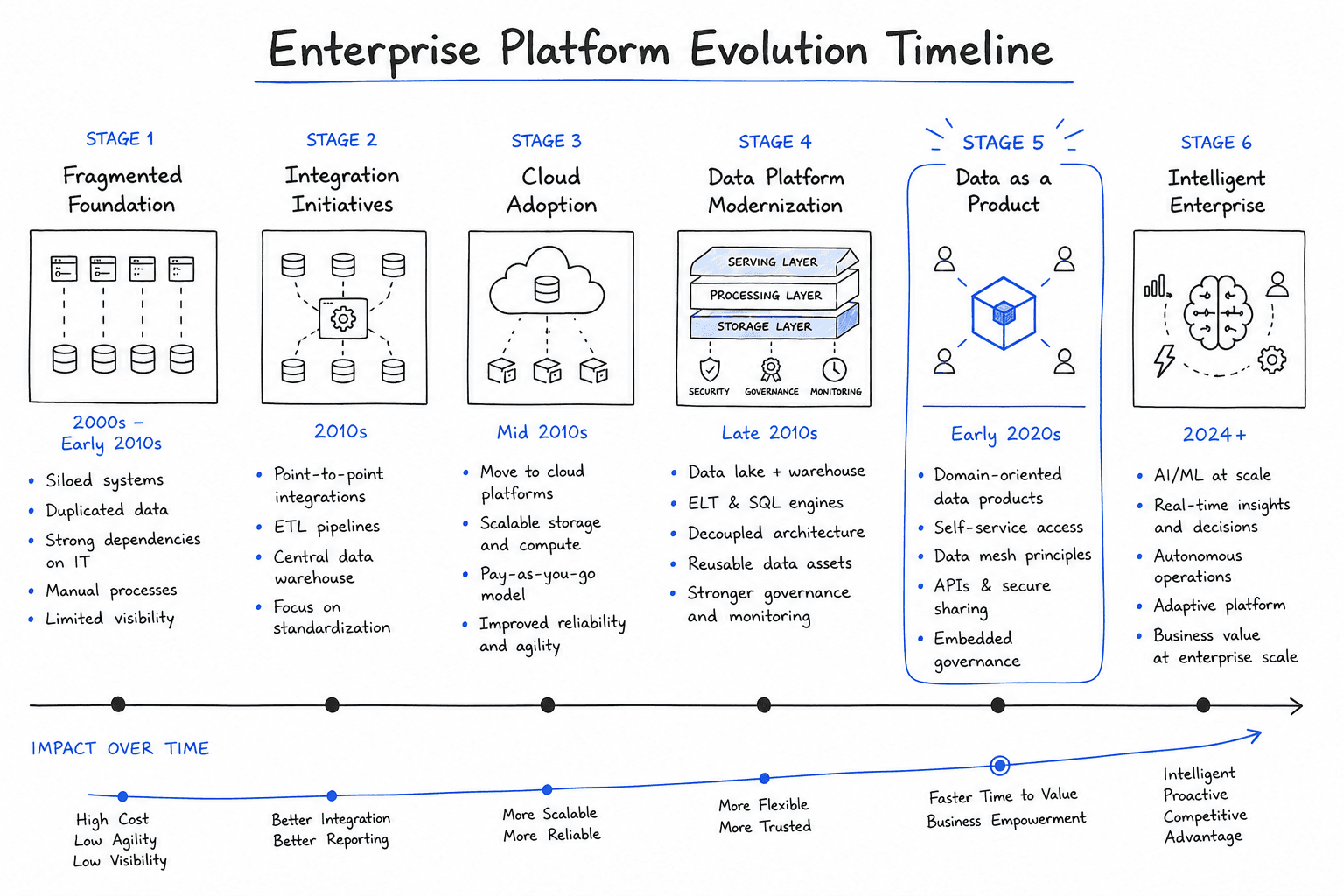
Managing Platform Evolution Without Rebuilding Everything
Large enterprises rarely replace their data platforms overnight. Business continuity, regulatory obligations, and legacy applications demand gradual modernization.
Incremental migration minimizes operational risk.
Typical modernization stages include:
Consolidate fragmented pipelines. Introduce centralized metadata. Implement automated lineage. Standardize orchestration. Improve observability. Establish governance policies. Enable self-service analytics. Modernize storage architecture. Introduce AI-ready data products.
Each phase delivers measurable value while reducing technical debt.
Enterprise Insight
Organizations attempting complete platform replacements frequently underestimate migration complexity, integration dependencies, and change management requirements.
Migration Strategy Comparison
| Topic | Description | Business Impact | Engineering Perspective | Enterprise Recommendation |
|---|---|---|---|---|
| Big-Bang Migration | Replace entire platform at once | High transformation potential | Significant implementation risk | Rarely recommended |
| Incremental Modernization | Gradual capability evolution | Continuous business value | Lower operational disruption |
Enterprise Anti-Patterns That Slow Platform Maturity
Many enterprise platforms accumulate complexity not because of poor technology but because of repeated architectural shortcuts.
Common anti-patterns include:
Building duplicate ingestion pipelines for every project. Embedding business logic directly into ETL workflows. Maintaining undocumented data transformations. Treating governance as a compliance exercise rather than an engineering capability. Allowing metric definitions to diverge across departments. Ignoring metadata until platform scale becomes unmanageable. Measuring success by the number of pipelines instead of the reliability of data products. Prioritizing new features while postponing observability and quality improvements.
Recognizing these patterns early helps organizations avoid costly platform rewrites and operational instability.
Conclusion
Enterprise data platforms succeed when they are designed as organizational infrastructure rather than collections of independent technologies. While storage engines, processing frameworks, and cloud services continue to evolve, the enduring architectural principles remain consistent: establish clear ownership, automate governance, invest in metadata, prioritize observability, and create reusable platform capabilities that enable teams to innovate safely.
The most resilient platforms are those that evolve incrementally. They replace duplicated engineering effort with shared services, reduce operational complexity through automation, and deliver trusted data products that support analytics, AI, regulatory reporting, and operational decision-making alike. Organizations that adopt this platform mindset position themselves not only to manage today's data challenges but also to adapt confidently as business priorities and technologies continue to change.
Any questions about this blog?
Frequently Asked Questions
What is an enterprise data platform?
An enterprise data platform is a centralized set of technologies, governance processes, and operating practices that enables organizations to ingest, store, process, govern, and serve trusted data across business functions.
How is an enterprise data platform different from a data warehouse?
A data warehouse primarily stores structured analytical data, whereas an enterprise data platform includes ingestion, orchestration, governance, metadata, security, observability, and self-service capabilities in addition to storage.
When should an organization build an enterprise data platform?
Organizations typically invest in a platform when data volumes, business domains, regulatory requirements, and analytics demands outgrow isolated ETL pipelines and standalone warehouses.
What role does metadata play in a modern data platform?
Metadata improves discoverability, lineage, governance, impact analysis, compliance, and operational efficiency by describing datasets, ownership, transformations, and usage.
Why is data observability important?
Observability helps detect freshness issues, schema drift, anomalies, and pipeline failures before they affect business decisions or downstream applications.
Is a lakehouse better than a traditional data warehouse?
A lakehouse is often better suited for mixed analytical and AI workloads, but the best choice depends on data types, governance requirements, performance expectations, and organizational maturity.
What is the difference between Data Mesh and Data Fabric?
Data Mesh is an organizational approach focused on domain ownership, while Data Fabric emphasizes metadata-driven integration and data accessibility across distributed environments.
How can enterprises improve data governance without slowing innovation?
By automating governance policies, implementing role-based access controls, maintaining metadata, and providing certified data products for self-service analytics.
What are the biggest challenges in enterprise data platform modernization?
Legacy systems, inconsistent data definitions, technical debt, fragmented ownership, migration risk, regulatory compliance, and organizational change management are among the most significant challenges.
What capabilities should every enterprise data platform include?
Core capabilities include scalable storage, data ingestion, transformation, orchestration, metadata management, lineage, observability, governance, security, semantic modeling, self-service analytics, and cost monitoring.
How does a semantic layer improve analytics?
A semantic layer standardizes business metrics and definitions, ensuring analysts and executives use consistent calculations across reports and dashboards.
Why is platform engineering becoming central to data teams?
Platform engineering reduces duplicated effort by providing reusable infrastructure, standardized workflows, automated governance, and developer-friendly tooling that accelerates delivery while maintaining consistency.
Should every organization adopt Data Mesh?
No. Data Mesh is most effective for organizations with mature engineering practices, clear domain ownership, and robust platform capabilities. Smaller organizations often gain more value from centralized governance.
What is the biggest indicator of a mature enterprise data platform?
Trust. When business users, engineers, data scientists, and executives consistently rely on shared data products without questioning their accuracy, ownership, or lineage, the platform has achieved true organizational maturity.