

AI Retrieval Optimization: How to Make Your Content Discoverable by Large Language Models

Learn how AI Retrieval Optimization (AIRO) helps websites become discoverable by ChatGPT, Google AI Overviews, Gemini, Claude, and Perplexity through semantic architecture, entity engineering, and machine-readable content.
Introduction
Search engines have traditionally ranked webpages based on relevance, authority, and hundreds of algorithmic signals designed to estimate which document best answers a user's query. Large language models (LLMs) approach the problem differently. Rather than presenting a ranked list of pages, they retrieve information from multiple sources, synthesize the findings, and generate a single response. This shift fundamentally changes what it means to be visible online.
Being indexed is no longer enough. Even ranking on the first page of Google does not guarantee that an AI assistant will reference your content. Modern retrieval systems prioritize information they can confidently understand, verify, and connect with broader knowledge. They evaluate entities, semantic relationships, topical authority, structured data, source reliability, and contextual relevance before deciding whether a document deserves to influence an answer.
This emerging discipline is known as AI Retrieval Optimization (AIRO). While traditional SEO focuses on helping pages rank, AIRO focuses on helping information become retrievable, understandable, and trustworthy for artificial intelligence systems. Businesses that understand this distinction will be significantly better positioned as conversational search continues replacing conventional search behavior.
This guide explores how AI retrieval works, the engineering principles behind retrieval optimization, and the practical strategies organizations can adopt to improve their visibility across ChatGPT, Google AI Overviews, Gemini, Claude, Perplexity, and future AI search platforms
Understanding AI Retrieval Instead of Traditional Ranking
The concept of ranking has dominated SEO for decades. Search engines evaluated thousands of pages, ordered them according to relevance and authority, and displayed the highest-ranking results to users. Success depended largely on improving position within those rankings.
AI retrieval follows a different philosophy. Instead of asking which page should appear first, retrieval systems ask which pieces of information are sufficiently reliable to help generate an accurate response. This subtle difference has profound implications for content strategy.
When a user asks a question such as, "How does entity SEO improve AI visibility?" the retrieval system may collect information from technical documentation, research papers, authoritative blogs, structured datasets, and trusted industry websites. These sources are then combined into a coherent answer rather than displayed individually.
Consequently, documents compete less for rankings and more for retrieval confidence. The objective is not merely to be discovered but to become a trusted source whose information is consistently selected during the retrieval process. Organizations that optimize for retrieval therefore invest heavily in semantic clarity, entity consistency, technical accessibility, and information quality instead of relying exclusively on keyword optimization.
Why Large Language Models Need Retrieval
Large language models possess remarkable language generation capabilities, but they are not continuously connected to the live web. Their internal knowledge reflects training data that may be months or years old. To answer current questions accurately, many AI systems use Retrieval-Augmented Generation (RAG), a framework that supplements model knowledge with external information.
Instead of relying solely on pre-trained parameters, the system first retrieves relevant documents from search indexes, vector databases, enterprise repositories, or structured knowledge sources. Those retrieved documents provide factual grounding before the language model generates its final response.
This process dramatically improves factual accuracy while reducing hallucinations. However, it also means that websites must compete for inclusion within retrieval pipelines rather than only traditional search indexes. Documents that are semantically rich, technically accessible, and contextually complete have a greater chance of being selected as supporting evidence.
For businesses, this creates a new optimization objective. The goal is no longer simply publishing content that ranks well. It is publishing content that retrieval systems consistently recognize as trustworthy, authoritative, and contextually relevant.
Retrieval Depends on Semantic Understanding
One of the defining characteristics of AI retrieval is its reliance on semantic understanding rather than literal keyword matching. Machines increasingly interpret the meaning behind concepts instead of searching for exact phrases.
A comprehensive guide discussing "AI Retrieval Optimization" may still be retrieved for questions involving "LLM discoverability," "AI search visibility," or "retrieval engineering" because the underlying concepts are semantically related. This ability allows AI systems to answer complex questions even when users employ unfamiliar terminology.
Semantic retrieval also rewards comprehensive coverage. Documents explaining definitions, implementation methods, technical considerations, benefits, limitations, and related concepts provide richer contextual signals than narrowly optimized keyword pages. The broader semantic context increases retrieval confidence because the system encounters multiple reinforcing pieces of evidence within the same document.
Organizations should therefore develop content clusters that explore topics from multiple perspectives instead of producing isolated articles optimized for individual keywords. Semantic depth strengthens retrieval quality while simultaneously improving user understanding.
Entity Recognition Makes Retrieval More Reliable
Retrieval systems operate more effectively when they recognize clearly defined entities instead of ambiguous text fragments. Every organization, technology, product, author, service, and concept represents a potential entity within a broader knowledge network.
When AI systems understand that a company specializes in AI Visibility Engineering, publishes technical research on structured data, employs recognized experts, and provides enterprise consulting services, retrieval decisions become more confident. The organization exists as a coherent entity rather than merely a collection of webpages.
Entity recognition depends on consistent naming conventions, structured data implementation, authoritative author profiles, internal linking, and external references. Every digital signal contributes additional evidence supporting the entity's identity.
As AI search matures, entity engineering will likely become one of the strongest differentiators between organizations that are frequently cited and those that remain invisible despite publishing substantial amounts of content.
Vector Search and Embeddings: The Foundation of Modern AI Retrieval
Traditional search engines relied heavily on lexical matching. If a webpage contained the same keywords as a user's query, it had a reasonable chance of appearing in search results. Although modern search algorithms introduced semantic understanding years ago, vector search has taken this concept significantly further.
Large language models convert words, sentences, paragraphs, and even entire documents into mathematical representations known as embeddings. These embeddings capture semantic meaning instead of exact wording. Two documents discussing the same concept can therefore appear highly similar in vector space even if they share very few identical keywords.
For example, a document explaining "AI Retrieval Optimization" may be closely related to another discussing "LLM discoverability" because both occupy nearby positions within a high-dimensional vector space. Retrieval systems compare these semantic vectors rather than relying solely on textual similarity.
This capability fundamentally changes content optimization. Repeating keywords no longer improves retrieval quality. Instead, documents become more discoverable when they comprehensively explain concepts, establish relationships between ideas, and provide sufficient contextual depth for embedding models to represent them accurately.
Businesses should therefore prioritize semantic completeness over keyword density. Well-structured explanations, consistent terminology, technical accuracy, and contextual richness create stronger embeddings, making documents easier for retrieval systems to identify as relevant evidence.
How Retrieval Pipelines Evaluate Documents
Retrieval is not a single algorithm but a sequence of engineering processes designed to identify the most useful information for answering a query. Understanding this pipeline helps explain why some content consistently appears in AI-generated responses while other content remains largely invisible.
The process typically begins with query interpretation. Rather than searching for exact phrases, the AI system analyzes the user's intent, identifies important entities, and determines the underlying concepts requiring explanation.
The interpreted query is then matched against indexed content using semantic retrieval techniques such as vector similarity. Candidate documents are identified based on conceptual relevance rather than keyword overlap alone.
Once potential sources have been retrieved, ranking mechanisms evaluate their quality. Factors such as topical authority, document completeness, technical accessibility, publication credibility, source consistency, and contextual relevance influence whether a document progresses to the next stage.
Many AI systems also perform reranking. A specialized model reevaluates candidate documents, selecting those most likely to contribute accurate information. Rather than relying exclusively on retrieval scores, rerankers assess how well each document addresses the specific context of the user's question.
Finally, selected passages are supplied to the language model as supporting evidence. The model synthesizes information from multiple sources, identifies overlapping facts, resolves contradictions where possible, and generates a coherent response.
Businesses seeking AI visibility should therefore optimize for every stage of this pipeline. Success depends not merely on retrieval but on remaining valuable throughout the evaluation and synthesis process.
Engineering Content for AI Retrieval
Writing for retrieval differs from writing solely for search rankings. Instead of focusing primarily on target keywords, retrieval-oriented content is designed to maximize machine understanding while maintaining exceptional readability for human audiences.
Comprehensive topic coverage plays a central role. AI systems generally favor resources that explain a subject from multiple perspectives rather than narrowly answering isolated questions. A detailed guide covering definitions, implementation strategies, technical concepts, common challenges, best practices, and future developments provides richer contextual information than several fragmented articles discussing individual subtopics.
Information architecture also influences retrieval quality. Clear heading structures, descriptive section titles, logical progression between concepts, and concise introductory paragraphs help retrieval systems identify relevant passages more efficiently. AI models frequently retrieve specific sections rather than entire documents, making structural clarity increasingly valuable.
Consistency of terminology is equally important. Introducing multiple names for the same concept without explanation creates ambiguity. Organizations should establish preferred terminology for services, technologies, and methodologies while acknowledging commonly used alternatives where appropriate.
Original insight further strengthens retrieval confidence. AI systems increasingly differentiate between content that simply summarizes existing information and content that contributes meaningful expertise through research, implementation experience, technical analysis, or unique frameworks. Documents demonstrating genuine subject matter expertise are more likely to become reliable retrieval sources over time.
Technical SEO as the Infrastructure for AI Retrieval
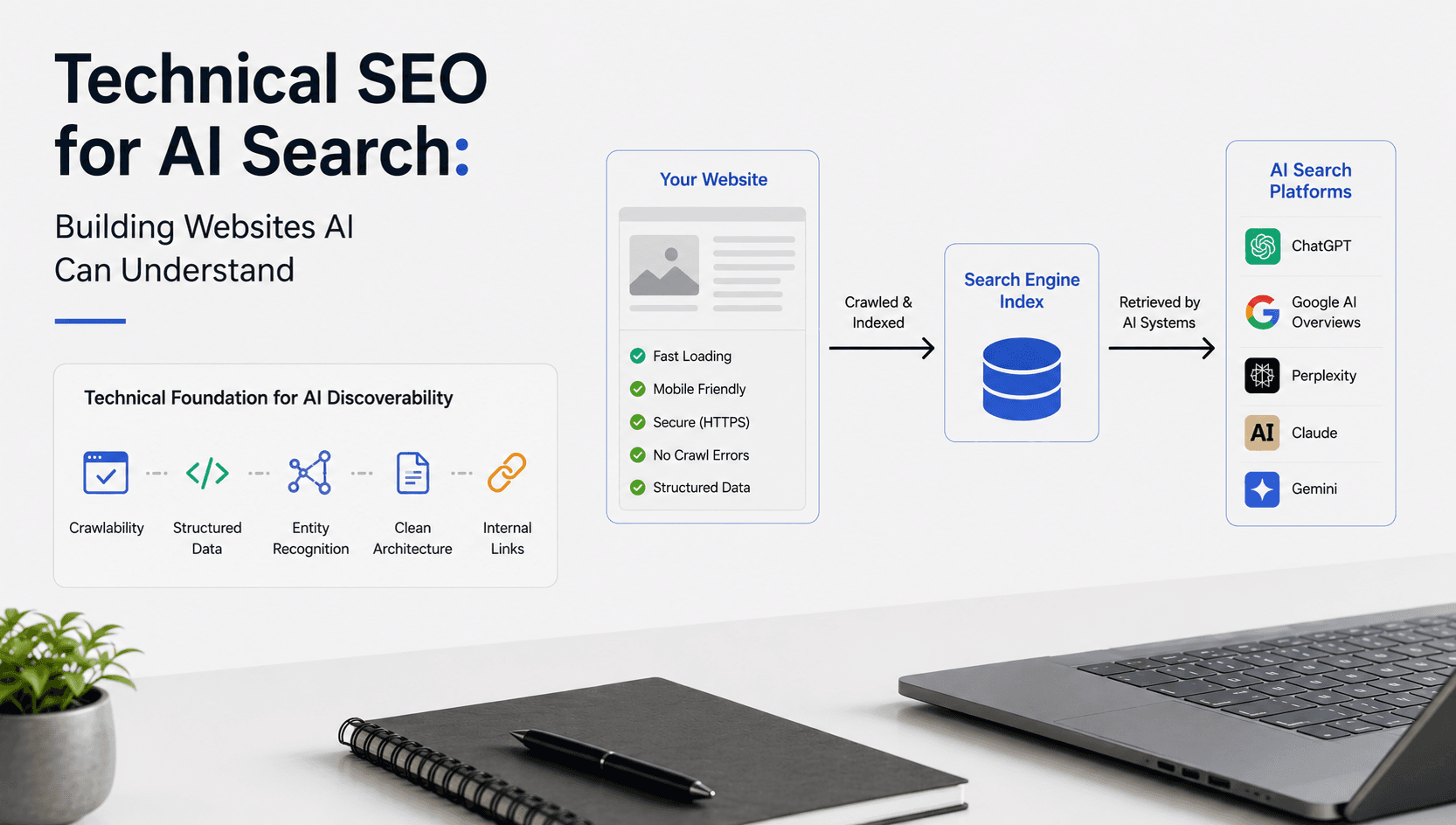
Technical SEO remains one of the most important enablers of AI Retrieval Optimization because retrieval systems depend on efficient access to high-quality information. Even the most authoritative content cannot contribute to AI-generated answers if crawlers struggle to discover, interpret, or index it.
Clean information architecture ensures that important resources remain accessible through logical internal linking. Canonicalization prevents duplicate pages from competing for the same concepts, while XML sitemaps help search engines identify newly published resources efficiently.
Structured data provides explicit descriptions of entities, reducing ambiguity during document interpretation. Although schema markup alone does not guarantee AI citations, it strengthens machine understanding by clarifying authorship, organizations, services, articles, and other important entities.
Performance also contributes to retrieval readiness. Fast-loading pages, reliable server infrastructure, semantic HTML, accessible content structures, and properly implemented metadata all improve the efficiency with which search engines process a website. Better crawl efficiency often translates into fresher indexes, increasing the likelihood that current information becomes available for retrieval.
Technical SEO should therefore be viewed as the infrastructure layer supporting every retrieval optimization effort. Without strong technical foundations, semantic quality alone rarely achieves consistent visibility.
Measuring AI Retrieval Optimization Success
Unlike traditional SEO, AI Retrieval Optimization cannot be measured solely through keyword rankings. Organizations need broader metrics that reflect how effectively AI systems understand and retrieve their information.
One practical indicator is citation frequency across AI platforms. Testing relevant industry questions in ChatGPT, Google AI Overviews, Gemini, Claude, and Perplexity helps identify whether an organization is consistently referenced as a trusted source. While responses vary across systems, recurring citations often indicate increasing retrieval confidence.
Entity recognition provides another valuable measurement. Businesses should periodically evaluate how AI systems describe their organization, services, products, and expertise. Accurate, comprehensive descriptions suggest that entity relationships are becoming stronger within the broader knowledge ecosystem.
Topical coverage is equally important. Instead of monitoring individual keywords, organizations should assess whether they have authoritative resources covering every significant concept within their domain. Comprehensive semantic coverage increases the probability that at least one document becomes relevant for diverse retrieval scenarios.
Technical metrics continue supporting this analysis. Crawl health, index coverage, structured data validation, internal linking quality, and page performance all contribute indirectly to retrieval success by ensuring information remains accessible and understandable.
Ultimately, the most meaningful measure is business impact. Growth in qualified traffic, AI-assisted referrals, branded searches, consultation requests, and conversions demonstrates that improved retrieval visibility is translating into tangible commercial outcomes.
Common AI Retrieval Optimization Mistakes
Many organizations approach AI Retrieval Optimization as an extension of keyword SEO, applying outdated tactics to fundamentally different retrieval systems. This often results in content that ranks reasonably well yet contributes little to AI-generated answers.
One common mistake is prioritizing publication volume over information quality. Large numbers of shallow articles rarely establish strong retrieval authority because they provide limited contextual depth. AI systems increasingly prefer comprehensive resources capable of answering complex questions thoroughly.
Another mistake involves fragmented topical coverage. Publishing disconnected articles without semantic relationships weakens overall expertise signals. Retrieval systems benefit from interconnected content ecosystems where supporting resources reinforce broader subject authority.
Some businesses also neglect entity consistency. Inconsistent service names, conflicting business descriptions, outdated author information, and disconnected digital identities create ambiguity that reduces retrieval confidence. Machines struggle to determine whether multiple references describe the same organization or entirely different entities.
Technical neglect remains another persistent issue. Broken internal links, crawl barriers, duplicate content, slow websites, and invalid structured data reduce the accessibility of otherwise valuable information. Retrieval optimization cannot compensate for weak technical foundations.
Finally, organizations often expect immediate results. Knowledge development, entity recognition, and retrieval confidence accumulate gradually as AI systems encounter consistent evidence across websites, publications, structured data, and external references. AI Retrieval Optimization is therefore a long-term engineering discipline rather than a short-term ranking tactic.
The Future of AI Retrieval Optimization
AI retrieval is evolving from document selection toward knowledge reasoning. Rather than retrieving isolated passages, future systems will increasingly evaluate relationships between entities, verify information across multiple sources, and reason over structured knowledge before generating responses.
This evolution places greater emphasis on authoritative entities rather than individual webpages. Organizations with consistent digital identities, comprehensive topical coverage, and well-engineered knowledge ecosystems will likely become preferred retrieval sources regardless of specific keyword rankings.
Another emerging trend is multimodal retrieval. AI systems are becoming increasingly capable of understanding images, diagrams, videos, audio recordings, technical documentation, and structured datasets alongside traditional text. Businesses that publish high-quality information across multiple formats may strengthen retrieval opportunities as these capabilities mature.
Agentic AI introduces another significant shift. Autonomous systems capable of researching vendors, comparing products, evaluating documentation, and completing complex workflows require reliable, machine-readable information throughout every stage of decision-making. Retrieval optimization will therefore extend beyond marketing into product documentation, developer resources, customer support, and enterprise knowledge management.
The organizations that succeed in this environment will not simply optimize content for search engines. They will engineer information ecosystems that machines can confidently retrieve, interpret, verify, and reuse across an expanding range of AI-powered applications.
Any questions about this blog?
Frequently Asked Questions
What is AI Retrieval Optimization (AIRO)?
AI Retrieval Optimization (AIRO) is the practice of improving how AI systems discover, understand, evaluate, and retrieve your content. Unlike traditional SEO, which primarily focuses on search rankings, AIRO focuses on making information easy for Large Language Models (LLMs) and Retrieval-Augmented Generation (RAG) systems to use when generating answers.
How is AI Retrieval Optimization different from SEO?
SEO is primarily designed to improve visibility within search engine results pages by optimizing rankings for specific queries. AI Retrieval Optimization extends beyond rankings by optimizing content for semantic understanding, entity recognition, structured information, contextual relevance, and retrieval confidence. While SEO remains an important foundation, AIRO prepares content for AI-powered search experiences where answers are generated instead of simply ranked.
What role do embeddings play in AI retrieval?
Embeddings convert text into mathematical representations that capture semantic meaning rather than exact wording. Retrieval systems compare these vectors to identify conceptually similar documents, allowing AI models to retrieve relevant information even when users do not use identical keywords. Strong semantic content produces higher-quality embeddings, increasing retrieval accuracy.
Does keyword optimization still matter for AI search?
Yes, but its role has changed. Keywords continue to help search engines understand page topics and user intent, yet AI retrieval systems rely much more heavily on semantic relationships, topical completeness, and contextual understanding. Rather than repeating target keywords, organizations should focus on comprehensive explanations that naturally incorporate related concepts and entities.
What is Retrieval-Augmented Generation (RAG)?
Retrieval-Augmented Generation is an AI architecture that combines external information retrieval with language generation. Before producing a response, the system retrieves relevant documents from search indexes, vector databases, enterprise knowledge bases, or other trusted repositories. These retrieved documents provide factual grounding, allowing the language model to generate more accurate and up-to-date answers.
How can structured data improve AI Retrieval Optimization?
Structured data provides explicit machine-readable descriptions of organizations, authors, services, articles, products, and other entities. Although schema markup alone does not guarantee AI citations, it reduces ambiguity during content interpretation and strengthens entity recognition, making retrieval systems more confident when evaluating information.
How do businesses measure AI retrieval success?
Organizations should evaluate AI retrieval using a combination of technical and business metrics. Useful indicators include AI citation frequency, entity recognition accuracy, topical authority, crawl health, structured data quality, branded search growth, AI-assisted referral traffic, and qualified lead generation. Together, these measurements provide a clearer picture than keyword rankings alone.
Can smaller businesses compete in AI retrieval?
Absolutely. AI retrieval systems prioritize expertise, semantic clarity, and trustworthy information rather than brand size alone. A specialized company with technically accurate, comprehensive, and well-structured content can become a preferred retrieval source within its niche, even when competing against much larger organizations.
How long does AI Retrieval Optimization take to show results?
AI Retrieval Optimization is a long-term strategy rather than a quick ranking tactic. Improvements often become visible gradually as search engines and AI systems strengthen their understanding of your entities, content quality, and topical authority. Depending on the competitiveness of the industry and the existing technical foundation, meaningful progress may take several months of consistent optimization.