

Architecting for AI-First, Multi-Regional Traffic: Rebuilding Enterprise Web Infrastructure for Global AI Visibility
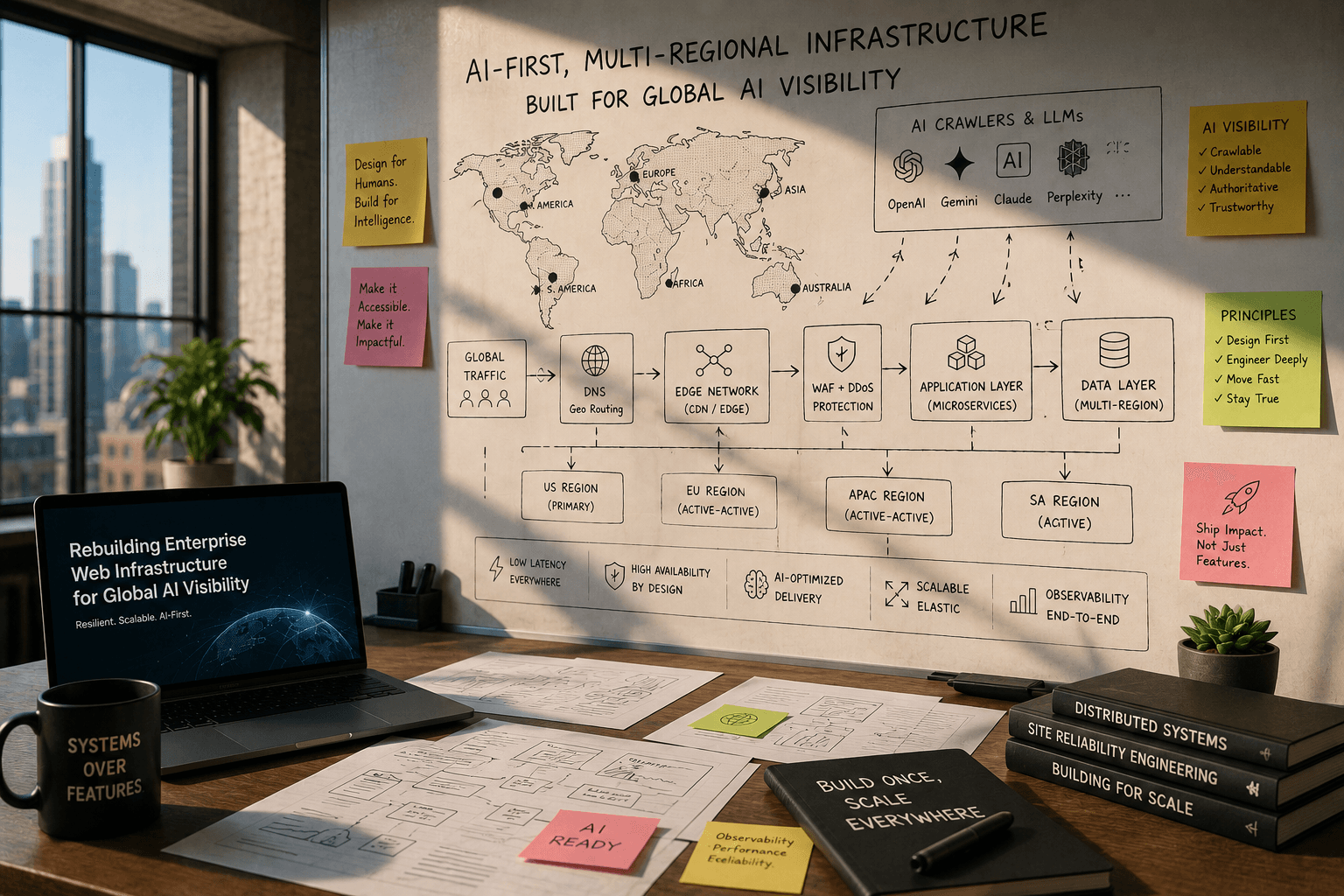
Why enterprise web architecture built for human browsers and traditional search engines breaks down for AI-first, multi-regional traffic, and how to rebuild it for global AI visibility across languages and markets.
Introduction
We recently reviewed the international setup for a client operating in six markets across four languages. Their hreflang implementation was clean by traditional SEO standards - Google Search Console showed no errors, regional rankings were solid across every market. When we ran the same locales through AI platforms, three of the four language versions barely surfaced at all, even for queries where the English version was consistently cited. Same content, same underlying facts, translated by a professional agency. The architecture around it simply wasn't built with AI retrieval in mind, because at the time it was built, nothing needed to be.
This is a genuinely different engineering problem than either enterprise web architecture or basic GEO taken separately, which is why treating them as two disconnected checklists tends to miss the actual failure points. Multi-regional AI visibility inherits every architectural challenge that comes with AI-first traffic generally, and then compounds it with the added complexity of language, locale-specific crawling behavior, and regional platform differences that most technical SEO guidance simply doesn't address.
Why AI-First Traffic Breaks Architecture Built for Human Browsers
Most enterprise web architecture was designed around two audiences: human visitors navigating through clicks and scroll, and search engine crawlers that, for over a decade, behaved in fairly predictable and well-documented ways. AI retrieval systems introduce a third audience with different constraints, and a lot of standard enterprise architecture patterns quietly assume that third audience doesn't exist.
Heavy client-side rendering is the clearest example. It's a reasonable choice for a complex, interactive enterprise application, and modern search engines have gotten reasonably good at rendering JavaScript before indexing. Several AI-specific crawlers have not caught up to the same degree, which means an architecture decision that costs nothing in traditional search performance can cost a great deal in AI visibility, invisibly, with no error message anywhere to flag it.
Personalization and geo-based content variation compound this. Enterprise platforms frequently serve different content to different visitors based on detected location, session history, or account status, entirely reasonable from a UX standpoint, and genuinely difficult for a crawler to reconcile, since a crawler typically sees one version of a page and has no way to know it's one variant among several, or whether the version it saw represents the canonical content at all.
Crawler access itself is a quieter version of the same problem. Enterprise sites often run regional WAF rules, bot-management configurations, or robots.txt directives that were written years before AI crawlers existed, and it's common to find AI user-agents blocked on one regional CDN configuration while allowed on another, with nobody having made that decision deliberately. A site can be fully open to Several bots on its primary domain and silently blocking the on a regional subdomain, and nothing in standard analytics will flag the gap - it just shows up later as an unexplained absence from AI-generated answers in that market.
The Multi-Regional Layer: Where This Gets Genuinely Harder
Add multiple languages and regions to this picture and the problems don't just multiply, they change in kind. A single-market architecture problem becomes a consistency problem across markets, and consistency is exactly what AI entity resolution depends on.
Hreflang tags tell search engines which language and regional variant of a page to serve to which audience - a mature, well-understood standard for traditional search. What hreflang does not do is guarantee that an AI retrieval system treats all those variants as expressions of the same underlying entity with the same facts. If your German pricing page and your Spanish pricing page were translated independently, by different agencies, at different times, and one is six months out of date, you now have two versions of the same claim disagreeing with each other in the retrievable corpus and no hreflang tag resolves that disagreement, because hreflang is a routing signal, not a consistency guarantee.
Translation quality itself becomes a technical SEO variable, not just a brand and localization concern. A literal, mechanically accurate translation that loses the specific terminology used elsewhere in that language's technical or industry discourse creates the same semantic mismatch problem within a single language that inconsistent terminology creates within a single market - the content technically says the right thing, but it doesn't match the vocabulary a retrieval system associates with the topic in that locale.
Regional AI platform differences add a layer most Western-market-focused GEO advice skips entirely. AI Overviews dominate discussion of AI search, but they aren't the dominant retrieval systems everywhere. Baidu operates its own search and AI ecosystem in China, largely disconnected from the platforms most GEO strategies are built around. Yandex holds meaningful share in Russia and parts of Central Asia. A multi-regional AI visibility strategy that only accounts for the English-language AI ecosystem is, by construction, only solving part of the problem for a genuinely global enterprise.
| Layer | Single-Market Problemd | Multi-Regional Compounding Factor |
|---|---|---|
| Rendering | JS-heavy content may be missed by AI crawlers | Same issue repeats across every locale's CDN/edge configuration |
| Crawler access | robots.txt or WAF rules may unintentionally block AI crawlers | Regional CDN/WAF configs can block AI crawlers inconsistently across markets |
| Content consistency | One version of a claim to keep accurate | Multiple language versions that can drift independently |
| Terminology | Consistent vocabulary within one language | Consistent vocabulary within each language separately |
| Crawler ecosystem | A handful of major AI crawlers to account for | Region-specific platforms (Baidu, Yandex) with different behavior |
| Entity resolution | One entity profile to maintain | Same entity resolved consistently across every language/region pairing |
Rebuilding the Architecture: What Actually Needs to Change
Server-side rendering or static generation for content that carries factual claims - pricing, specifications, comparisons, core positioning - needs to apply uniformly across every regional and language variant, not just the primary market. It's common for enterprise teams to prioritize rendering fixes for their highest-traffic market and treat secondary markets as lower priority, which is precisely how the gap we described in the introduction happens: not through neglect, exactly, but through a reasonable-sounding prioritization decision made without AI retrieval in mind.
Structured data needs to be implemented per locale, not just once and machine-translated. Organization, Product, and FAQ schema should reflect the actual translated content of each language version, including locale-appropriate formatting for things like currency, units, and regulatory disclosures that differ by market - schema that says one thing while the visible translated content says something subtly different creates exactly the kind of inconsistency that damages retrieval confidence.
A single source of truth for core factual claims, translated and synchronized deliberately rather than independently, prevents the drift we saw in that six-market client's pricing pages. This often means restructuring how translation workflows operate, treating a change to a core claim as an event that triggers review across every language variant, rather than something that updates the primary market and waits for translators to eventually catch other markets up.
Terminology consistency within each language needs its own deliberate research, not a direct translation of the primary market's keyword strategy. What a German-speaking technical buyer expects to see as standard vocabulary for a concept may differ meaningfully from a literal translation of the English term, and getting this right typically requires native-language technical review, not just translation review.
For markets where Baidu, Yandex, or other regional platforms matter, this requires treating those ecosystems as genuinely separate technical requirements rather than an afterthought bolted onto a Western-platform-first strategy - different crawler behavior, different indexing infrastructure, and in some cases entirely different structured data conventions.
Common Mistakes in Multi-Regional AI Visibility
The most frequent mistake is treating translation as a content problem solved once the words are converted, without revisiting the technical architecture - rendering, structured data, crawlability - for each language variant independently. A perfectly translated page sitting behind the same JavaScript rendering issue that affects the English version has simply moved the problem into a new language.
A second common mistake is assuming hreflang implementation, done correctly, solves the consistency problem. Hreflang is necessary and it does its job well, but its job is routing the right variant to the right audience. It says nothing about whether the variants agree with each other factually, and for AI systems that may retrieve and compare information across a multilingual corpus, that disagreement is a real and measurable liability.
A third mistake, and possibly the most common one among enterprises expanding into new regions, is building the entire AI visibility strategy around the same handful of Western AI platforms regardless of where the actual regional traffic is coming from, leaving genuinely significant markets under-addressed simply because they weren't part of the original strategy conversation.
The Bigger Pattern
None of this is really a story about translation or about AI crawlers specifically. It's the same underlying pattern that shows up whenever an organization scales: architecture decisions that were reasonable at a smaller scope stop being reasonable once complexity compounds, and nobody revisits them until the gap becomes visible in results. Multi-regional AI visibility just happens to be one of the places where that compounding effect shows up fastest and most visibly, because language and region multiply every consistency requirement that AI retrieval already cares about within a single market.
Any questions about this blog?
Frequently Asked Questions
Does hreflang implementation guarantee AI visibility across languages?
No. Hreflang correctly routes search engines to the right language or regional variant of a page, but it does not verify that those variants are factually consistent with each other. AI retrieval systems can surface disagreements between language versions that hreflang has no mechanism to catch or resolve.
Why would a translated page perform worse in AI search than the original?
Common causes include client-side rendering issues that affect every locale equally, structured data that wasn't localized alongside the visible content, and translations that are technically accurate but don't match the specific terminology a retrieval system associates with the topic in that language.
How often should multilingual content be checked for consistency across languages?
Any change to a core factual claim, such as pricing or product specifications, should trigger a review across every language variant, rather than updating the primary market and allowing other markets to be updated on a separate, slower schedule.
Is machine translation sufficient for AI-facing content, or does it need human review?
Machine translation can be a reasonable starting point, but native-language technical review matters specifically for terminology consistency, since a literally accurate translation can still use different vocabulary than what a retrieval system associates with the topic in that language's technical discourse.
Should structured data be translated automatically along with page content?
Structured data should be implemented per locale and checked against the actual translated visible content, including locale-appropriate formatting for currency, units, and regulatory disclosures, rather than assuming a direct machine translation of schema fields will remain accurate.
What's the most common architectural mistake enterprises make when expanding into new language markets?
Treating translation purely as a content and localization task without revisiting the underlying technical architecture - rendering method, structured data, crawlability - for each new language and region independently.
Where should a multi-regional AI visibility audit start?
Start by checking whether core factual claims (pricing, specifications, positioning) are consistent across every language variant, then verify that each locale's rendering and structured data implementation matches the standard applied to the primary market, rather than assuming what works for one market has been replicated everywhere else.
Can robots.txt or WAF settings accidentally block AI crawlers in some regions but not others?
Yes, and it happens more often than most enterprise teams expect. Regional CDN configurations, bot-management rules, and robots.txt directives are frequently set up independently per market, sometimes years apart, which means an AI crawler like GPTBot or PerplexityBot can be fully allowed on a primary domain while unintentionally blocked on a regional subdomain. This shows up as an unexplained absence from AI-generated answers in that market rather than as an obvious error.